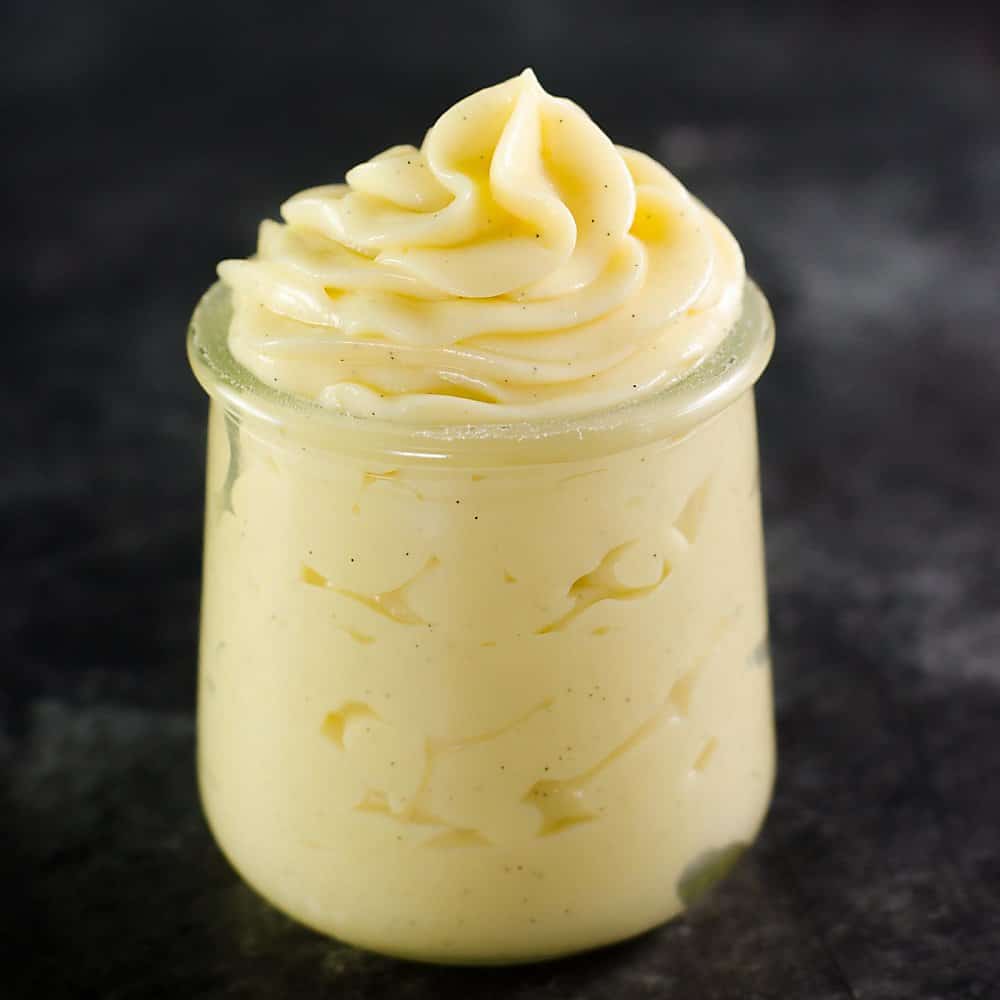
Creme Patissiere (Vanilla Pastry Cream)
Servings: 14 servings , 50g each
Calories: 59kcal
Creamy vanilla pastry cream used in many types of dessert. Perfect for profiteroles, cream puffs, eclairs etc. This recipe is gluten free and also dairy free friendly.Easy - This is an easy recipe, but requires constant supervision. Please read the recipe fully before proceeding. Please use weight measurements for accurate, consistent results.
Print Recipe
Ingredients
- 480 mL milk 2 cups (Preferably whole milk, see recipe notes)
- 75 g sugar 6 tbsp (Use more if you want a sweeter pastry cream. This recipe isn't too sweet)
- Pinch sea salt kosher salt is fine too
- 30 g cornstarch (cornflour) 3 tbsp. packed tablespoons (4 tbsp / 40 g for a stiffer pastry cream OR you can also add up to 50 g / 5 tbsp if you want an even thicker, more stable pastry cream)
- 15 mL vanilla bean paste or extract 1 tbsp. 1 vanilla bean pod
- 4 large egg yolks about 17 - 20 g each (please see recipe notes)
- 43 g unsalted butter 3 tbsp, softened
Adding gelatin (optional)
- 45 mL water 3 tbsp
- 5 g powdered gelatin 1½ tsp. 225 bloom strength
Instructions
- If using vanilla bean pods, split the bean and scrape the vanilla seeds / caviar out of the beans.15 mL vanilla bean paste or extract
- Add the bean and caviar with the milk into a saucepan. Heat the milk over medium high heat and bring it to a simmer, almost to a boil (see recipe notes below).480 mL milk
- While heating the milk, place the sugar, egg yolks, cornstarch, and salt in a bowl. Whisk until you have a thick, smooth mix. (If you're using vanilla bean paste or extract, add it to the egg mix too). Place the bowl with the egg mix on a towel or napkin (to prevent the bowl from slipping while whisking in the next step), and set aside until the milk comes to a boil (almost to a boil).75 g sugar, Pinch sea salt, 30 g cornstarch (cornflour) , 4 large egg yolks, 15 mL vanilla bean paste or extract
- As soon as the milk starts to steam or simmer, remove it from the heat. Slowly pour about a half of the hot milk in a thin stream into the egg mix, WHILE WHISKING CONSTANTLY to temper the egg mix. When the eggs have been tempered, add the egg mix back into the hot milk in the saucepan.
- Heat the custard base over medium heat, while whisking vigorously until it starts to thicken. This should take about 1 - 2 minutes depending on the heat of your stove and size of your saucepan. Make sure to reach the corners of the saucepan so that the custard does not catch at the bottom of the pan.
- While whisking, let the custard come to a boil (the custard will release bubbles). You may need to stop whisking from time to time for a few seconds to see if the custard is "bubbling". Look for big "bloops" breaking the surface of the custard (see pictures in the post for reference).
- Lower the heat and cook for a further 1 - 2 minutes after you see the first bubbles break the surface, and make sure to whisk constantly.
- Remove from the heat and add the butter. Whisk in the butter until it’s completely mixed in.43 g unsalted butter
- Pour the custard into a bowl and immediately cover the surface with plastic wrap, making sure the plastic wrap is touching the whole surface. This is to prevent a custard skin from forming on top. You can also choose to pass the custard through a sieve to remove any lumps.
- Let the custard cool down to room temperature and then let it chill in the fridge for a few hours, until completely chilled.
- The custard will "set" after chilling. So it's important to whisk the pastry cream to make it smooth again before using.
- Use as needed after the pastry cream has been chilled.
Adding gelatin
- Gelatin should be added to the pastry cream WHILE IT'S STILL HOT. Please read recipe notes below on whether adding gelatin to your pastry cream is the right option for you.
- While the milk is heating (for the pastry cream), place the water in a small bowl.45 mL water
- Sprinkle the gelatin over the water and use a toothpick or skewer (something slim) to mix the gelatin into the water so that there is no dry gelatin. Let this sit for at least 10 minutes to bloom (or until the pastry cream has cooked and thickened).5 g powdered gelatin
- While the pastry cream is hot, add the bloomed gelatin along with the butter, and thoroughly whisk to make sure all the gelatin has dissolved in the hot pastry cream.
- Cover the pastry cream with plastic wrap (same as above), and keep an eye on the pastry cream. Let it come to room temperature and then use the pastry cream as needed. If you chill the pastry cream it will harden as the gelatin sets.
Notes
This recipe initially called for 1 whole egg, but I have updated the recipe to include ONLY egg yolks. I have also included more information on how to make it thicker for other applications.
- For a thicker and richer vanilla creme patissiere, you can add up to 5 egg yolks.
- For a richer taste, you can also substitute half of the milk with heavy cream or 18% fat cream (half and half).
- Increase the amount of cornstarch to 50 g for a thicker pastry cream.
- For a dairy-free version, substitute the milk and butter with a plant-based milk such as almond milk, coconut milk, cashew milk, or even soy milk, and use a plant-based butter.
- You can choose to bring the milk to a boil, or just let it come to a simmer. It was important to boil the milk back in the days when milk wasn't pasteurized. However, I have not noticed any difference in the pastry cream consistency when using boiling milk vs steaming hot milk.
- Here's the recipe for classic vanilla diplomat cream (crème diplomat).
- Here's the recipe for classic chocolate pastry cream.
Adding gelatin to your pastry cream
You can absolutely add gelatin to your pastry cream for any reason. If you allow your pastry cream to cool in the fridge, the gelatin will set. You can still re-whisk and use this pastry cream as normal, but it won't "set" the same way as before, but will be thicker and more stable than if you hadn't used gelatin at all. For proper setting properties, allow the pastry cream to cool to slightly warmer than room temperature. Then you may use it for any application you please. But this means you cannot make it ahead of time. You can add whipped cream to it to make diplomat cream (and you do not have to add extra gelatin to the whipped cream). You may also add Italian meringue to make chiboust cream as well.Nutrition
Serving: 50g | Calories: 59kcal | Carbohydrates: 5g | Protein: 1g | Fat: 3g | Saturated Fat: 1g | Cholesterol: 44mg | Sodium: 15mg | Potassium: 38mg | Sugar: 4g | Vitamin A: 145IU | Calcium: 33mg | Iron: 0.1mg