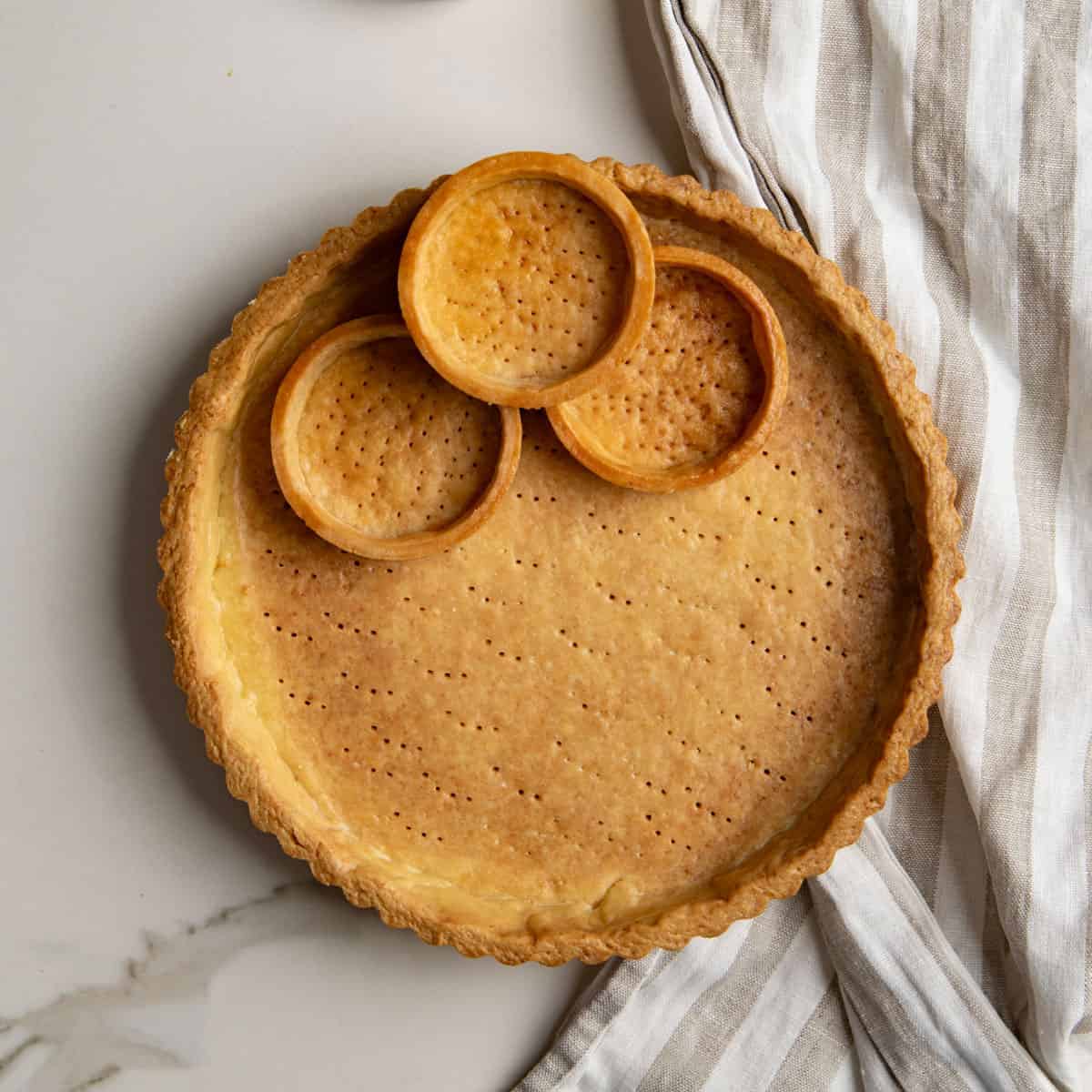
Shortcrust Pastry (Pâte Brisée)
Servings: 2 9 inch pans
Calories: 1107kcal
A buttery, crisp, crumbly, neutral-flavored pastry dough that's perfect as a tart crust or pie crust, and for both sweet and savory applications! INTERMEDIATE - While this recipe is very straightforward, some authentic French techniques may seem a little complicated for beginner bakers. But I provide detailed, step by step instructions to break down the whole process! Makes about 780 g of dough. Enough to make 2 9 inch shallow tart shells OR about 12 4 inch mini tarts.
Print Recipe
Ingredients
- 455 g all purpose flour approximately 3 ¾ cups (spooned and leveled)
- 226 g unsalted butter softened, 1 cup / 2 sticks
- 1 tsp salt
- 100 mL water OR 2 whole large eggs (100 g)
- 1 tbsp sugar optional
- Extra egg for the egg wash (optional)
Instructions
Shortcrust pastry dough
- If the butter is hard and cold, then cut it into small pieces so that it softens faster. The butter should be malleable, but still cold. See recipe notes below for more details.226 g unsalted butter
- If you'd like to use eggs instead of water, whisk the eggs well in a bowl. Then pass the mixture through a sieve to remove any lumps. This will make the egg mixture smooth, and will mix in with the dough much better.100 mL water
- Place the flour, salt, and sugar (if using) in a large bowl.455 g all purpose flour, 1 tsp salt, 1 tbsp sugar
- Add the butter and start rubbing the butter pieces into the flour using your fingers or a fork or a pastry cutter.226 g unsalted butter
- It's important that the butter doesn’t melt as you do this, but it doesn’t need to be chilled either. If the butter starts to melt, then place the mixture in the fridge to chill it for a little bit.
- I like to quickly rub the butter and flour mixture between my palms to get the butter really mixed in with the flour. There shouldn’t be any large lumps of butter in the flour. The mixture should resemble wet, coarse sand. This is the sablage stage. (You can read the post for more information about this technique, and others.)
- To mix in the wet ingredients, keep the dough in the large shallow bowl, OR place the mixture on a clean work surface. Make a well in the middle.
- Pour half of the egg or water mixture. Use a fork or your fingers to stir the liquid into the flour. Add the remaining amount and keep stirring to incorporate the liquid into the flour. The resulting mixture will have lumps.100 mL water
- Using your palm, quickly push one part of the dough to spread it on your work surface, then bring it back together with well floured hands or a bench scraper. Repeat this process just a few times to evenly mix in the ingredients, and to have a homogenous mixture. (Take care not to overwork the dough, as this can form gluten.)
- Bring the dough together and divide it into two portions.
- Dust the portions with flour and shape each one into a disc, and cover with plastic wrap.
- Let the dough rest for at least 1 hour in the fridge, although I prefer to let it rest for at least 4 hours.
Baking the shortcrust pastry
For larger tarts (about 9 inch)
- You can roll out the dough on your work surface using extra flour to make sure it doesn’t stick to any surface. Or you can roll the dough between two parchment papers as well.
- Remove the rested pate brisee dough from the fridge. Knock the dough a few times on your work surface to soften the butter if needed. You can also roll out the dough while it has softened quite a bit, as long as you use parchment paper to roll it out.
- Roll out the dough to a thickness of about 3 mm.
- Carefully transfer the dough onto a 9 inch tart pan. Gently fit the dough in the pan, making sure not to stretch the dough to fit. Stretching will lead to the dough shrinking as it bakes.
- When the tart pan is lined with the pastry dough, trim off the excess using a sharp paring knife. If you'd like a thicker crust, you can fold over some of the crust at the top to create a thicker border (see pictures in the post for reference). Then trim off the excess dough.
- Place the tart pan in the fridge for about 30 minutes to chill, while your oven preheats.
- Preheat the oven to 350°F / 180°C.
- When your oven is preheated, remove the chilled tart pan from the fridge and dock the base of the tart dough with a fork.
- Line the tart shell with parchment paper or foil and fill it with rice, beans, or sugar (as pie weights).
- Place the tart pan on a baking sheet pan, and transfer it into the oven to bake for about 20 minutes.
- When edges of the dough start to turn a light blonde in color, remove the pan from the oven and carefully lift out the pie weights.
- Return the tart shell to the oven and bake for a further 3 minutes until the bottom looks dry. Now your tart shell is par-baked.
- Bake the tart shell for a further 10 - 15 minutes or so, or until the shell is a golden color for a fully blind baked tart shell.
- OPTIONAL - Brush the inside of the shell with an egg wash to seal the crust and to get a shiny golden sheen - about 5 minutes before the bake time ends, and then continue baking it for that final 5 minutes.Extra egg
- Let it cool, and then use as needed.
For mini tart shells
- Roll out the dough as per the same instructions above for regular 9 inch tarts.
- For fluted mini tart pans, cut out circles of dough that will fit the bottom and sides of the mini tart pans. Then line each pan with the circles.
- For perforated tart rings (or any tart ring), cut circles of dough using the tart ring. Then also measure the circumference of the tart rings and cut out strips that are long enough to fit inside the sides of the tart rings.
- Carefully cut the dough with a sharp cutter to get clean lines for the dough circles AND the dough strips.
- Place the rings on a silpat-lined baking tray. Place the dough circles inside each ring.
- Brush the sides of the tart rings with some water and place the dough strips along the inside edge of the ring. Gently push the strips into the base, so that the dough strips and the dough circle at the base seal together.
- Trim the excess, and make sure the dough is sticking together well.
- Refrigerate the tart shells for about 30 - 60 minutes before baking.
- Before baking, dock the base of the tarts with a fork.
- You can choose to blind bake with pie weights if you like. But with tart rings, if the shell is chilled well, you can blind bake without using any pie weights as well.
- Bake in a preheated oven for about 15 minutes for par baking, and about 20 - 25 minutes for fully blind baked shells.
- Brush the tart shells with egg wash during the last 5 minutes of baking for a shiny, golden sheen, and to seal the shell as well.Extra egg
Notes
For making the dough in hot environments
Nutrition
Serving: 1large tart | Calories: 1107kcal | Carbohydrates: 120g | Protein: 16g | Fat: 62g | Saturated Fat: 39g | Polyunsaturated Fat: 3g | Monounsaturated Fat: 16g | Trans Fat: 2g | Cholesterol: 161mg | Sodium: 1176mg | Potassium: 179mg | Fiber: 4g | Sugar: 6g | Vitamin A: 1874IU | Calcium: 42mg | Iron: 7mg