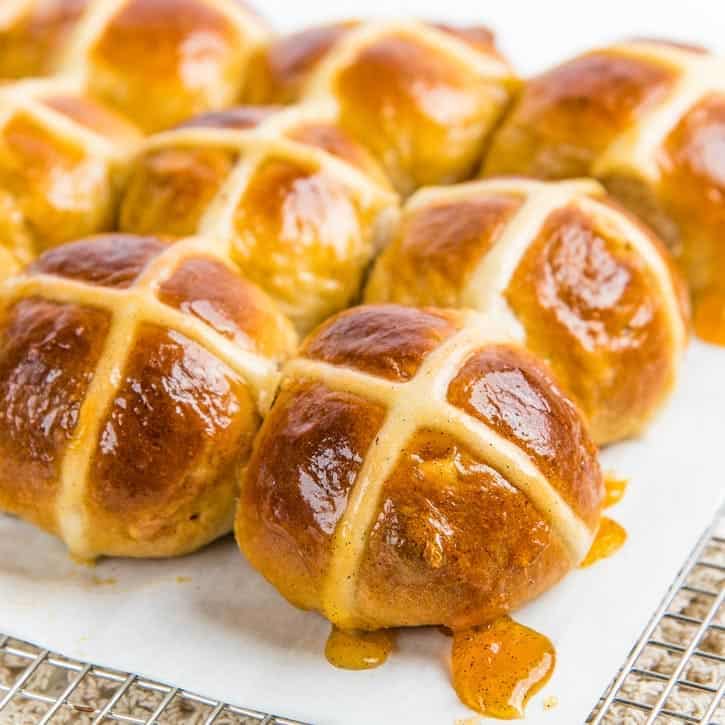
Soft, Fluffy Hot Cross Buns
Servings: 20 servings
Calories: 167kcal
These are the softest, fluffiest, spiced hot cross buns made with the tangzhong technique! Topped with a sweet, fruity apricot honey glaze (or a simple egg wash for convenience). Intermediate - This recipe involves a few cooking / baking techniques (tanzhong, bread shaping, flour paste etc). These techniques are simple, but they do add extra prep time. Don't be intimidated by the length of the recipe below. Detailed step by step instructions provided to guarantee the best results!Please use weight measurements for accurate, consistent results. US based cup, teaspoon, tablespoon measurements. Common Measurement Conversions.
Print Recipe
Equipment
- Stand mixer
- Silicone spatulas
- Measuring spoons and cups
- Weighing scale
- Piping bag or ziploc bag (to pipe flour crosses)
- Pastry brush
Ingredients
For the bread and tangzhong
- 240 mL warm milk divided in half - 120 mL each (1 cup, divided into ½ cup portions)
- 450 g AP flour 4 cups, measured by spoon and level method (set aside 2 ½ tbsp / 25 g of the flour)
- 7 g active dry yeast 2 ¼ tsp. (you can also use instant yeast)
- 100 g granulated white sugar ½ cup
- 56 g unsalted butter ¼ cup (melted)
- 2 large eggs
- 1 ½ tsp ground cinnamon
- ½ tsp allspice
- ½ tsp ground cloves
- ¼ tsp grated nutmeg
- 1 tsp salt
- 2 tsp grated orange rind from 1 large orange
- 1 tbsp vanilla extract
Additions for the bread (see recipe notes below)
- 100 g raisins / currants
- 60 g mixed peel
- ¼ cup warm orange juice
Flour paste for the cross
- 20 g confectioner's sugar 2 tbsp
- 62 g AP flour ½ cup, measured by spoon and level method
- 4 - 5 tbsp water 60 - 75 mL
For the glaze
- ¼ cup apricot jam
- 1 tbsp honey
- 2 tsp vanilla extract optional
Frosting for the cross (optional - instead of flour paste)
- 226 g confectioner's sugar 2 cups, measured spoon and level method
- 60 mL milk you may not need all of it
Instructions
- Measure out all the ingredients for the dough. Separate the milk into two portions. Place 120 mL / ½ cup of milk in a small saucepan.240 mL warm milk
- Warm up the other ½ cup until just lukewarm and place it in the mixer bowl.240 mL warm milk
Making tangzhong
- Take 2 ½ tbsp (about 25 g) of the measured AP flour and whisk it into the milk in the saucepan. Make sure the flour-milk mix is completely smooth, with no lumps.450 g AP flour
- Heat the flour-milk mix over medium heat, while constantly whisking. In a few minutes, the flour-milk mix will start to thicken. Keep heating while whisking, until you have a runny paste. Remove from the heat. The tangzhong paste is now ready. (It should weigh about 130 to 140 g - about ½ cup.)
- Cover the tangzhong with plastic wrap, making sure the plastic wrap is touching the surface of the paste. Let it cool down to room temperature before using.
Add-ins and mix-ins (prepare these while the dough is proofing for the first time)
- Warm up the orange juice slightly in a pan or in the microwave. Add the dried fruits to the warm orange juice and let it sit for at least 30 minutes (this is to soften the raisins and for them to absorb orange flavor).100 g raisins / currants, ¼ cup warm orange juice
- Strain the mixture through a strainer to remove the excess orange juice. Let them sit there to let the excess orange juice drain out. The raisins should be plump and soft, but not soggy.
- OPTIONAL - If you'd like to, you can add some liquor to the orange juice to add more flavor. Such as whiskey, brandy, or rum.
- Mix the softened dried fruits with the mixed peels and set aside.60 g mixed peel
Flour paste for the crosses (prepare this while hot cross buns are proofing for the final time)
- Place the flour and confectioner's sugar in a bowl and whisk together.62 g AP flour, 20 g confectioner's sugar
- Add water, 1 tbsp at a time, until you have a smooth paste that is loose enough to pipe easily, but thick enough that it will not run off the sides of the buns either. (For me, this is about 4 tbsp and a bit of water).4 - 5 tbsp water
- Place the flour paste in a small piping bag or a ziploc bag, and set aside.
For the sweet glaze (make this when the hot cross buns are almost done baking)
- Place the jam, honey, and vanilla in a saucepan. Heat over low heat until the mixture is runny and liquid. To make the glaze even smoother, pass the jam mix through a fine sieve to remove any bigger chunks.¼ cup apricot jam, 1 tbsp honey, 2 tsp vanilla extract
- Return the glaze to the saucepan and keep it warm until the hot cross buns are ready.
- See recipe notes for egg wash instructions.
Making the frosting for the crosses (optional - instead of flour paste or in addition to it)
- Make this after the hot cross buns have been baked and have cooled down. It will be easier to make this with a hand mixer, or a sturdy metal whisk, as the frosting needs to be thick.
- Place the confectioner's sugar in a large bowl. Make sure there are no lumps. Add milk, just a little bit at a time (1 tbsp at a time, and then 1 tsp at a time when the the consistency is almost right), and whisk it really well to form a thick paste. The frosting only needs just a little bit of liquid to form a smooth, thick paste.226 g confectioner's sugar, 60 mL milk
- If you accidentally add too much liquid, you can add more confectioner's sugar to thicken it to the right consistency. The frosting will need to be whisked well to be smooth, while maintaining the thick consistency. Place the frosting in a piping bag. Snip the end of the bag to pipe the frosting when needed.
Making the dough
Activating yeast
- Dissolve about ½ tbsp of the sugar in the warm milk in your mixer bowl. Sprinkle the yeast over the milk and gently stir. Let the yeast activate for about 10 - 15 minutes until it looks frothy and foamy.240 mL warm milk, 7 g active dry yeast, 100 g granulated white sugar
Hot cross bun dough
- In to the mixing bowl with the activated yeast - add the rest of the sugar, eggs, melted butter, tangzhong, zest, and vanilla. Add the remaining flour, spices, and finally the salt.450 g AP flour, 100 g granulated white sugar, 56 g unsalted butter, 2 large eggs, 1 ½ tsp ground cinnamon, ½ tsp allspice, ½ tsp ground cloves, ¼ tsp grated nutmeg, 1 tsp salt, 2 tsp grated orange rind, 1 tbsp vanilla extract
- Mix all the ingredients together to form a scraggly dough.
- With the kneading hook attached to the stand mixer - knead the dough until you have a smooth dough (about 2 - 3 minutes). Check the consistency of the dough. It should be soft and sticky. When kneading the dough at mid speed, the dough should still stick to the bottom, but not to the sides of the bowl. If needed, add more milk to the dough to get it to the right consistency as described.
- Knead the dough for a further 10 - 15 minutes, alternating between low speed (2 - 3) and medium speed (5 -6). The higher speed is needed to help form the gluten. Make sure to scrape the bottom of the bowl once or twice during this time to ensure the dough is kneading evenly.
- The dough is done kneading when the sides of the bowl are clean of the dough when kneading on medium speed, and the dough looks shiny and smooth. When you lift up the dough from the bowl using the kneading hook, it should cleanly come out in one piece, without leaving any dough behind. Alternatively, the dough should be close to passing the window pane test.
- Take out the kneaded dough and shape it into a ball. Place this ball of dough back in the bowl and cover with plastic wrap. Proof the dough in a warm place until it is about 1.5 - 2 times the size.
Laminating the dough with mix-ins
- Take the proofed dough out of the bowl and onto a lightly floured work surface. Use lightly floured hands to evenly stretch out the dough on the work surface. It's OK if there is some tearing, but the dough should stretch out really well if the dough was properly kneaded before.
- The dough should be stretched out to a rough shape of 2 x 1.5 ft, and fairly evenly thinly. It doesn't have to be exact and the edges will be thinner than the middle.
- Take the raisin and mixed peel mixture and sprinkle about ⅔ of the mixture over the surface evenly. Fold roughly ⅓ of the dough over the middle, and the remaining ⅓ of the dough over the center as well. See pictures in the post for reference.
- Sprinkle the remaining ⅓ of raisins and mixed peel mixture on top of the folded dough. Fold or roll up the dough to enclose the filling in the dough. Fold the dough to form a ball shape.
- Place the fruit filled dough ball in the mixer bowl. Cover and let the dough proof in the fridge overnight (see recipe notes below).
Portioning and shaping the buns
- Line a half sheet baking pan with parchment paper.
- When the dough has proofed overnight, remove the dough and place it on a work surface. Gently press on the dough to remove excess air.
- Weigh the dough and then divide it into equal portions to form hot cross buns. Portion 15 equal portions to make medium-sized hot cross buns similar to storebought ones. OR between 20 - 24 portions to make smaller buns.
- Take each dough portion and fold over the edges towards the middle to form a tighter dough. Then pinch these edges at the bottom to seal. Place the dough ball with the seam side down on your work surface. Gently roll the ball of dough with a cupped palm to shape the dough ball. Make sure the work surface doesn't have much flour to allow the dough to tighten into a smooth ball.
- Repeat this process with all the dough portions.
- Place each bun on the prepared baking pan, with about ½ inch of space between each. Arrange them in a 3 x 5 configuration for 15 buns. OR 4 x 5 configuration for 20 buns. OR 4 x 6 configuration for 24 buns.
- Cover the hot cross buns with plastic wrap and let them proof for the final time. On a cold day, this takes me about 90 minutes, and on a hot day, about 45 minutes. You can also let them proof in the oven, with the oven light on. But remember to take them out when you're preheating the oven!
- Finger indentation test - The way I test for proofing is by gently pressing my fingertip into a couple of the buns. If the indentation springs back up completely, then it’s not ready. If the indentation springs back half way, leaving a shallower indentation, then they are sufficiently proofed and are ready to be baked.
Baking the hot cross buns
- While the dough is proofing, prepare the flour paste for the crosses, and preheat the oven to 350°F / 180°C.
- If you're using the flour paste, this must be piped on before baking the buns. You can skip this if you want to pipe frosting instead for the crosses.
- Snip off the tip of the piping bag for the flour paste (make sure the opening is smaller than the desired thickness of the lines you want to pipe). Pipe the flour paste on the proofed buns as desired for the crosses.
- Place the buns in the preheated oven and bake for 25 - 30 minutes. Rotate the tray if needed, half way through baking.
- While baking, prepare the sticky glaze, and keep it warm.
- As soon as the buns are done baking (an instant read thermometer will register at 190 - 200°F when they are done baking), remove the baking tray from the oven.
- Brush the warm apricot glaze over the freshly baked buns, and then let them cool completely.
- When the hot cross buns have cooled down, or slightly warm, they can be served. But you can pipe the frosting on top before serving as well (after the buns have cooled down).
- These are best eaten warm or lightly toasted with a little butter. Enjoy!
Notes
Storage instructions
Keep the buns in an airtight container at room temperature for up to 2 - 3 days. If you want to keep it for longer, place them in the freezer for up to 1 month.Egg wash option
Before piping flour crosses on the buns, glaze the buns with an egg wash. Then pipe the crosses on the hot cross buns, and bake according to the recipe. You will NOT need the apricot glaze if you use egg wash (but note that the egg wash will not add a sweet, fruity flavor like the honey apricot glaze).Egg wash recipe
1 egg yolk + 2 tbsp cream, mixed together.Vegan options
- Use almond milk or soy milk instead of regular milk for the recipe.
- Instead of 2 eggs, use 100 g of plant-based milk. Or you can also use 50 g milk and 60 g apple sauce.
- Use vegan butter in place of regular butter.
Note about the add-ins
You can use a combination or just 1 of the options I've provided. You can also add other add-ins. To keep the recipe consistent, I recommend that you do not exceed a total 160 g of add-ins in this recipe.Note about the overnight cold proof
You can skip this step if you like. But the dough will be very soft and fairly sticky when forming into buns. Avoid using too much flour, as this will dry out the hot cross buns. The overnight proof will chill the dough, making it easier to manage. It will also help to develop the flavor of the dough further!Recipe update - March 2025
After making hot cross buns for years, I have now switched to adding the fruits to the dough after the first proof. I do this using a technique called "lamination". This means that the dough will have better gluten development without having to add the fruits to the mixer. This way, your stand mixer won't need to work too hard to knead the dough to the right consistency either. And it's much easier this way to ensure the fillings are evenly spread throughout the dough.Nutrition
Serving: 1small bun | Calories: 167kcal | Carbohydrates: 30g | Protein: 4g | Fat: 3g | Saturated Fat: 2g | Polyunsaturated Fat: 0.3g | Monounsaturated Fat: 1g | Trans Fat: 0.1g | Cholesterol: 24mg | Sodium: 132mg | Potassium: 61mg | Fiber: 1g | Sugar: 10g | Vitamin A: 115IU | Vitamin C: 0.03mg | Calcium: 25mg | Iron: 1mg