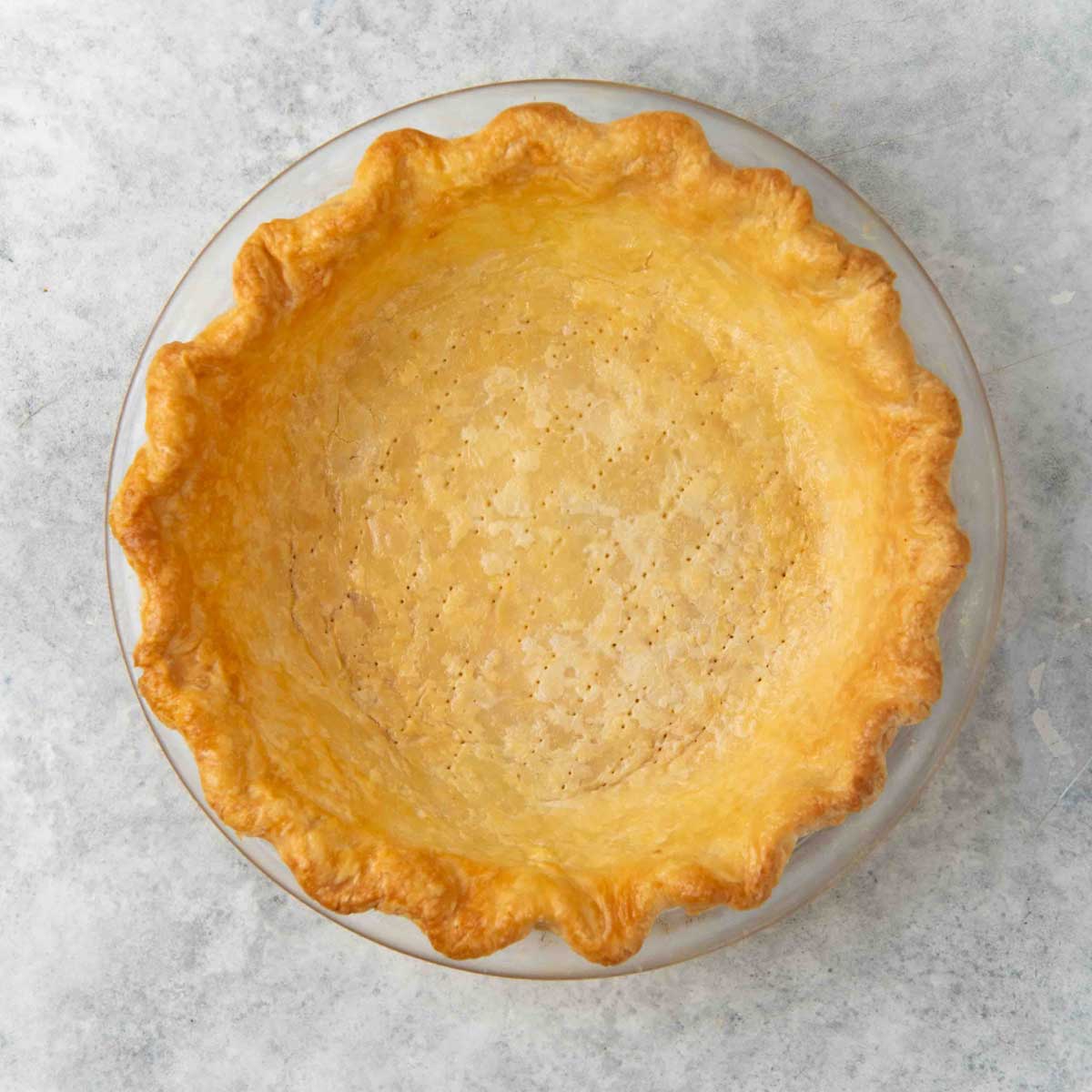
Blind Baking Pie Crust
Servings: 2 crusts to fit a standard 9 inch, deep pie dish
Calories: 1861kcal
A complete guide on how to blind bake pie crust perfectly with tips on how to avoid shrinking, burnt, collapsed, or soggy crusts. This guide guarantees the flakiest, perfectly baked, golden brown pie crust for all your sweet and savory pies!EASY - This is a very detailed, but easy guide to perfectly blind baking pie crust. Easy to follow instructions using homemade or store-bought pie crust.
Print Recipe
Equipment
- 9 or 9.5 inch pie plate (1 - 2 inches deep)
- Foil or parchment paper
- Sugar or rice to use as pie weights
- Rolling Pin
Ingredients
- 300 g unsalted butter preferably chilled
- 120 mL iced water
- 30 mL chilled vodka optional (substitute with the same amount of iced water, if you prefer)
- 400 g all purpose flour spooned and leveled when using cup measurements
- 30 g sugar
- ¾ tsp fine sea salt
Instructions
Making the dough
- Make the pie crust dough according to the instructions in my homemade pie crust recipe linked here. Make sure that the dough rests for a few hours before rolling out.300 g unsalted butter, 120 mL iced water, 30 mL chilled vodka, 400 g all purpose flour, 30 g sugar, ¾ tsp fine sea salt
Rolling out the dough
- Take one portion of the pie crust dough. Unwrap the plastic wrap and place it on a floured surface.
- Since the butter will be very firm, it'll be hard to roll out the dough right away at this point. Strike the dough disc a few times with a rolling pin, on both sides, to make it more pliable and easy to roll out.
- Roll out the dough while maintaining a round shape as best you can. Pinch or squeeze any cracked dough areas together to seal. Turn the dough a quarter turn after each roll, to ensure that the dough maintains a round shape and also doesn't stick to your work surface. Use a light dusting of flour as needed, and also remember to flip the dough over so that you roll it out on both sides.
- Roll the dough until it’s about 3 mm in thickness. The diameter could vary, but it should definitely fit a 9.5 inch diameter, deep pie dish.
- If the dough starts to shrink as you roll it, lightly flour the dough surface and either fold it into quarters OR roll it onto a rolling pin, and then cover it with plastic wrap. Let this dough rest in the fridge for at least 30 minutes, and then proceed with rolling it out again.
- After rolling out the dough to the correct thickness, transfer the dough onto the pie dish. You can do this by rolling up the dough on a rolling pin and then carefully unrolling it over a pie dish (see pictures in the post for guidance).
- Do NOT stretch the dough to fit it inside the pie dish. This is crucial and a common beginner mistake. Instead, carefully lift the pie crust and let it gently fall onto the pie dish. Use the back of your fingers to gently press the dough into the bottom of the pie dish, so that it fits neatly in the dish.
- There should be an overhang over the pie dish rim. Using scissors or a sharp knife, cut the excess pie crust, leaving at least a 1 inch (or up to 1.5 inches) overhang for single crust pies. The overhang should be measured from the inner rim of the pie dish and not from the pie pan ledge (if your pie dish has one).
- Roll the overhang dough under the pie crust edge to form a thick border. This should be flush against the inner rim of the pie dish.
- For a fluted or crimped edge - Hold your thumb and index finger on one hand parallel to each other, and rest the tips of those fingers against the outside edge of the pie border. Then using the index finger or thumb on the other hand, gently push the inside edge of the pie border between the two fingers on your other hand. Repeat this all along the pie border to form a fluted pie crust edge. (See pictures in the post or recipe video for reference.)
- Crimped edge - Alternatively, you can use a fork to flatten the pie crust edge to create a crimped edge.
- Loosely cover the pie crust with plastic wrap and let it rest in the fridge for at least 45 minutes. If the butter softens at any stage, refrigerate the crust.
Blind baking pie crust
- Preheat the oven to 350°F / 180°C (conventional oven). Let the oven preheat for at least 30 - 45 minutes.
- Take a large piece of foil or parchment paper. I like to use extra wide heavy duty foil. If you're using parchment paper, gently crumple it and then unravel and smooth it out (to make it easier to mold it into the shape of the pie plate). Foil can be crumpled too, but it can also tear easily, so take more care with foil.
- Place the parchment or foil inside the chilled pie crust. Carefully shape it to fit the pie crust. Press it against the crust to make the surface of the foil / parchment paper smooth and flush against the crust. Make sure the foil / parchment paper is touching the whole surface of the pie crust, and loosely covers the border of the pie crust as well.
- If needed, use 2 - 3 pieces of foil (overlapping) to make sure the bottom and sides of the pie crust are fully covered. If the foil / parchment paper doesn't cover the whole pie, I like to use 3 pieces. One in the middle and two on either side of it, broadly overlapping. This makes it easier to remove the pie weights with the lining later on.
- Fill the pie plate with sugar or rice (not both!), or ceramic pie weights. Make sure the weights are filled about ¾ of the way up the pie dish.
- Transfer the pie plate onto a half sheet pan. Then place both in the preheated oven. Rotate the plate once half way through baking IF needed. Bake the pie crust for about 45 - 50 minutes.
- After 50 minutes, the bottom of the crust should start to caramelize and turn light golden brown in color. The sides and top of the crust will still be very blonde in color (i.e. only have a little bit of color).
- Remove the pie plate from the oven and then VERY CAREFULLY remove the foil / paper from the pie plate along with the baking weights (making sure not to spill anything!). Immediately transfer the weights into an empty bowl or plate. Be careful with this step since the foil will be hot, and you need to hold it firmly to prevent any tearing and spilling of contents.
- Prick the whole bottom of the pie crust with a fork. This is to dock the crust to finish baking.
- For par baking pie crust - Return the blind baked pie crust into the oven and bake for a further 5 - 10 minutes until the bottom of the crust looks matte or dry. Remove from the oven. The crust is ready to be filled and baked with the filling now.
- For a fully blind baked pie crust - Return the blind baked pie crust to the oven and bake further for about 15 - 20 minutes, until the crust turns golden brown. For a shiny finish, brush an egg wash all over the pie crust before the last 5 minutes of baking. Then bake for the last 5 minutes, until the crust is golden in color and shiny.
- If the pie crust edge is browning too quickly, use a silicone pie crust shield or shape a piece of foil to cover the crust.
- OPTIONAL (to seal the crust) - If you prefer not to brush with an egg wash, you can also brush the pie crust with the following options to seal the crust AFTER baking and cooling the crust. Melted cocoa butter or melted chocolate (white, milk, or dark chocolate).
Video
Notes
All butter pie crust dough
Follow the step by step instructions in my all butter pie crust recipe for perfect, tender, flaky pie crust.How to bake a double pie crust
See my double pie crust recipe post for baking temperature and detailed step by step instructions on how to bake a filled double crusted pie (with a solid top crust).Nutrition
Serving: 1crust | Calories: 1861kcal | Carbohydrates: 168g | Protein: 22g | Fat: 124g | Saturated Fat: 77g | Polyunsaturated Fat: 5g | Monounsaturated Fat: 32g | Trans Fat: 5g | Cholesterol: 323mg | Sodium: 893mg | Potassium: 250mg | Fiber: 5g | Sugar: 16g | Vitamin A: 3749IU | Calcium: 67mg | Iron: 9mg