



About
My Cookbooks
Work With Me
Contact
  • Facebook
  • Instagram
  • Pinterest
  • X
  • YouTube
The Flavor Bender

Master the Science of Delicious

  • Recipe Index
    • All Recipes
    • Desserts
      • Cakes & Cupcakes
      • Candy & Bite Sizes
      • Chocolate
      • Cookies, Brownies & Bars
      • Frozen Desserts
      • Fruit Desserts
      • Puddings & Custards
      • Dessert drinks
      • No Bake
      • Pastries & Breads
      • Sweet Syrups & Spreads
      • Tarts & Pies
      • Cheesecakes
      • Healthy sweets
    • Breakfasts
      • Tarts, Quiches, & Pies
      • Waffles, Pancakes & Crepes
      • Quick Breads, Scones & Muffins
      • Breakfast Sandwiches
      • Breakfast Pastries
      • Eggs
      • Breakfast & Brunch Drinks
      • Make Ahead Breakfasts
      • Healthy Breakfasts
      • Coffee and Tea drinks
      • Breakfast Smoothies & Juices
      • Breakfast Sides
      • Casseroles
      • Jams & Spreads
    • Courses
      • Main Meals
        • Bread, Sandwiches & Burgers
        • Curries
        • Salads
        • Roasts & BBQ
        • Soups & Stews
        • Casseroles
      • Bread
      • Lunch
      • Beverages
      • Appetizers & Tapas
      • Sides
      • Dips & Condiments
      • Tea Time & Snacks
      • Desserts
      • Meal Prep
      • Cocktails
      • Pet Friendly Recipes
    • Cuisines
      • American
      • European
      • Australasian
      • Sri Lankan
      • East Asian
      • Mexican
      • Middle Eastern
      • South Asian
    • Sri Lankan
      • Main Meals
      • Drinks
      • Desserts
      • Breakfasts
      • Snacks
    • Skill Level
      • Easy
        • Easy Desserts
        • Easy Cooking
        • Easy Breads
        • Easy Breakfasts
        • Easy Dinners
      • Intermediate
        • Intermediate Desserts
        • Intermediate Cooking
        • Intermediate Breads
        • Intermediate Breakfasts
        • Intermediate Dinners
      • Advanced
        • Advanced Desserts
        • Advanced Cooking
    • Recipes by Season
      • Christmas
      • Fall & Winter
      • Halloween
      • Spring & Summer
      • Thanksgiving
      • Valentines Day
    • Recipes by Diet
      • Dairy Free
      • Eggless
      • Gluten Free
      • Paleo
      • Vegan & Vegetarian
    • Recipe Basics
      • Baking Basics
      • Cooking Basics
      • Baking & Cooking 101
  • New? Start Here
  • Measurement Conversions
  • How-To Posts
  • About
  • My Cookbooks
  • Work With Me
  • Contact
The Flavor Bender   ›   Recipes   ›   Delicious Desserts   ›   Pastry Recipes   ›   How To Make Doughnuts (Doughnut Troubleshooting)

How To Make Doughnuts (Doughnut Troubleshooting)

Author:

Dini Kodippili


Jump to Recipe


Updated: 7/17/2023
Total Time11 hours hrs 20 minutes mins
Quick and Easy Recipes
Pastry Recipes
Perfect Glazed Doughnuts - The guide to Perfect Doughnuts with a vanilla glaze with a complete troubleshooting guide. Now you can have perfect doughnuts every single time.

A detailed, step by step recipe and troubleshooting guide with a recipe video on how to make doughnuts with a vanilla glaze!

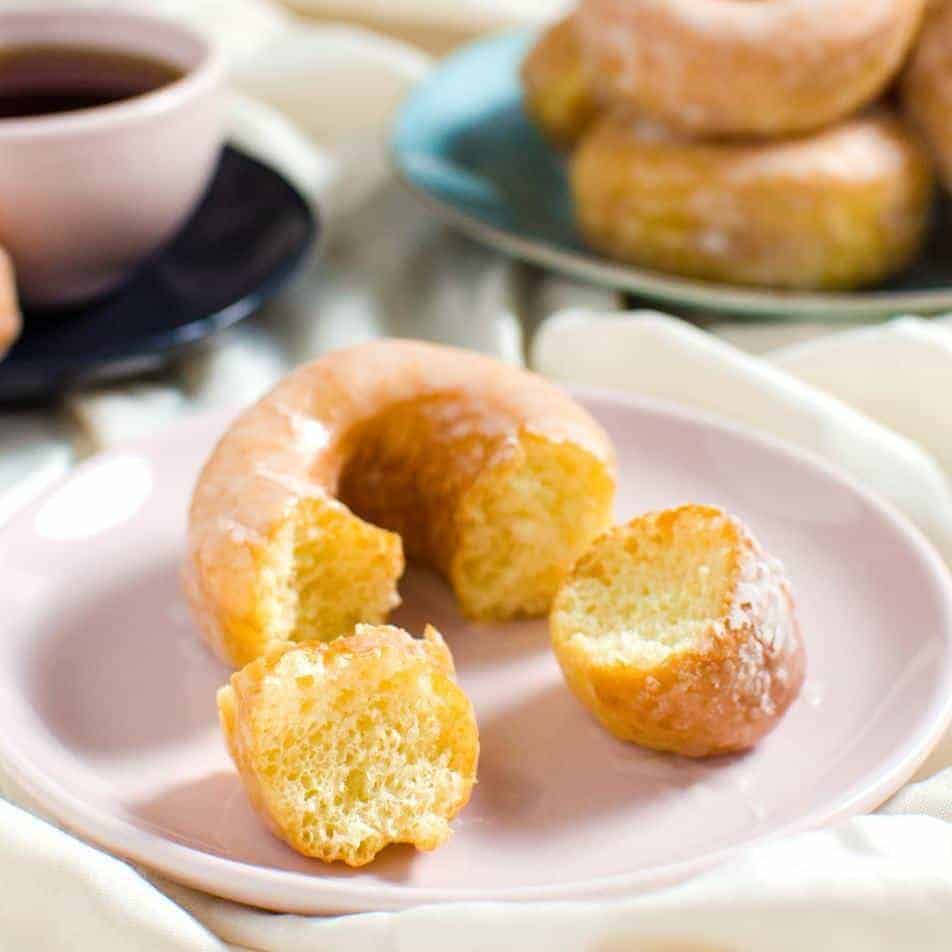
Donuts are one of our favorite pastry recipes. These are deliciously fluffy and airy on the inside and tender on the outside. These homemade doughnuts (homemade donuts) with a sweet glaze are an absolute treat!

Perfect Glazed Doughnuts - The guide to Perfect Doughnuts with a vanilla glaze with a complete troubleshooting guide. Now you can have perfect doughnuts every single time

Perfect homemade doughnuts

Deliciously fluffy and airy (on the inside), and tender (on the outside) fried pieces of dough coated with a sweet glaze? What’s not to love about that? Doughnuts (or donuts, I’ll be using both spellings interchangeably in this post) have been around for centuries.

Glazes, fillings, and other little twists aside – there’s a reason why these breakfast pastries are still so popular in essentially the same way they were first conceived. Yes, there are baked, raw “donuts” out there now, but a deep-fried donut is where it all started, and there’s nothing like it in terms of flavor and texture.

I made doughnuts for the blog for the first time when I made these Simpsons doughnuts, a while back. Since then, I’ve also shared these delicious blueberry glazed doughnuts, coffee doughnuts, and even these fun mini unicorn rainbow doughnuts!

But here’s the holy grail of doughnut recipes, the basics of how to make doughnuts with all of my troubleshooting tips and advice.

How to make doughnuts (troubleshooting tutorial)

Flavor

These doughnuts (donuts) are made with 1 tbsp of active dry yeast. This may seem like a lot, but it ensures that the dough rises well, especially when it’s resting in the refrigerator, and it gives the donuts that characteristic flavor that we all love.

The overnight rise is preferable for developing flavor. Much like my favorite pizza dough, the cold rise of any yeasted dough lends characteristic flavor and texture to the doughnut, which a “warm place rise” simply cannot replicate.

Why? A cold rise slows down the process of yeast growth, allowing the yeast to develop a deeper flavor as they grow and multiply. Plus, a chilled dough is easier to handle as well. I talk more about this in my hot dog buns recipe and brioche bread recipe as well.

Butter plays an important part in this recipe too. Butter or oil, softens the gluten structure that you develop during the kneading process. This makes the dough soft and shiny and adds flavor too.

It’s important to incorporate the butter properly. You could possibly melt the butter and add it in a stream while kneading, but the method I’ve described in this recipe is what works best for me to get perfect donuts. I add the butter at the end, so that the flour has had a chance to completely hydrate with the milk and water that were added before.

Kneading while adding butter one table spoon at a time helps distribute the butter evenly throughout the dough. If you need to, you could increase the speed of your mixer to help the butter incorporate into the dough better.

Preparing the dough

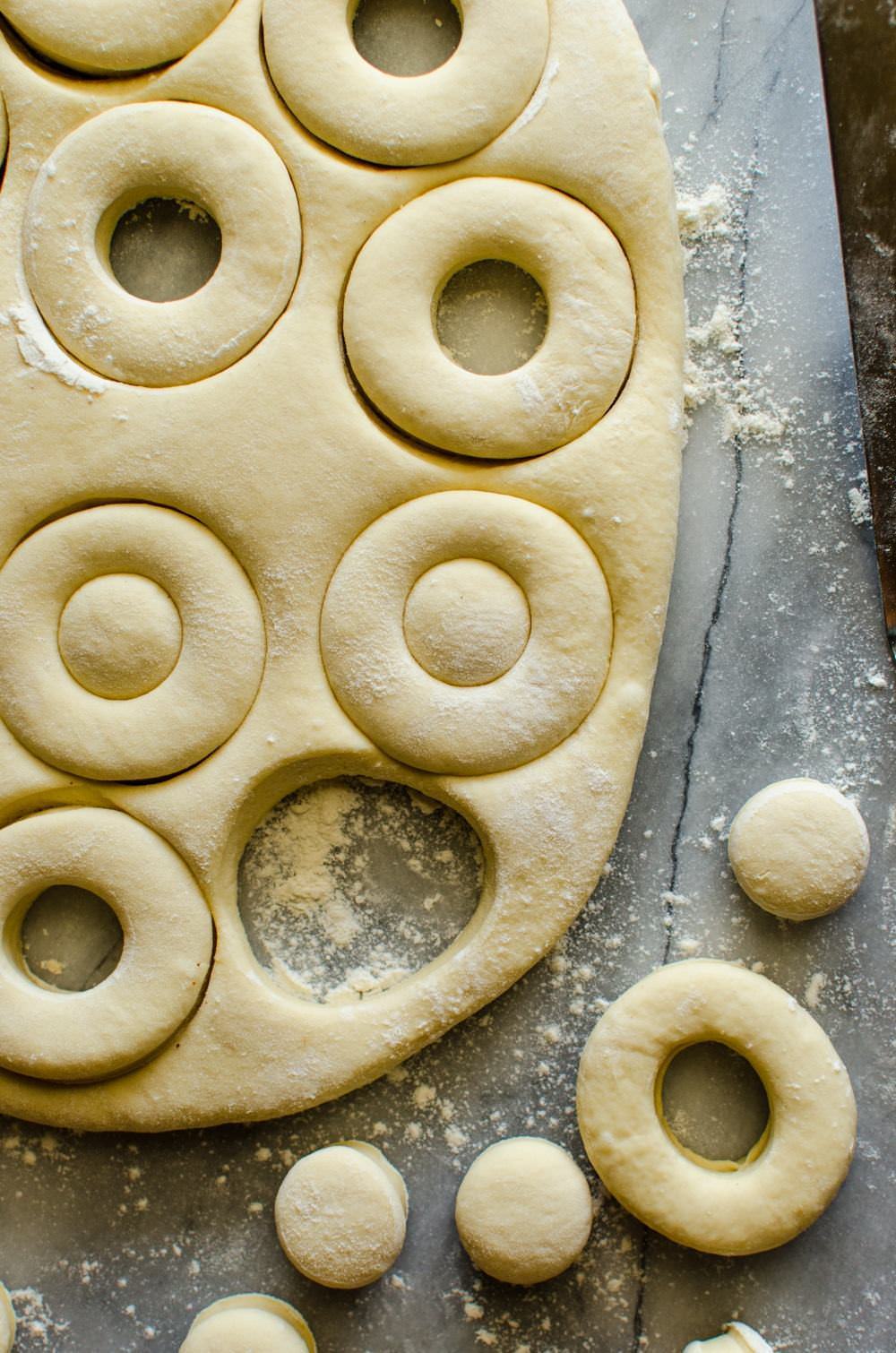
You can roll out the dough and cut out circles (or any donut shape you like). For regular doughnuts, I use round cutters (as you can see in the photos and video) to get the shapes and sizes I want.

You could use a custom doughnut cutter too, but I prefer using 2 cookie/biscuit cutters, since I find them sharper and they cut through the dough cleanly.
Perfect Glazed Doughnuts - The guide to Perfect Doughnuts with a vanilla glaze with a complete troubleshooting guide. Now you can have perfect doughnuts every single time

When you cut out circles, or regular doughnut shapes, you’re going to end up with scraps. These scraps can be re-rolled (after a one hour resting time in the fridge) and then cut again, once.

Remember, you want to cut out as many as you can from the first roll, because the 2nd re-rolled dough is harder to handle and can end up being thicker than your first batch (due to over handling of the dough and not enough resting).

So re-rolling the scraps a second time isn’t really ideal if you’re looking for PERFECT donuts. To avoid that, I try to use up as much of the dough scraps to make donut holes instead! 🙂

If you want filled donuts, then you can simply cut/divide the dough in to portions more or less equally, and roll them into smooth balls.
Perfect Glazed Doughnuts - The guide to Perfect Doughnuts with a vanilla glaze with a complete troubleshooting guide. Now you can have perfect doughnuts every single time

How to know when the doughnuts are ready to be fried

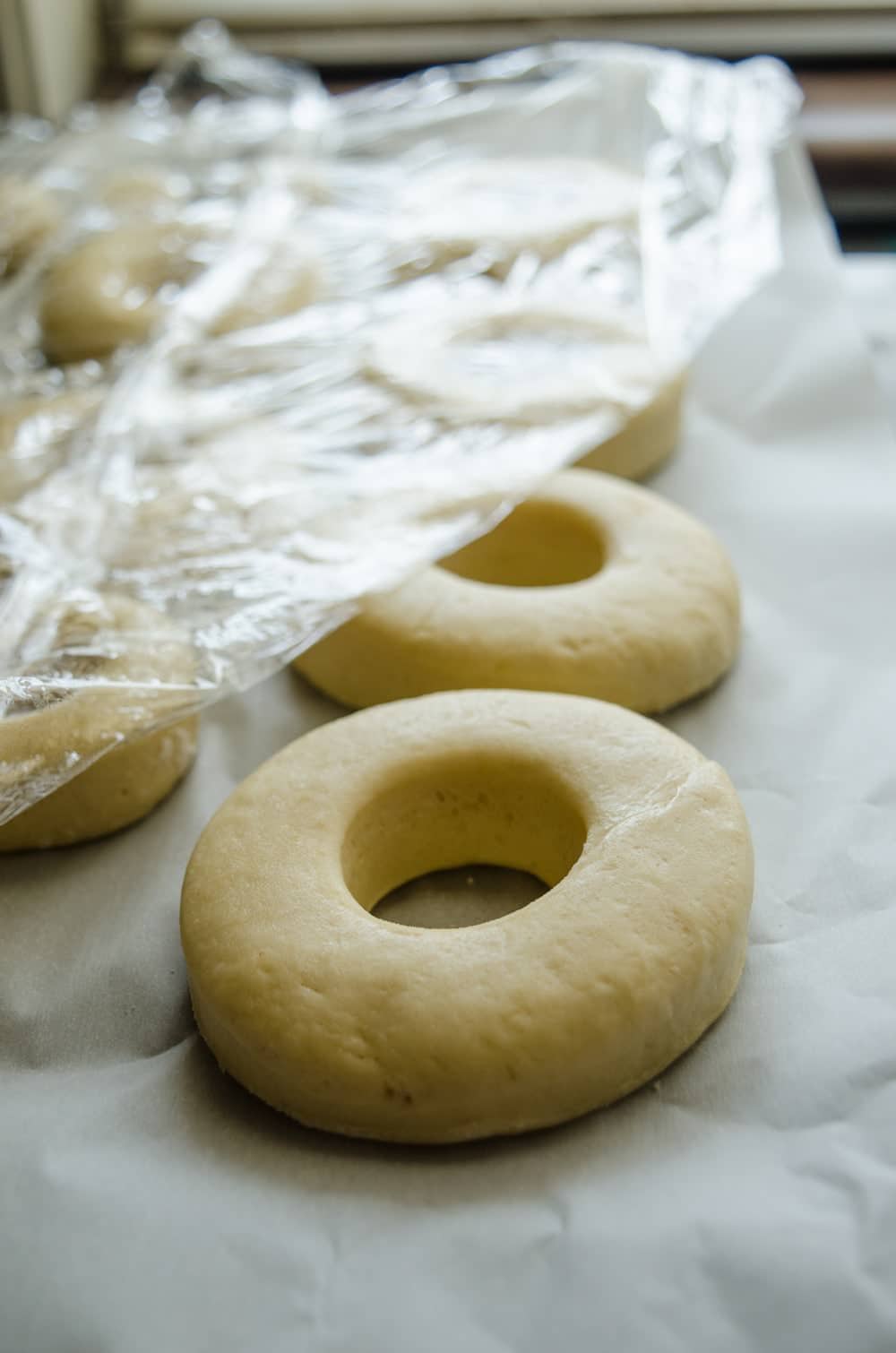
The second proofing usually only takes 1 hour at a room temperature of around 72°F- 75°F (22°C- 25°C) – a little less in the summer if it’s warmer, and a little longer in the winter if it’s cooler.

After I leave the doughnuts (covered with plastic wrap) for this second rise, I check on them after 30 minutes and then every 10-15 minutes. Check the first doughnut you cut out/rolled up and lightly press/prod it.

If the indentation you make with your finger immediately disappears, the dough is not done yet (underproofed).
If the indentation stays (see the recipe video below) – it’s ready! Remove the plastic wrap, and it’s time to heat up that oil.

However, if the cut dough starts to deflate, then it has been overproofed (which is why you should keep an eye on them after the first 30 minutes of your second proofing step), and will need to be re-kneaded, and re-chilled in the fridge for at least one hour (to rest).

Here’s another important tip that works for me – once the doughnuts have been perfectly proofed, take off that plastic wrap cover and let the dough “dry” for about 10-15 minutes. This will form a crust on the surface of the doughnuts and will make it easier to handle them and protects the donuts while they are being fried.

This step is not required, but I’ve found that it makes it easier for me to pick up the donuts, and it also helps them keep their shape better during frying.

What happens if the doughnuts haven’t proofed properly?

  • Overproofed – leads to oily, collapsed, flat donuts.
  • Underproofed – leads to stiffer (denser) donuts that don’t puff up well when fried.
  • Cracked donuts – this may have happened if you used a cutter and it wasn’t sharp enough to cut through the dough cleanly. Or the dough is underproofed or too cold.
  • Balled up donuts – if the dough has not had enough time to rest (especially donuts cut from the second re-roll), they tend to shrink (in width, not in height) and ball up when fried.

If your donuts were rested and proofed correctly, frying is the next step.
Perfect Glazed Doughnuts - The guide to Perfect Doughnuts with a vanilla glaze with a complete troubleshooting guide. Now you can have perfect doughnuts every single time

Frying the perfect doughnuts

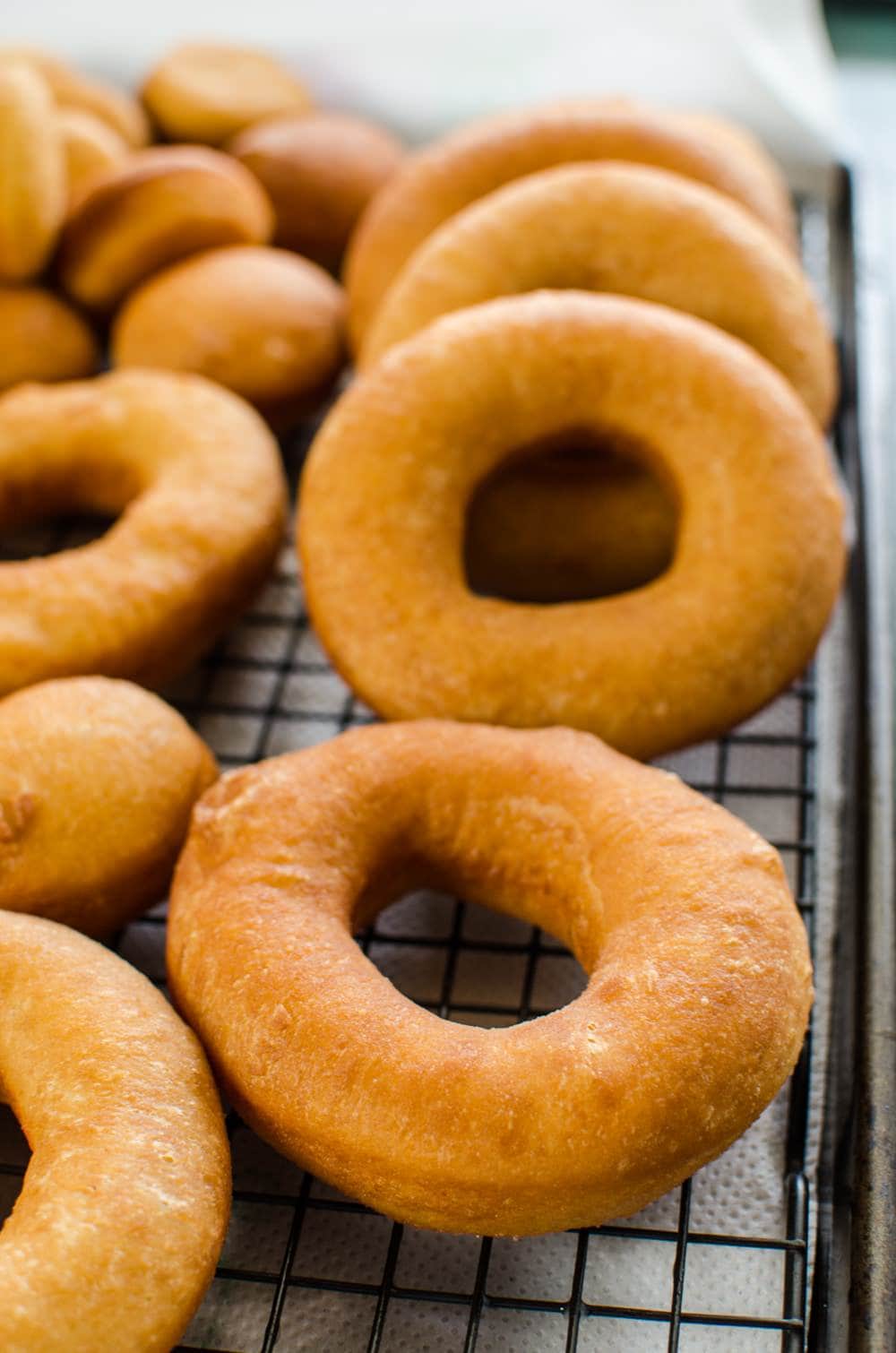
The optimum temperature for the oil/shortening should be 370°-375°F (188-191°C).

If your oil is at this optimum temperature, then the oil does its job, and when you drain your fried doughnuts, any excess oil gets drained out cleanly so that you don’t end up with any oily residue on your doughnuts.

But if the oil temperature is too low (lower than around 360ºF/183°C), you will end up with very oily doughnuts, since the oil gets trapped and absorbed by the dough.

Conversely, if the oil/shortening is too hot, this results in your doughnuts browning too fast and leaving a raw center, or burnt doughnuts, or both!

Another tip for frying doughnuts – you want your doughnuts to float in the oil/shortening. Since only half of the doughnut gets fried at a time (only half is submerged in the oil due to buoyancy resulting from that light, airy inside), you might be tempted to shallow fry it with less oil. DO NOT do that!

Please make sure there’s a good amount of oil, allowing the doughnuts to freely float while being fried.

Plus, it’s easier to maintain the temperature of the oil when there’s a sufficient volume of it too. The oil heats more evenly resulting in evenly browned/fried perfect donuts.
Perfect Glazed Doughnuts - The guide to Perfect Doughnuts with a vanilla glaze with a complete troubleshooting guide. Now you can have perfect doughnuts every single time

Glazing doughnuts

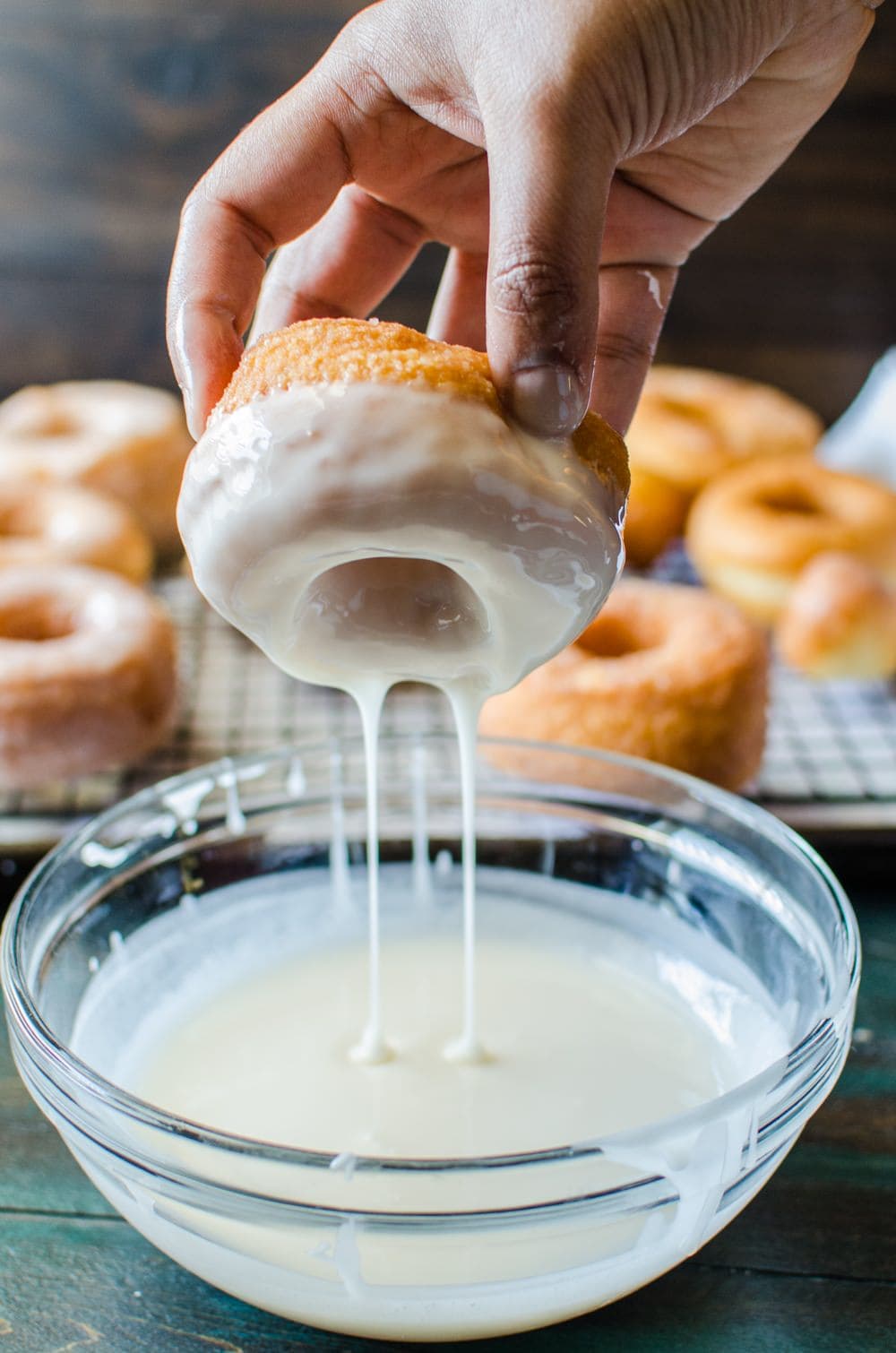
If you’re only glazing doughnuts (for classic glazed doughnuts), then wait till the doughnuts are cool enough to handle, but still warm.

Warmer doughnuts are easier to glaze than cold doughnuts and it results in a thinner, more even glaze. However, I have glazed doughnuts that were at room temperature as well without an issue.

But if I’m planning on filling my doughnuts, then I prefer to let them cool first, then fill and finally glaze them, especially because I work alone. If you have someone lending you a helping hand – you can have them glaze the doughnuts while they’re still warm.

Perfect Glazed Doughnuts - The guide to Perfect Doughnuts with a vanilla glaze with a complete troubleshooting guide. Now you can have perfect doughnuts every single time

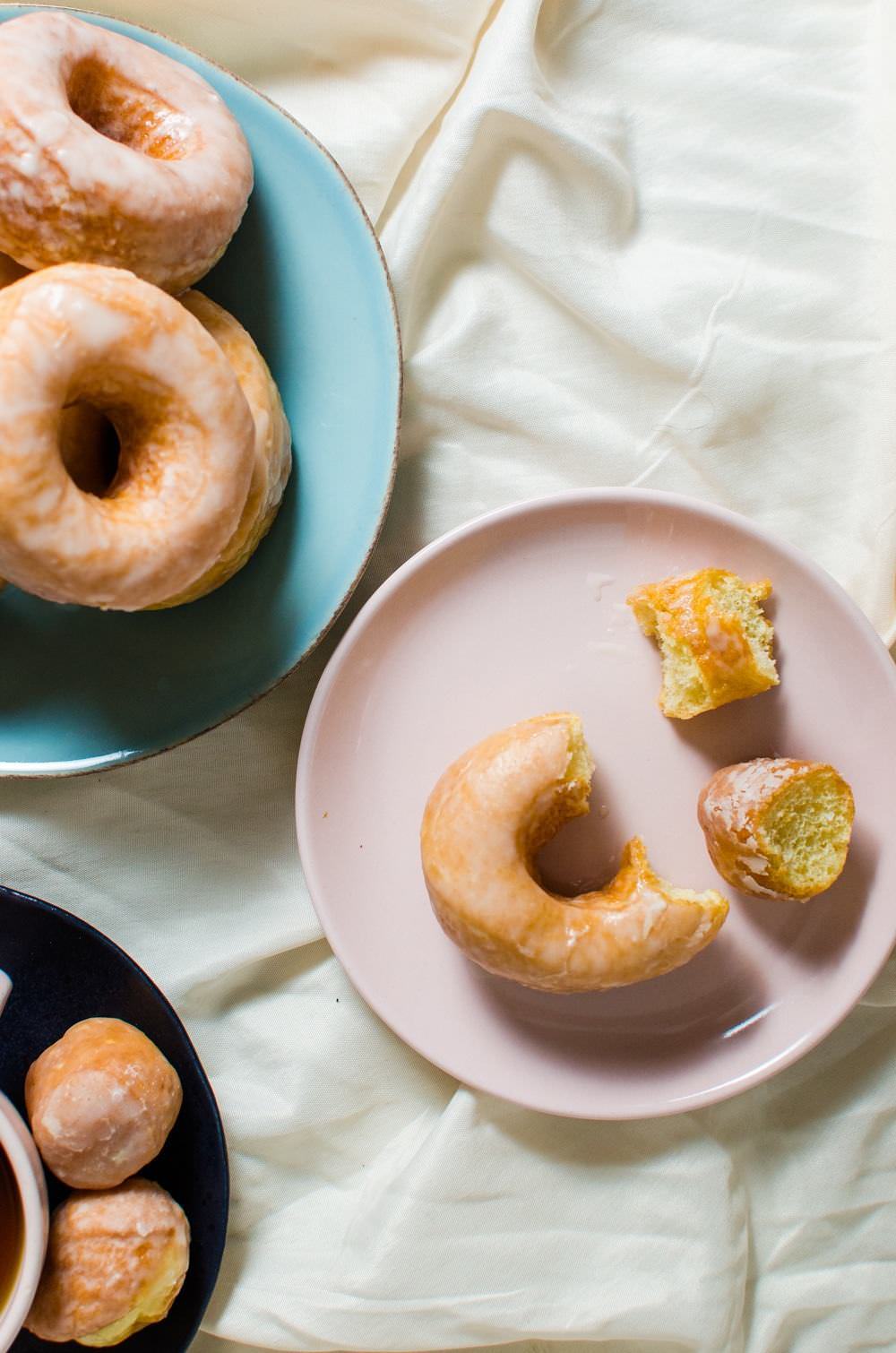
Doughnuts are best eaten on the same day they are made! Really. Unglazed doughnuts really don’t taste that great the next day – unless they were stored in an air-tight container.

Glazed doughnuts withstand time and drying slightly better because they are protected by that glaze which prevents them from going stale rapidly.

These taste pretty good even the next day. But so-so by the third day, by which time, you could probably consider making bread pudding out of those doughnuts! 🙂 That’s what I do if we have leftovers and that tastes pretty amazing as well!

Perfect Glazed Doughnuts - The guide to Perfect Doughnuts with a vanilla glaze with a complete troubleshooting guide. Now you can have perfect doughnuts every single time

We have stored glazed doughnuts in the freezer as well, which helps keep them fresh for longer (up to a week). Each doughnut was stored separately in a ziploc bag. They thaw out fairly quickly at room temperature when you’re ready to snack!
Perfect Glazed Doughnuts - The guide to Perfect Doughnuts with a vanilla glaze with a complete troubleshooting guide. Now you can have perfect doughnuts every single time

Recipe Video

Recipe

5 from 22 votes

How to make glazed doughnuts (doughnut troubleshooting)

Author: Dini Kodippili
Yield: About 12 donuts
Cuisine: American, North American
Perfect Glazed Doughnuts - The guide to Perfect Doughnuts with a vanilla glaze with a complete troubleshooting guide. Now you can have perfect doughnuts every single time.

 Difficulty: 

Easy
These Homemade Glazed Doughnuts are super fluffy and airy on the inside, and tender on the outside. And then dipped in a perfectly sweet glaze. Follow all of my tips to make the most perfect donuts ever!
EASY – This is a great recipe for beginners who want to try to make donuts. The step by step instructions and video will help with making the recipe familiar.
Please note that there is an optional overnight inactive proofing step in this recipe.

US based cup, teaspoon, tablespoon measurements. Weight‌ ‌measurements‌ ‌are‌ ‌recommended‌ ‌for‌ ‌accurate‌ ‌results whenever available.

Common Measurement Conversions
Prep: 1 hour hr
Cook: 10 minutes mins
10 hours hrs 10 minutes mins
Total Time: 11 hours hrs 20 minutes mins
Print Recipe Rate SaveSaved!
Makes: 12 donuts

Ingredients:
 

Dough for the doughnuts
  • 500 g AP flour approximately 4 cups, spoon and leveled
  • 120 mL lukewarm water ½ cup
  • 120 mL lukewarm milk ½ cup
  • 1 tbsp active dry yeast
  • 1 large egg
  • 1 large yolk
  • 50 g sugar ¼ cup
  • 115 g butter 1 stick / ½ cup. Softened
  • ½ tsp sea salt
  • Oil or shortening for deep frying
Glaze
  • 226 g icing sugar or confectioner’s sugar approximately 2 cups, spooned and leveled
  • 80 – 100 ml whole milk about ⅓ cup
  • 1 tsp vanilla

Instructions:
 

Doughnut dough
  • Dissolve about 1 tsp of sugar in lukewarm water. Sprinkle the yeast over the water and stir to combine. Set aside for 10 – 15 minutes to activate the yeast. The yeast should become frothy when activated.
    120 mL lukewarm water, 1 tbsp active dry yeast, 50 g sugar
  • Add the activated yeast into the mixing bowl, along with the rest of the sugar, milk, egg and yolk.
    120 mL lukewarm milk, 1 large egg, 1 large yolk, 50 g sugar
  • Set aside about ¼ cup of the flour and place the rest in the mixing bowl with the other ingredients. Finally add the salt.
    500 g AP flour, ½ tsp sea salt
  • Mix on low speed with the paddle attachment or kneading hook on your mixer, until the mix comes together. You can also use a spatula for this as well.
  • If you used the paddle mix, switch to the dough hook and start kneading the dough for about 5 minutes.
  • Add the softened butter (½ – 1 tbsp at a time) until it's all incorporated. Add some flour, if you need to get the dough off the sides of the bowl. Add the rest of the flour if needed, to form a soft dough ball. The dough should be tacky and soft.
    115 g butter
  • Knead the dough for about 5 – 7 minutes until you have a soft, shiny, slightly tacky dough. Check if the dough is kneaded well with the window pane test.
  • Knead the dough for a couple of minutes in your hands till you have a smooth dough ball.
  • Place this ball of dough in a lightly oiled bowl (with enough room to rise) and cover with plastic wrap. (remember to place the dough with the seam side down).
  • Let the dough rise at room temperature (70-75°F) until it is has doubled in size – this should take about an hour, maybe less depending on how warm the ambient temp. is. (If you are pressed for time, you can let it proof in the fridge – for at least hours upto 24 hours, and continue from step 10).
  • If you allowed the dough to rise at room temperature – gently release the air in the dough.
  • OPTIONAL BUT RECOMMENDED – Reshape the dough, and place it in the bowl again for an overnight proof in the fridge. This helps develop the flavors of the dough better and the dough is also easier to handle when chilled. The nxt morning you can remove the dough from the bowl and proceed with the recipe.
    If you want to skip the overnight proof, then skip this step.
  • Place the dough out on to a floured surface and roll it out to a ½ inch thickness.
  • With a 3 to 3.5 inch diameter cookie cutter / donut cutter, cut out the donuts from the dough. Use a smaller cookie cutter to punch out the center whole.
  • Place the donuts and donut holes on a parchment paper lined baking tray and cover with plastic wrap or towel.
  • Knead the left over dough lightly and let it rest for about 30 minutes, and repeat rolling and cutting once more.
  • Cover the cut donuts and donut holes with plastic wrap and let them rise for about 1 hour or until proofed properly. (see tips in the post to check if the doughnuts are proofed properly).
  • Heat a good amount of oil or shortening (the donut needs to float at least 2 inches above the bottom of the pan) in a heavy bottomed pan.
    Oil or shortening
  • When the oil is heated to 375°F/190°C, carefully drop in a doughnut. After 30 – 45 seconds, check to see if the donut has turned a golden brown. If it has, flip it over. If it hasn't, leave it for a few seconds longer and then flip it over (the doughnut will darken as they cool down, so be careful not to let it darken too much while frying). If the donuts brown too quickly, lower the heat of your stove.
  • Transfer the donut to a wire rack to let it cool.
  • To glaze, place a donut in the prepared glaze and turn to coat it completely. Then keep it on a wire rack to let the excess glaze drip. Sprinkle with funfetti or sprinkles if you like, before the glaze sets.
For the glaze
  • Sift the icing sugar, add vanilla and whisk in the milk or water – 1 tbsp at a time, until you get a pourable consistency. Add coloring if you like.
    226 g icing sugar or confectioner’s sugar, 1 tsp vanilla, 80 – 100 ml whole milk
  • Make more as needed.

Recipe Notes

Storage – Doughnuts are best eaten on the same day, or the next day, refrigerated.
If you have too many doughnuts, freeze them individually, then thaw them out later when ready to eat.
Activating Yeast – If I know my active dry yeast is fresh, I add it directly to the dough. However, if you are unsure whether your active dry yeast is fresh, you can activate it first. 
 

Nutrition Information:

Serving: 1donut Calories: 337kcal (17%) Carbohydrates: 56g (19%) Protein: 6g (12%) Fat: 10g (15%) Saturated Fat: 6g (38%) Polyunsaturated Fat: 1g Monounsaturated Fat: 3g Trans Fat: 1g Cholesterol: 53mg (18%) Sodium: 176mg (8%) Potassium: 95mg (3%) Fiber: 1g (4%) Sugar: 24g (27%) Vitamin A: 321IU (6%) Vitamin C: 1mg (1%) Calcium: 44mg (4%) Iron: 2mg (11%)

“This website provides approximate nutrition information for convenience and as a courtesy only. Nutrition data is gathered primarily from the USDA Food Composition Database, whenever available, or otherwise other online calculators.”

Tag me on Instagram!I love seeing what you’ve made! Tag me on Instagram at @TheFlavorBender or leave me a comment & rating below.

You can use this dough to make your favorite doughnuts. Like these Simpsons donuts, or blueberry cardamom doughnuts, or coffee doughnuts filled with white chocolate creme patisserie!

I have other favorite ways to prepare doughnuts too! Maple bacon bars (with bacon and maple glaze, lemon meringue dougnuts, chocolate truffle doughnuts (with Lindt truffles inside), Nutella stuffed caramel doughnuts (Nutella inside, caramel outside!), and so many more flavors. Stay tuned for all these delicious recipes!

If you liked this tutorial on how to make perfect doughnuts with vanilla glaze (perfect donuts) and this comprehensive troubleshooting tutorial, don’t forget to subscribe for new (and free) recipes by entering your email address on the side bar (and get all these recipes delivered straight to your inbox), so you don’t miss out on a thing. You can find me on FACEBOOK, INSTAGRAM,  PINTEREST, YOU TUBE and GOOGLE-PLUS too.

Dini Kodippili Avatar

About

Dini Kodippili

Dini Kodippili is a professional food writer, recipe developer, food photographer, cookbook author, and baker. Dini has been featured on HuffPost, Cosmopolitan, Forbes, Delish, Food & Wine and more. Learn More

I love hearing from you! Submit your question or recipe review here.

5 from 22 votes (1 rating without comment)

Leave a Reply Cancel reply

Your email address will not be published. Required fields are marked *

Made this? Rate this recipe:


This site uses Akismet to reduce spam. Learn how your comment data is processed.

165 responses

  1. Emily Persico
    December 28, 2020

    Hi, I’m doing research about donuts but I can’t seem to find information about the rise. It seems like you know a lot about donuts, so I was hoping you could answer a few of my questions. How much volume would you say a donut gains while frying? Also, how much would you say the donut weighs before frying? I know these questions are weird, so no worries if you have no idea – it’s for a math project. Than

    Reply
    1. Emily Persico
      December 28, 2020

      *Thanks

      Reply
    2. Dini
      December 28, 2020

      Hi Emily
      It would be very difficult to answer those questions.
      The volume increase depends on too many factors to be predicted reliably. How much it proofs before frying. How much yeast is used in the recipe. How much moisture is in the dough. Size and shape of the donut. These are just some of the factors that can have an effect on the final volume of a donut.
      Sorry I couldn’t help more.

      Reply
      1. Emily Persico
        December 29, 2020

        5 stars
        That’s ok! It actually did help, as now I have more factors to analyze. Thanks for taking the time to respond.

        Reply
  2. Guillermo Tell
    December 23, 2020

    5 stars
    Awesone!!! Absolutely great recipe and tips. I’m pleased. Thank U a lot.
    I gotta be following U 4 the tutorials.

    Reply
  3. Halima Sani
    December 13, 2020

    Hi, I followed this exact recipe save for the eggs, I used one instead of two( yolk). But my dough was too sticky too handle before I refrigerated it and after refrigerating over night it was still very sticky. I added flour before cutting but still. I had to fry them like dat to avoid going over the recipe. What could be the problem. Thank you

    Reply
    1. Dini
      December 13, 2020

      Hi Halima
      As noted in the recipe, this is a sticky dough. If the dough is kneaded properly, then the gluten will develop, making the dough shiny, satiny and tacky (So still sticky but not messy). This dough shouldn’t be sticky after refrigerating either. If it’s cold, it should just be slightly tacky, but shouldn’t stick to any surfaces (especially floured surfaces). I’ve made this many times and haven’t had it be sticky.
      Do you mean tacky or sticky?

      Reply
  4. Hadizah
    November 24, 2020

    Thanks for the guidelines and all, almost the same as mine except for the butter, I want to ask a question, why does ring doughnut taste entirely different from round doughnuts (bomboloni) ?

    Reply
    1. Dini
      November 24, 2020

      Hi Hadizah
      If the two types of donuts use different doughs, that can result in different flavors. A change in the ingredient amounts can lead to differences in texture and flavor.
      If it’s made with the same dough, then there shouldn’t be a change in flavor.
      Hope that helps

      Reply
      1. Hadiza
        November 28, 2020

        Thank you but I can’t find your video on YouTube

        Reply
        1. Dini
          November 28, 2020

          Hi Hadiza,
          I have linked to the video in the post here as well. You can find it just above the recipe card. I hope that helps!

          Reply
  5. Naomi
    September 26, 2020

    Is the sugar 4tbs of sugar or 1/4 c?? Thank you!

    Reply
    1. Dini
      September 26, 2020

      Hi Naomi
      4 tbsp is 1/4 cup in the US.
      1/4 cup = 60 ml
      1/4 cup of sugar = 50 g
      I hope that helps

      Reply
  6. Chris
    September 8, 2020

    Hey Dini
    Any chance we can use an air fryer or bake it in the oven?
    The thought of a whole wok of oil terrifies me.

    Reply
    1. Dini
      September 8, 2020

      Hi Chris
      These doughnuts are meant to be fried.
      I unfortunately haven’t tried an air frier, but I anticipate it would be hard to move the proofed doughnuts into an air fryer without damaging them
      If you prefer to bake them, I recommend following a baked doughnut recipe instead as it would be designed to work in the oven.
      I hope that helps

      Reply
      1. Chris
        September 12, 2020

        Thanks D!

        Reply
  7. Sheidu Favour
    July 25, 2020

    The recipe was helpful,it gave me the directions I needed.
    Amazing job Dini♥️

    Reply
  8. Sadi
    July 14, 2020

    Thanks dear, when cut the doughnuts, where to put them to rise in the refrigerator or at the room temperature.

    Reply
  9. Dave0
    July 13, 2020

    Great recipe, thanks! My donuts ended up darker than yours. I kept the oil at 265-275 deg F and flipped them after 45 – 60 sec. The oil was reclaimed from previously making 2 or 3 batches of donuts. Could that be my problem?

    Reply
    1. Dini
      July 24, 2020

      Hi Dave0
      Thank you!
      When using oil that has been used a few times it could have an impact on the donuts that are fried in them later.
      I hope that helps!

      Reply
  10. Theresa
    July 13, 2020

    Your written dough recipe calls for 1/2 cup milk and a 1/2 cup of water. The video only shows the milk being used. Could you clarify the amount of liquid to use. Seems like a lot of liquid.

    Reply
    1. Dini
      July 13, 2020

      Hi Theresa
      In the video I have mixed the water and milk together (it’s still 1 cup of liquid) to activate the yeast. This whole amount is sufficient to hydrate the dough and also keep it soft, so you end up with fluffy doughnuts.

      Reply
  11. uriam ale
    June 10, 2020

    Great ! I love this recipe so much and I am looking for more…!

    Reply
  12. Nats koa
    June 8, 2020

    Hi Dini. I made my 1st ever doughnuts from another recipe. But it came dense and ever denser on the 2nd daym my problems let me to this very useful post of yours. Thanks so much. Why am i having hard time cutting them? I used the ones made out of plastic to make a hole. But it doesnt quite cut off perfectly. Always leaving an intact dough in between the lined cut.
    Maybe i havnt knead for dough that much? Im using hands for kneading. Is that also fine? Thanks a bunch! I enjoy reading your posts. Stay healthy and safe!

    Reply
    1. Dini
      June 13, 2020

      Hi Nats
      If the cutter is not cutting through the dough, it’s usually because the cutter is dull.
      I usually use a metal cutter because they don’t dull like plastic ones.
      You could also try dipping the cutter in flour first, then cutting straight down the dough, and twisting the cutter a little to release the dough. If this still doesn’t work, I recommend getting a metal cutter.
      I hope that helps!

      Reply
  13. Shela
    June 1, 2020

    Hi Dini,
    Sorry but I have one more question.
    What can I make out of the rest of the dough. Am i able to make apple fritters?

    Thanks

    Reply
  14. Shela
    May 31, 2020

    Hi Dini,
    This entire article was very useful! I am new to making doughnuts and I want to make perfect doughnuts. This recipe is the one that finally worked for me, so thank you!
    I have a question,
    I made one of my doughnuts without hole but the inside didn’t get cooked. Would this recipe still be good for no hole doughnuts or maybe I did something wrong somewhere in the frying ??

    Thanks

    Reply
    1. Dini
      June 1, 2020

      Hi Shela
      Doughnuts without holes can be made. However they need to be fried longer because of the extra dough. For this reason, I prefer to make my doughnuts without holes slightly smaller, so they cook through easily.
      If you are frying bigger doughnuts they need more time to fry and smaller doughnuts will need less time to fry.

      With leftover dough, I usually cut it into scraps and fry them or I make more doughnut holes. Apple fritters use a much runnier batter, so this wouldn’t work the same way.
      I hope that helps!

      Reply
  15. deepthi anand
    May 29, 2020

    Hiiii Dini…
    I read throu ur procedure…u have explained it so well… but I stil have one unanswered question. Before we cut out the dough,do I flour or oil the surface on which I’m gonna lay the dough, and also do I flour or oil the parchment paper on which I place the cut outs. Because when I try to handle the cut outs ,its sticking to the surface and also patchment paper ,so the shape is changing off when I try to remove them and also the dough Is so soft that my finger prints r falling on the dough.
    I’m surprised no one has asked this question. Pls pls answer my question

    Reply
    1. Dini
      May 29, 2020

      Hi Deepthi
      When you roll out bread dough, it’s never on an oiled surface. This is because it becomes slippery and the dough becomes harder to handle.
      So bread dough is usually always rolled out on a floured surface or if the dough isn’t sticky they don’t have to flour the surface at all.

      Reply
  16. deepthi anand
    May 29, 2020

    Hii..I love the way u have explained. I made donuts from another recipe today. After reading ur procedure I realised may be I overpriced the dough.but I stil have my question unanswered.after the first proofing, the dough is so soft and slightly sticky, do I flour the surface on which I’m gonna do the cut outs, or butter the surface???? And also the parchment paper on which I’m gonna place these cut-outs on,do I flour or oil them?? Because when I try to remove them from the surface or the parchment paper,they r so soft that they have my finger Mark’s on them and they reshape or most probably stick to the surface. I dont know how to remove them from the surface easily. Il be really glad if I find an answer for this.

    Reply
    1. Dini
      May 29, 2020

      Hi Deepthi
      It’s hard for me to be 100% sure on the technique without knowing the recipe that you used, so my answers are based on my recipe.
      I flour the surface that I will be rolling and cutting the dough. Using butter will make it stickier and harder to work with because the dough is already an enriched dough.
      Since parchment paper is non stick, I don’t flour them when I place the doughnuts. However, if you feel like you would like the additional failsafe, you can lightly dust the parchment paper if you like.
      If you find it hard to lift the doughnuts from the parchment paper, then you can cut the parchment paper around the doughnut, and lift the doughnut using the parchment paper underneath and place the doughnut in the oil WITH the parchment still attached. Once it starts to fry you can gently peel off the parchment paper from the doughnut.
      I hope that helps

      Reply
  17. Nad
    May 27, 2020

    Hello! I don’t have active dry yest at the moment…can i substitute with instant yeast? if yes, please provide me with the correct measures to do so 🙂
    thank you!

    Reply
    1. Dini
      June 4, 2020

      Hi Nad
      I haven’t used instant yeast unfortunately. You can either substitute it 1:1 (some packages suggest that), but reduce the proofing times. Or use about 25% less, and hopefully not need to change proofing times.
      Instant yeast is more active than active dry yeast, and therefore you will need to adjust proofing times accordingly.
      I hope that helps!

      Reply
  18. Christy
    May 21, 2020

    I noticed my donut was hard immediately I took it out of the frier (that’s while it was still hot) but when It was a bit cool, it got softer. Please Is that normal? Or is it supposed to be soft even while hot?

    Reply
    1. Dini
      May 21, 2020

      Hi Christy
      Do you mean they were hard on the surface? Since donuts are fried, the outer crust does feel more “crust-like” straight out of the frier. But the whole donut shouldn’t be hard. They should be soft even when hot (although it’s a little too hot to break apart at that stage).
      The only thing I can think of is that maybe the dough had too much flour – if you used cup measurements, it’s possible that you may have measured more flour than intended.

      Reply
  19. Karen
    May 13, 2020

    I don’t have a deep frier. What shall I do??

    Reply
    1. Dini
      May 14, 2020

      Hi Karen
      I didn’t use a deep fryer for these either. I fried them in my big pot, that I filled with enough oil to fry donuts.
      I hope that helps!

      Reply
  20. Okoye Austin
    May 10, 2020

    Was really helpful.
    I want to know why my dough keeps coming back after rolling them out. This makes it difficult to cut out equal sized doughnut

    Reply
    1. Dini
      May 10, 2020

      Hi Okoye
      The reason why the dough keeps coming back is because the dough has been overworked. The gluten is springing back causing the dough to shrink.
      I recommend covering the dough with plastic wrap and letting it rest in the fridge for at least 15 minutes to relax the gluten. I like to rest mine for about 30 – 60 minutes when it’s overworked. You also need to make sure the dough isn’t sticking to the work top as you roll and before you cut the doughnuts.
      Hope that helps.

      Reply
←Older Comments
1 2 3 4 5
Newer Comments→

Hey There!

Hi! I’m Dini, a third culture kid by upbringing and a food-geek by nature. I was born in Sri Lanka, grew up in New Zealand and lived in Australia, and then the US, before moving to and settling down in Canada. My food is a reflection of those amazing experiences!

Read More
Front cover of the Secret Layer Cakes cookbook by Dini Kodippili.

The Flavor Bender

Cookbook

Buy now on Amazon!

Recipe Basics

  • How To Make Perfect Choux Pastry

    How To Make Perfect Choux Pastry

  • Flaky All Butter Pie Crust Recipe

    Flaky All Butter Pie Crust Recipe

  • How To Make Homemade Marshmallows (Foolproof Guide)

    How To Make Homemade Marshmallows (Foolproof Guide)

  • The Best Homemade Bread (White Bread Recipe)

    The Best Homemade Bread (White Bread Recipe)

  • Homemade French Croissants (Step By Step Recipe)

    Homemade French Croissants (Step By Step Recipe)

  • The BEST Pavlova Recipe (Step by step recipe and video)

    The BEST Pavlova Recipe (Step by step recipe and video)

Featured On

Master the science of baking!

Get my FREE Printable Charts!

So you’ll know how to substitute cake pans of different shapes, sizes & volumes, and how to convert ingredient measurements in a pinch!

Must have resources for all pro bakers, novice bakers, and aspiring bakers alike!

Download now!

Reader Faves

  • How to make the Best Instant Pot Short Ribs

    How to make the Best Instant Pot Short Ribs

  • Perfect Quick and Easy Rough Puff Pastry

    Perfect Quick and Easy Rough Puff Pastry

  • The Best Spicy Sweet Chili Sauce (Easy Recipe!)

    The Best Spicy Sweet Chili Sauce (Easy Recipe!)

  • The Best Homemade Bread (White Bread Recipe)

    The Best Homemade Bread (White Bread Recipe)

The Flavor Bender

I love baking, cooking, experimenting with flavors and ingredients, and passing on all my tips and tricks to you!

Read More

About

Meet Dini
My Book
Work With Me
Contact

Browse

Recipes
Measurement Guide
Baking How-To’s
Shop My Faves
Privacy
Disclosure
Terms

Branding by MRD

Theme by OC

Back to Top
  • Facebook
  • Instagram
  • Pinterest
  • X
  • YouTube
1337 shares

Rate This Recipe

Your vote:


A rating is required
A name is required
An email is required

Recipe Ratings without Comment

Something went wrong. Please try again.