


About
My Cookbooks
Work With Me
Contact
  • Facebook
  • Instagram
  • Pinterest
  • X
  • YouTube
The Flavor Bender

Master the Science of Delicious

  • Recipe Index
    • All Recipes
    • Desserts
      • Cakes & Cupcakes
      • Candy & Bite Sizes
      • Chocolate
      • Cookies, Brownies & Bars
      • Frozen Desserts
      • Fruit Desserts
      • Puddings & Custards
      • Dessert drinks
      • No Bake
      • Pastries & Breads
      • Sweet Syrups & Spreads
      • Tarts & Pies
      • Cheesecakes
      • Healthy sweets
    • Breakfasts
      • Tarts, Quiches, & Pies
      • Waffles, Pancakes & Crepes
      • Quick Breads, Scones & Muffins
      • Breakfast Sandwiches
      • Breakfast Pastries
      • Eggs
      • Breakfast & Brunch Drinks
      • Make Ahead Breakfasts
      • Healthy Breakfasts
      • Coffee and Tea drinks
      • Breakfast Smoothies & Juices
      • Breakfast Sides
      • Casseroles
      • Jams & Spreads
    • Courses
      • Main Meals
        • Bread, Sandwiches & Burgers
        • Curries
        • Salads
        • Roasts & BBQ
        • Soups & Stews
        • Casseroles
      • Bread
      • Lunch
      • Beverages
      • Appetizers & Tapas
      • Sides
      • Dips & Condiments
      • Tea Time & Snacks
      • Desserts
      • Meal Prep
      • Cocktails
      • Pet Friendly Recipes
    • Cuisines
      • American
      • European
      • Australasian
      • Sri Lankan
      • East Asian
      • Mexican
      • Middle Eastern
      • South Asian
    • Sri Lankan
      • Main Meals
      • Drinks
      • Desserts
      • Breakfasts
      • Snacks
    • Skill Level
      • Easy
        • Easy Desserts
        • Easy Cooking
        • Easy Breads
        • Easy Breakfasts
        • Easy Dinners
      • Intermediate
        • Intermediate Desserts
        • Intermediate Cooking
        • Intermediate Breads
        • Intermediate Breakfasts
        • Intermediate Dinners
      • Advanced
        • Advanced Desserts
        • Advanced Cooking
    • Recipes by Season
      • Christmas
      • Fall & Winter
      • Halloween
      • Spring & Summer
      • Thanksgiving
      • Valentines Day
    • Recipes by Diet
      • Dairy Free
      • Eggless
      • Gluten Free
      • Paleo
      • Vegan & Vegetarian
    • Recipe Basics
      • Baking Basics
      • Cooking Basics
      • Baking & Cooking 101
  • New? Start Here
  • Measurement Conversions
  • How-To Posts
  • About
  • My Cookbooks
  • Work With Me
  • Contact
The Flavor Bender ย ย โ€บย ย  Recipes ย ย โ€บย ย  Recipes by Course ย ย โ€บย ย  Sauces and Condiments ย ย โ€บย ย  The Best Homemade Curry Powder Recipe

The Best Homemade Curry Powder Recipe

Author:

Dini Kodippili


Jump to Recipe


Updated: 5/24/2024
Total Time25 minutes mins
Quick and Easy Recipes
Sauces and Condiments
Sri Lankan Roasted Curry Powder - This roasted curry powder is deeply aromatic and has very robust and complex flavors. The ingredient ratios are easy to remember (4:3:2:1 and 3:2:1), so go ahead and make a big batch and use it any way you like to make flavorful curry dishes!

An adaptable, fragrant, easy curry powder that truly transforms every one of your meat, seafood, vegetable, and fruit curry recipes!

Plus, this Sri Lankan curry powder is made with whole spices, which makes for the most robust flavor imaginable, and it lasts longer as well. The perfect base for the best curry recipes from the comfort of your home.
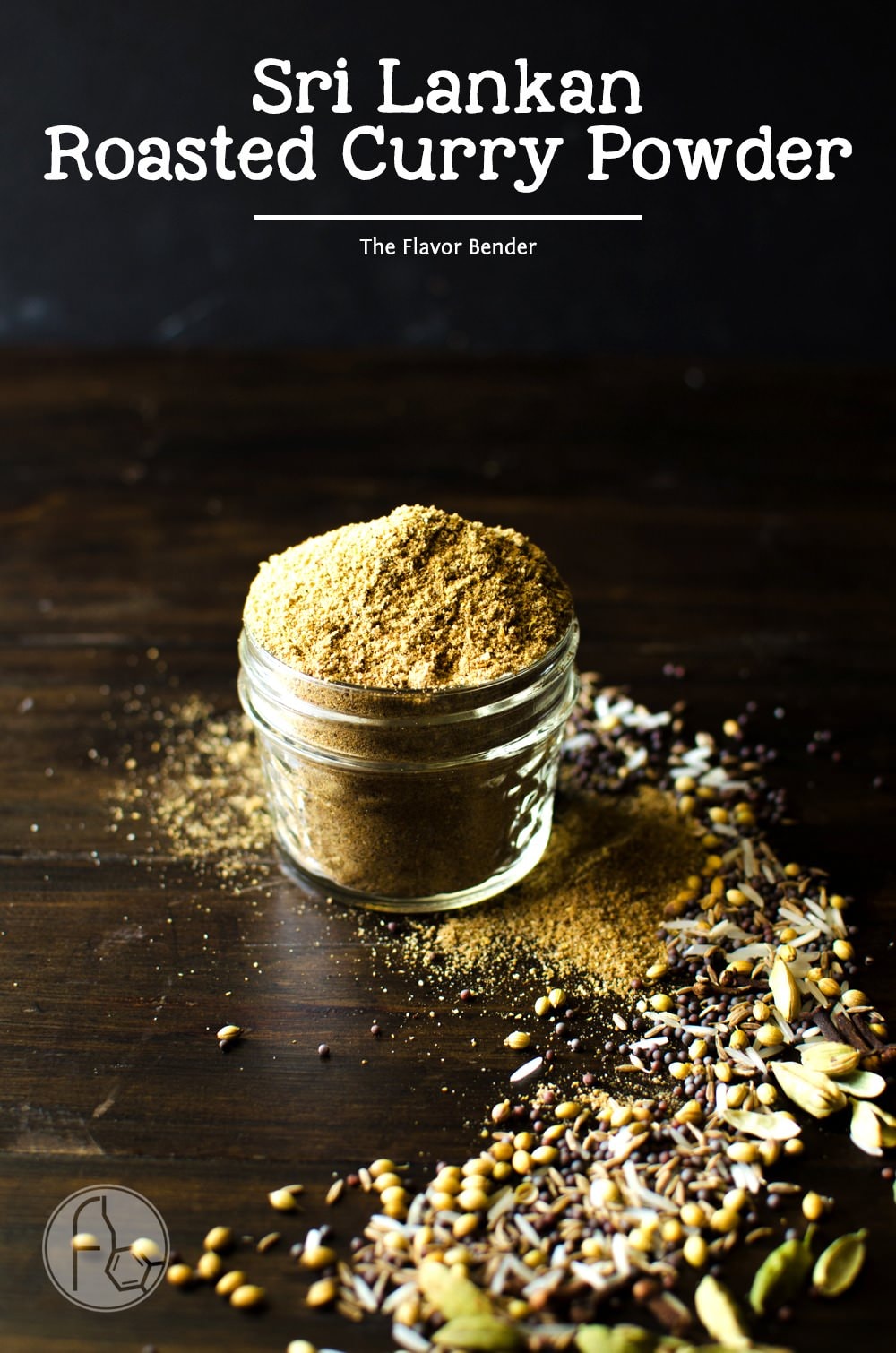
Roasted curry powder in a small glass jar with all the whole spices used to make it in front of it.
Contents
ย [hide]
  • Why an easy curry powder should be a staple in your pantry
  • What is curry powder?
  • What’s special about this Sri Lankan curry powder
  • Ingredients to make this curry powder
  • How to make curry powder (step by step instructions)
  • Recipe tips
  • How to use curry powder in your cooking
  • Storage
  • Frequently asked questions

Why an easy curry powder should be a staple in your pantry

  • This curry powder recipe is one of the most adaptable and easy curry powders you can make with common ingredients. Having such a flexible curry powder allows you to impart great flavor to your curries, with just a spoonful of curry powder. AND you can add more spices to make it even better.
  • Curry powder is a great way to add flavor to any food (not just curry) that needs an extra flavor boost. Add it to popcorn, chips, grilled cheese and more!
  • Since this curry powder is made with whole spices, the flavor is stronger, and it lasts longer than curry powders made with ground spices.
  • The range of curry recipes you can make with just this one easy curry powder is truly mind-boggling! From chicken curry, beef curry and fish curry to seafood curries (like crab curry, shrimp curry etc.), vegetable curries (carrot curry, cauliflower curry, beetroot curry etc.) and fruit curries (apple curry, mango curry) too!
  • This easy Sri Lankan curry powder doesn’t contain chili powder or cayenne pepper, so it’s a mild curry powder that is used to introduce spices to kids too. This way, you can adjust the spice levels to your taste for individual curries.
  • An easy curry powder that has been made for generations in South Asian cuisine, this is a truly authentic curry powder that is big on flavor.

What is curry powder?

Curry powder is a mix of dried spices that have been ground and can be used to flavor many dishes, from vegetarian to meat to seafood dishes.

There is no ONE curry powder recipe. Each culture, each country or region, and even each household and recipe may use a different curry powder or mixture of spices.

A common misconception is that curry powder HAS to be spicy. That’s not true. These homemade spice blends can be mild in heat, or have lots of heat and be spicy.

It can have as little as 2 – 3 individual spices, or as many as 10 spices or more! It depends on the type of curry you wish to make, and the flavor that you’re looking for.

Some believe that all curry powders MUST contain turmeric, which isn’t true either. For example, THIS curry powder does not contain turmeric. Instead, it’s made with very flavorful and fragrant spices, and it isn’t too spicy either!
Sri Lankan Roasted Curry Powder - This roasted curry powder is deeply aromatic and has very robust and complex flavors. The ingredient ratios are easy to remember (4:3:2:1 and 3:2:1), so go ahead and make a big batch and use it any way you like to make flavorful curry dishes!

Where does curry powder come from?

Curry powders originated in South Asia. As a result of colonization, spice mixes from India, Sri Lanka, Bangladesh and other neighboring countries made their way to the lands of the British, Portuguese and others. To make it more palatable to the British, these spice mixes were generically labeled as “curry powder”.

The word “curry” is also thought to have originated from Tamil ‘kari”, which means “black” or “blackened”. While that could refer to the roasting of spices to make a curry, a simpler explanation is that it meant black pepper, which was and still is a prized spice from South India and Sri Lanka, where many Tamil people live.

Growing up, we used different types of curry powder for different recipes, which is why we kept a blend of simple spices in our pantry cupboards, and then add different spices as needed to the dish to get the flavor we liked.

Different types of curry powder

Madras curry powder – Example of an Indian curry powder or blend originating from Chennai (previously, Madras), the capital of Tamil Nadu (a state in South India). It’s a curry powder that includes a lot of chili powder, so it’s quite spicy.

Garam masala – Quite popular in the Western world. Masala simply means “a mix of spices”, so technically garam masala is a mix of spices that is also a type of curry powder. It usually contains very fragrant spices like cinnamon, cardamom, star anise, and nutmeg.

Jamaican curry powder – Turmeric is the main spice for Jamaican curry powders. For heat, scotch bonnet powder is added (which shows how curry powders can be adapted to use ingredients that are readily available in a specific region). Curries were introduced to Jamaica by Indians who arrived there as workers. This is why curries in the Caribbean have a lot of similarities to those from the Indian subcontinent.

Thuna paha or Sinhala curry powder – Sri Lanka, like India, also has different types of curry powder. This varies from region to region and dish to dish. Thuna paha is the blend of spices that is used in most households in the southern part of Sri Lanka. The curry powder recipe that I’m sharing here is this thuna paha recipe (aka Sri Lankan curry powder).

Coriander, cumin, black pepper, and cardamom are the main spices in this blend, and the other spices can be adjusted and/or omitted according to your preference.

Both the roasted or unroasted curry powders can be used interchangeably, but there is a preference in terms of how they are used.

  • Roasted curry powder – Absolutely fantastic for meat curries, where you want the spices to have a more robust flavor to hold up to the flavors of the meat.
  • Unroasted curry powder – The spices are not toasted, so the flavor is a little milder. Unroasted curry powder is perfect for fish or seafood curries.

Jaffna curry powder – Another important curry powder blend from Sri Lanka. This curry powder originated in the northern part of Sri Lanka. Jaffna curry powder is used in Sri Lankan Tamil households, and like Madras curry powder, it’s spicy due to the higher dried chili content. Black pepper is very prominent in this spice blend and it’s also darker in color than thunapaha.

British curry powder – These curry powders usually use a lot of turmeric, and can be very bland in flavor because there aren’t a lot of flavorful spices added to it. Mediocre curry powder often includes garlic powder and even ginger powder, which aren’t ingredients used in South Asian kitchens (since we add fresh garlic and ginger instead).

However, more boutique brands may use a better blend of spices, but turmeric is still the main spice.

Japanese curry powder – Japanese curry comes as a paste (or cube), but is also available as a powder (S&B curry powder). This includes a range of difference spices. For the traditional yellow color, turmeric is one of the main spices. In addition, allspice and star anise are added for smoky and sweet flavors. The spice level can vary depending on how much cayenne pepper one adds to it.

Yellow curry powder or red curry powder – These curry powders are just about the color of the resulting curry. Yellow curry powder contains more turmeric and is mild. Red curry powder has more chili powder or cayenne pepper, and consequently, more spicy.

A big glass jar and a measuring spoon filled with Sri Lankan curry powder.

What’s special about this Sri Lankan curry powder

This Sri Lankan curry powder is near and dear to my heart! It’s such a versatile, adaptable, and flavor-packed curry blend that I’ve been making for decades.

Over the years, I’ve tweaked it a little here and there, but as someone who has been making this curry powder every week for a long time, I can very comfortably say that this is ABSOLUTELY the best curry powder you need to have in your kitchen.

With this curry powder, you can make SO MANY authentic and delicious Sri Lankan recipes.

I used to make this curry powder with 4:3:2:1 ratio, but I have since opted for using weight measurements because the potency of some spices can vary due to freshness, and affect individual tolerance levels.

With this amazing homemade curry powder, you can make mild curries, super spicy curries, extravagant curries, and super simple curries. Flexibility is one of its biggest strengths.

Plus, without turmeric, which can be overpowering in large amounts, the flavors of the all the spices truly shine through. But, you can also add turmeric in addition to this curry powder if you’d like to, like I’ve done in my carrot curry and beetroot curry recipes.

You can also choose to roast the spices, as per the recipe. Or if you’re a little lazy like I am most of the time, you can choose not to roast it too. Simply sautรฉ the spices while making the curry.

Ingredients to make this curry powder

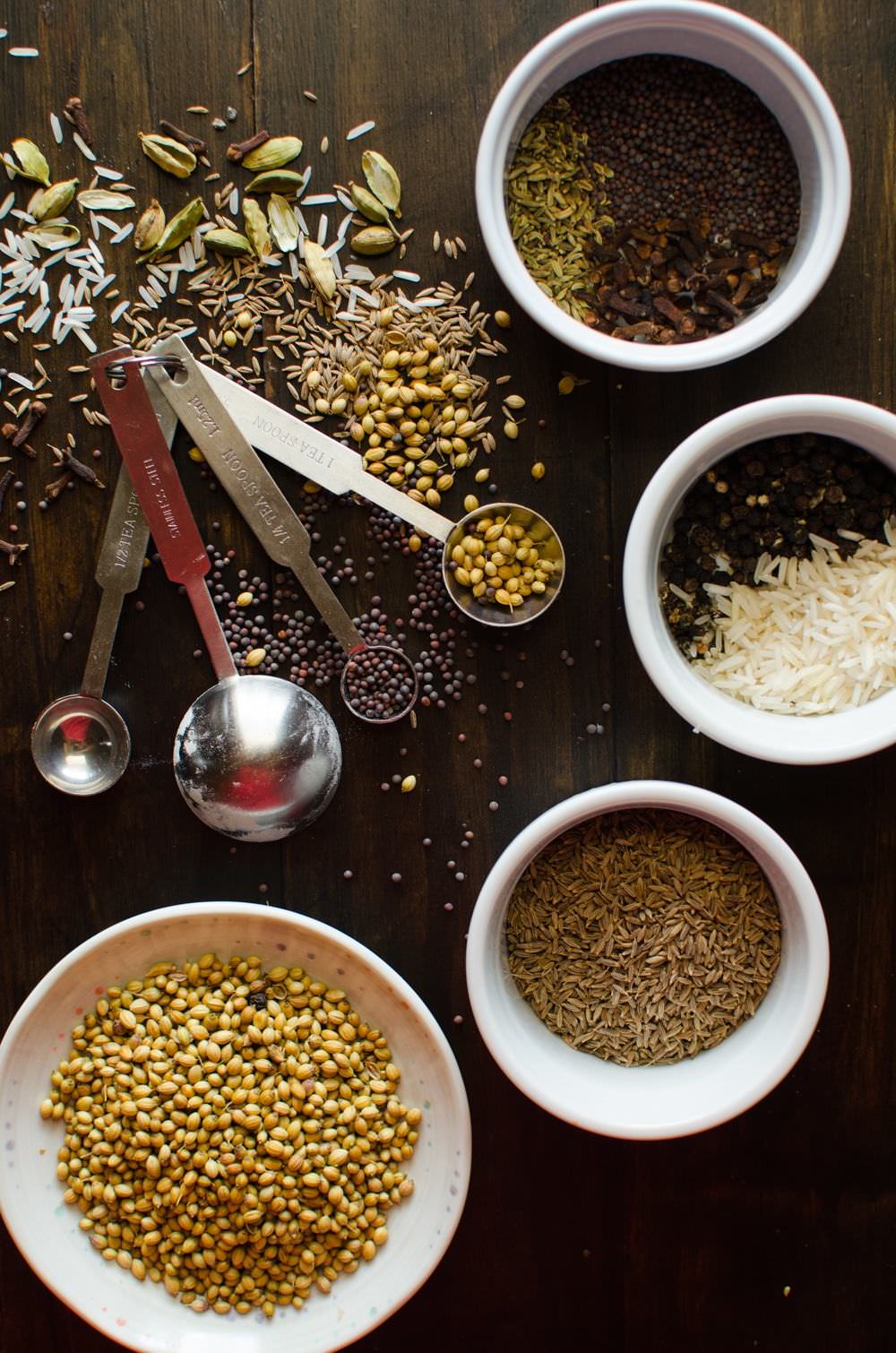
Ingredients needed to make curry powder in individual bowls with labels.

Essential ingredients

  • Coriander seeds
  • Cumin seeds
  • Whole black pepper
  • Green cardamom

Recommended spices

  • Cloves
  • Fennel
  • Black mustard seeds

Other additions

I usually add these to the curry separately, but they can also be added to the curry powder if you like.

  • Turmeric
  • Cinnamon (Ceylon cinnamon is traditional, but cassia is OK too)
  • Dried chili
  • Dried curry leaves – Some store-bought curry powders also include curry leaves. I usually prefer to add fresh curry leaves straight into the curry. However, it does add a lovely earthy flavor to the curry powder, so you can go ahead and do so, if you have access to curry leaves.
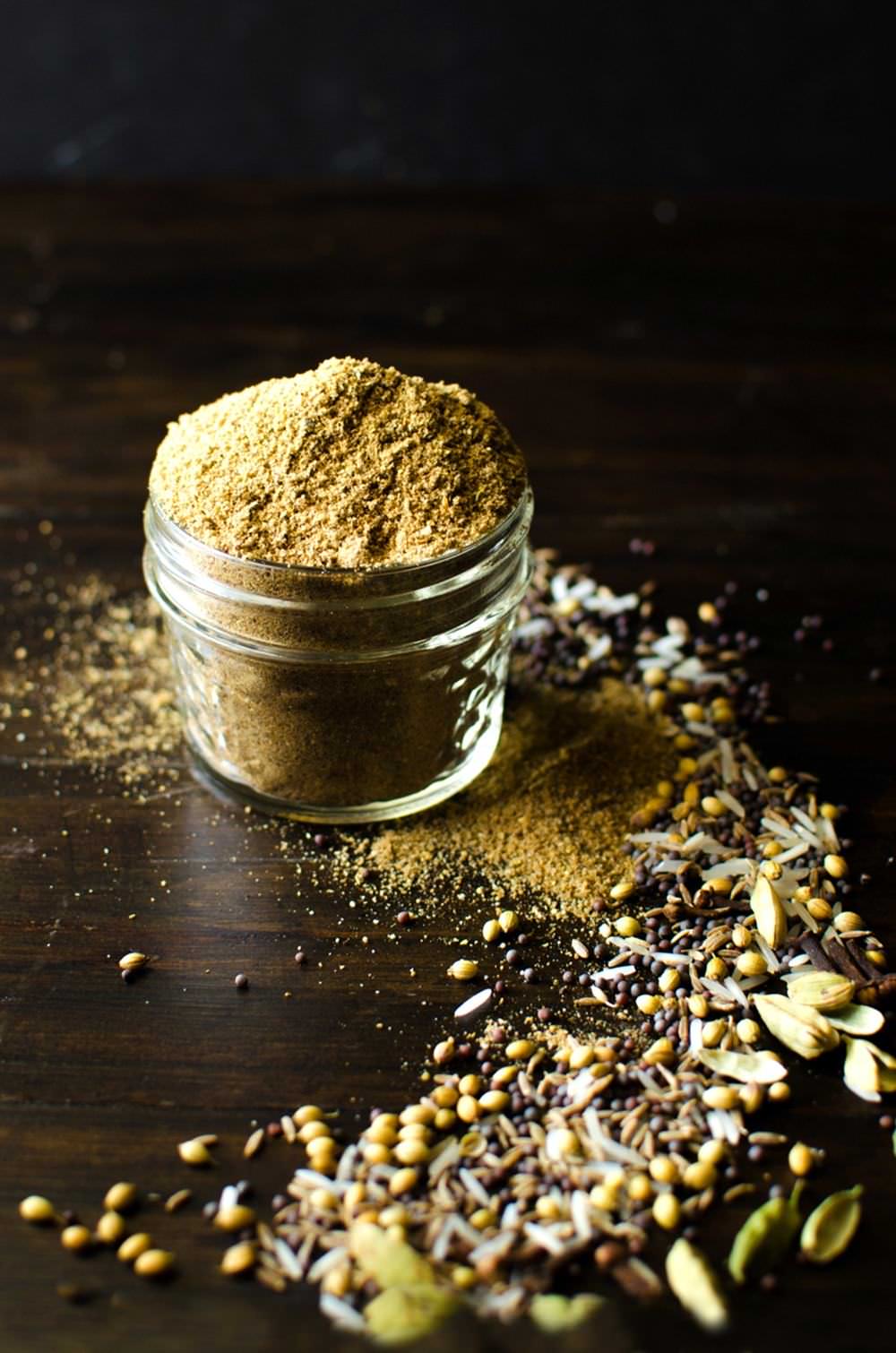
Sri Lankan Roasted Curry Powder - This roasted curry powder is deeply aromatic and has very robust and complex flavors. The ingredient ratios are easy to remember (4:3:2:1 and 3:2:1), so go ahead and make a big batch and use it any way you like to make flavorful curry dishes!

Is there a difference between using whole or ground spices to make curry powder?

Whole spices are more fresh and more potent than ground spices.

For convenience, you can absolutely use ground spices to make this curry powder. However, ground spices lose their flavor MUCH faster than whole spices do. Which is why I use whole spices and grind them fresh every time I make this powder.

I make smaller batches of curry powder, more often, so that the flavor of my curry powder is much better than that of store-bought blends, OR when made from ground spices.

There are many recipes that do use ground spices to make curry powder, but if you’re looking for the absolutely best and most authentic flavor – use whole spices!

Whole spices can be easily found in South Asian stores, and it’ll be cheaper than buying from the supermarket. That’s a win – win.

But if you do not own a spice grinder, then use pre-ground spices. But do make smaller batches so that the curry powder doesn’t lose its flavor over time.

How to make curry powder (step by step instructions)

In this curry powder recipe, I include weight measurements and volume measurements, but honestly a little variation is OK. It doesn’t have to precise, BUT the proportions have to be similar. If you don’t like cloves, add less. Want a spicy curry powder? Add chili.
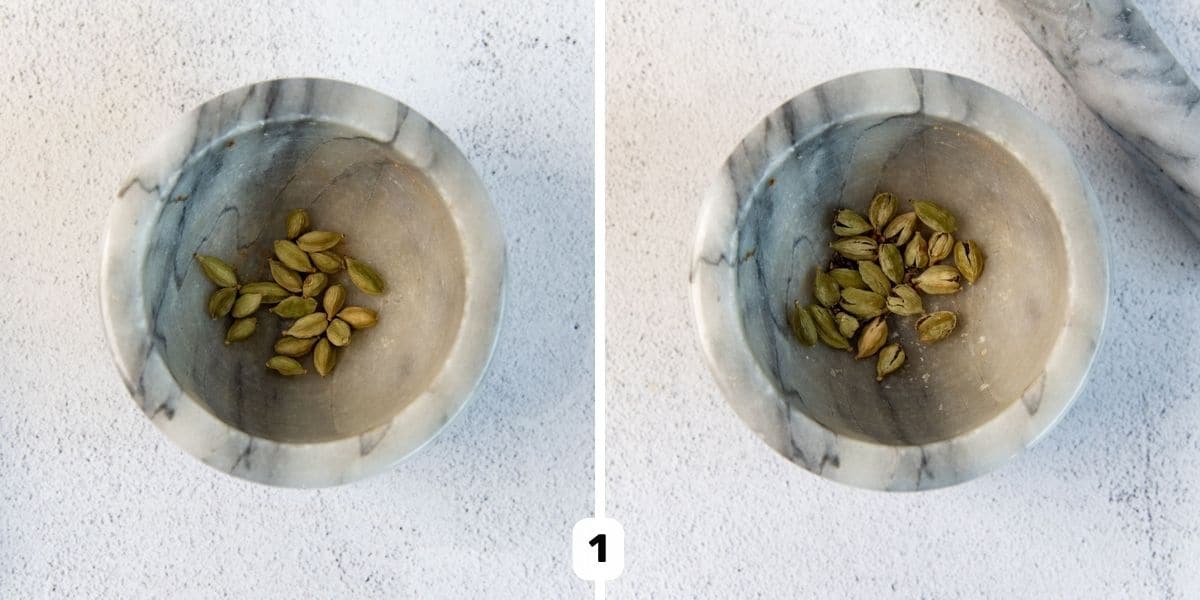
Images showing cardamom pods being split inside a mortar.

The first step is to measure and prepare the spices. This is mostly for the green cardamom. Measure out the whole pods, and then remove the seeds from the pod.

To do this, crack the pods with a mortar and pestle or by hand, and then remove the seeds and discard the husks (images labeled 1 above and below).
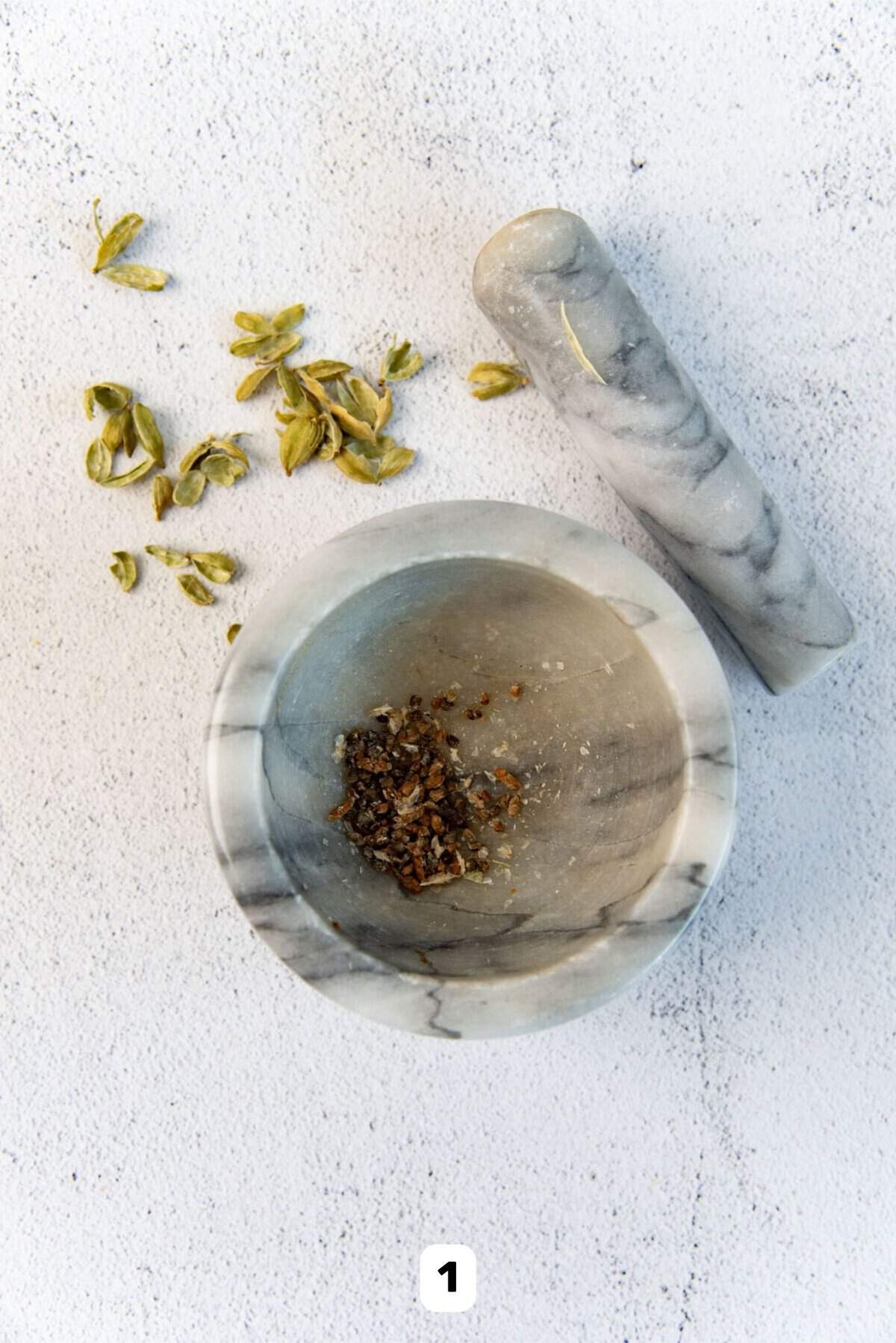
Cardamom pods removed from the seeds that are inside a mortar with the pestle next to it.

However, if you’re making unroasted curry powder, you can even keep the pods whole. I’ve done this many times and have had no issues.

Heat a stainless steel or nonstick pan on medium or medium low heat. Put the curry leaves in there and allow the leaves to dry out on low heat (image 2).

Make sure to move the leaves around to prevent them from burning. Using curry leaves is optional, so you can leave them out if you prefer. To make it even easier, you can purchase already dried curry leaves too.

Next, remove the dried curry leaves.

Collage showing curry leaves being dried on a skillet and rice being toasted in the skillet separately.

Steps for unroasted curry powder

For unroasted curry powder, you can mix all the spices (including the dried curry leaves – if using), and then use a spice grinder to grind all the spices (in batches if necessary).

For roasted curry powder

Add the rice to the heated skillet. Move the rice around with a spatula or by shaking the pan, and toast the rice until it starts to brown (image 3).
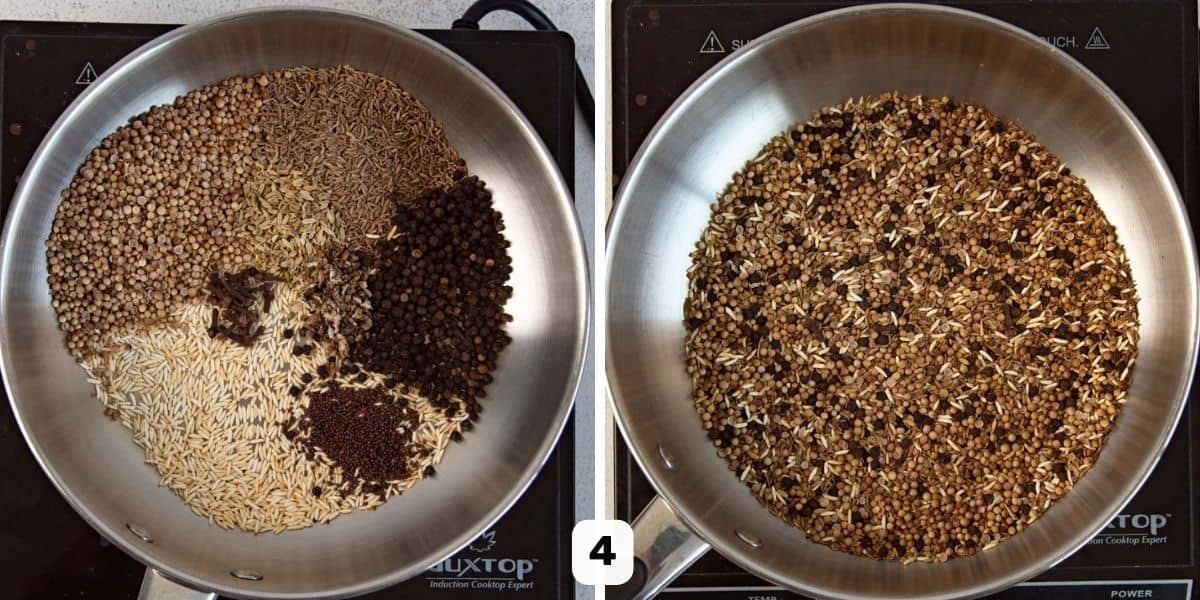
Spices being added to toasted rice, and then toasting the spices on a skillet to make curry powder.

Remove from the heat and add all the rest of the spices. Then return to the stove and toast the spices for a further 2 – 3 minutes until you can start to smell the toasty spices (image 4). Make sure they do not burn.

Burnt spices will result in a bitter curry! To prevent the spices from burning, move the spices around in the skillet throughout the whole toasting process.

Transfer all the toasted spices onto a plate and let them cool down. Add the curry leaves as well. Mix the spices around to allow them to cool faster (image 5).
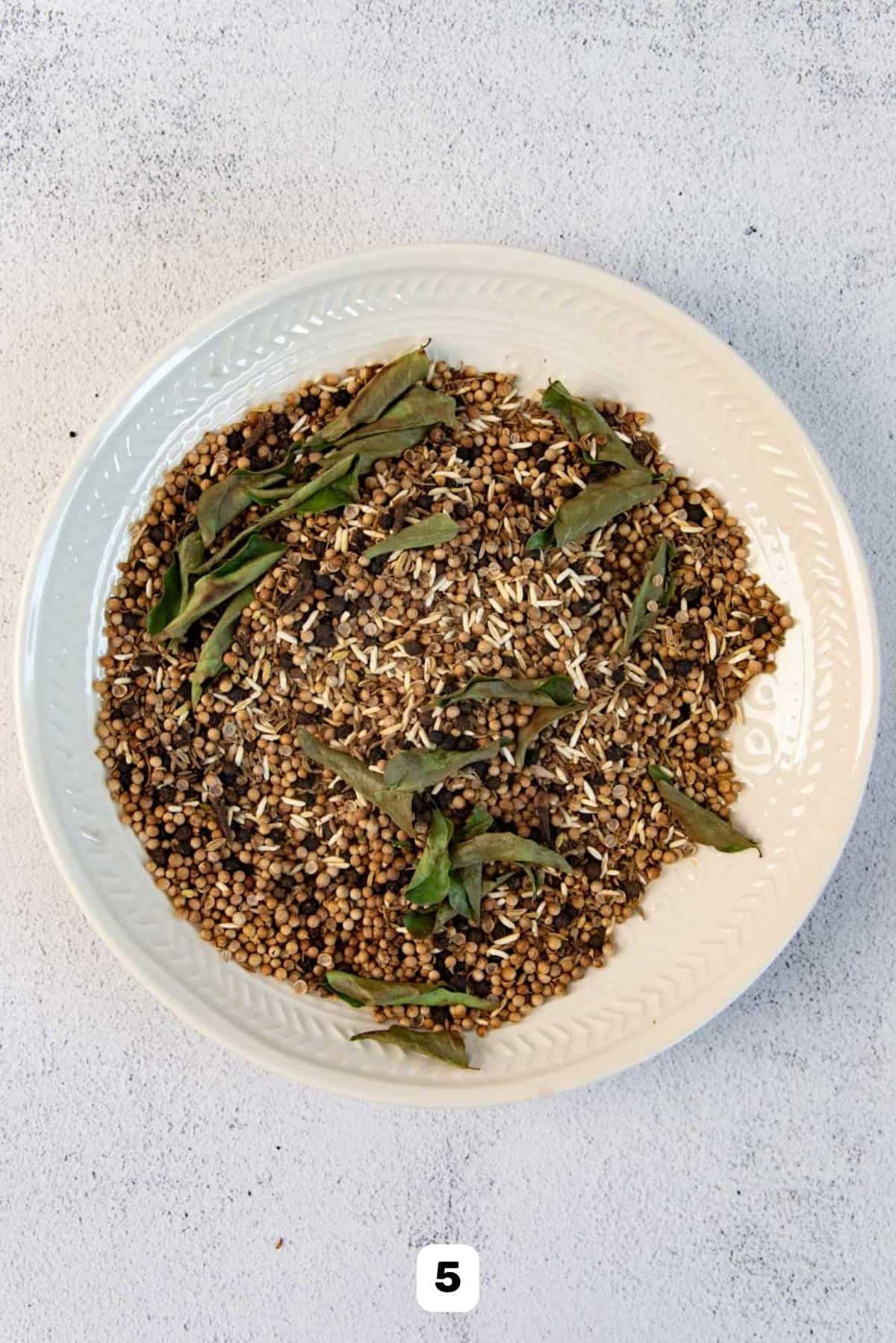
Freshly toasted spices on a plate, cooling down before being ground.

When the spices have cooled down, grind them in a spice grinder. I have my trusted grinder that I’ve been using for 8 years now, and I use this to ONLY grind spices with savory and spicy notes.

Since it’s a smaller grinder, I add the spices in batches until I have the curry powder finely ground and ready to be used (image 6).

Store the curry powder blend in a glass bottle or container with an airtight lid.

A spice grinder filled with ground spices, with whole spices in the background.

Recipe tips

  • Make smaller batches, more often! This will ensure that you always have the freshest flavor from your spices.
  • Preferably use whole spices. They taste better AND are cheaper to buy in bulk.
  • Roasting the spices gives you a deeper, more complex flavor. BUT, to save time, it’s OK to use unroasted curry powder as well.
  • This curry powder is adaptable (within reason). If you don’t like a particular spice, you can add less of it. Keep the main spices, but adjust the other spices, as long as you keep the proportions the same. I sometimes leave out the cloves and mustard if I feel like it. If I’m making a curry for someone who doesn’t love heat, I’d reduce the black pepper a little. I even reduce the cardamom sometimes, but still ALWAYS include some cardamom. I don’t always add curry leaves either.
  • If you’re using pre-ground spices, then the flavor of the curry blend might not be as strong as when using whole spices.
  • Do NOT add salt to your curry powder. Salt will make the spice blend go stale much faster.
Freshly ground spices for Sri Lankan curry powder in a small bowl.

How to use curry powder in your cooking

There are many ways to use curry powder in your cooking.

  • Marinating meats. Curry powder can be added to raw meat to marinate it (like in this meatball curry for example). You can even mix it with yogurt and marinate meat for a curry, or even to grill.
  • To make curries. Obviously. Adding curry powder to meat or vegetarian dishes is a great way to make your favorite curry recipe. Roasted curry powder is perfect for meats, while unroasted is more suitable for vegetable or fish curry. But, I also sauté unroasted curry powder with a little oil to deepen the flavor for meat curries.
  • To finish dishes. Roasted curry powder is fantastic as a finishing spice for dishes. Sprinkle a little unroasted curry powder on top of meat curries, or lentil curry (dhal curry) for a fresh hit of the spices when you serve it to people.
  • Adding spice to any meal. I love using curry powder for other types of meals that are not traditionally “curries”. Add some curry powder on your fried egg for a little extra flavor! Mix the curry powder into your chicken salad or egg salad.
Sri Lankan curry powder in a glass jar, on a plate, with a measuring spoon filled with curry powder.

Storage

Curry powder should be stored in an airtight container. This will prevent the spices from going stale too soon.

While curry powder doesn’t expire, it can go stale over time as the spices lose their potency. The time for this will depend on how fresh the spices were at the start.

If the curry powder is a lacking in flavor a little, you can still use it! But you may have to add more to get the same flavor.

Frequently asked questions

What’s the difference between curry powder and garam masala?

The term curry powder is a generic name for most spice blends. Whereas garam masala is the name of a particular spice blend. Masala means “mix of spices”, so it is a type of curry powder, just with a specific name! It can be used to make curry dishes, but usually other spices are also added to get a good balance of flavor.

Even this particular Sri Lankan curry powder is known as “thuna paha”, but the rest of the world knows it as “Sri Lankan curry powder”.

How to choose a good curry powder

Avoid using curry powders that include sugar and salt. These seasoning blends go stale much faster. Also avoid curry blends that include only turmeric, garlic, ginger, and onion powder (unfortunately several superstores in North America carry these less than mediocre “curry powders”).

Curry powder MUST include other spices such as coriander, cumin, black pepper, or chili powder.

What is a good substitute for curry powder?

A blend of spices is a great substitute for curry powder. Just the mix of coriander, cumin, and cardamom together is a great curry powder.

But please remember that ground turmeric is NOT a substitute for curry powder on its own, because turmeric powder is not the same as curry powder. But you can absolutely add turmeric to your curry powder blend.

Does curry powder expire?

Not really, but it will lose its flavor as the spices become stale and lose their potency. Salt can make the curry powder go stale even faster.

To make curry powder last longer, use whole spices and store the curry powder in an airtight container. Also, make smaller batches (more frequently), so that you have the freshest curry powder at all times.

Curry powder jar spilling out curry powder onto a plate, with whole spices surrounding the jar.

Recipe

Sri Lankan curry powder in a glass jar with all the whole spices used to make it in front of it.
5 from 51 votes

Easy Curry Powder (Sri Lankan Curry powder)

Author: Dini Kodippili
Yield: Makes about 115 g / 1 cup of curry powder
Cuisine: South Asian, Sri Lankan
Sri Lankan Roasted Curry Powder - This roasted curry powder is deeply aromatic and has very robust and complex flavors. The ingredient ratios are easy to remember (4:3:2:1 and 3:2:1), so go ahead and make a big batch and use it any way you like to make flavorful curry dishes!

โ€‰Difficulty:โ€‰

Easy
This authentic Sri Lankan curry powder is deeply aromatic and has very robust and complex flavors. I make this curry powder every week in my kitchen, so you know it's the good stuff! Super adaptable and easy recipe, and can be used to make so many different curries.
Makes about 115 g / 1 cup of curry powder.
EASY – This recipe is easy and perfect for anyone new to curries, or wants to learn more about Sri Lankan and South Asian cuisine.

US based cup, teaspoon, tablespoon measurements. Weightโ€Œ โ€Œmeasurementsโ€Œ โ€Œareโ€Œ โ€Œrecommendedโ€Œ โ€Œforโ€Œ โ€Œaccurateโ€Œ โ€Œresults whenever available.

Common Measurement Conversions
Prep: 20 minutes mins
Cook: 5 minutes mins
Total Time: 25 minutes mins
Print Recipe Rate SaveSaved!
Makes: 16 servings (1 tbsp)

Ingredients:
 

  • 30 g coriander seeds 4 – 5 tbsp
  • 30 g cumin seeds 3 tbsp
  • 20 g black peppercorns 2 tbsp
  • 20 g basmati rice 1.5 – 2 tbsp
  • 5 g green cardamom seeds from about 20 – 30 green cardamom pods. Reduce by half for a more subtle cardamom flavor
  • 6 g fennel seeds about 2 tsp
  • 4 g whole cloves about 20 – 30 cloves. Leave out if you don't like cloves or reduce to 10– 15 for a more subtle clove flavor
  • 4 g black mustard seeds optional, about 1 tsp
  • 16 leaves curry leaves optional, you can use either dried or fresh leaves

Instructions:
 

  • Remove the seeds from the cardamom pods and discard the husks.
    5 g green cardamom seeds
  • Optional (if using fresh curry leaves) – Heat a skillet over medium low heat. When the pan is hot, add fresh curry leaves to dry them out on low heat. Keep moving the leaves around in the skillet so that they dry out evenly, and don't burn. Skip this step if you're not using curry leaves OR if you're using dried curry leaves. Remove the dried leaves and set aside.
    16 leaves curry leaves
  • Place the rice in a dry non-stick pan. Heat over medium heat until the rice starts to turn light brown in color.
    20 g basmati rice
  • Add the rest of the spices and the cardamom seeds to the rice, and pan roast for a further 2 – 4 minutes until the spices start to brown, toast, and become aromatic. The time will vary depending on the heat of your stove and the amount of spices in your skillet.
    30 g coriander seeds, 30 g cumin seeds, 20 g black peppercorns, 4 g whole cloves, 6 g fennel seeds, 4 g black mustard seeds
  • Keep moving the spices around to prevent them from burning. I like to shake the pan to keep the spices moving, and doing this off heat from time to time will also help to evenly toast the spices. Make sure not to burn the spices, as this will result in a bitter curry powder.
  • Remove from the heat and place all the toasted spices in a plate or bowl for the spices to cool down.
  • Add the dried curry leaves to the spices and mix once or twice to allow the spices to cool down faster.
  • Once the spices cool down, use a spice grinder (or a mortar and pestle) to grind the spice mix into a powder (in batches if needed), and mix well. Store in an airtight container.
  • Use as needed.

Recipe Notes

Unroasted curry powder

Unroasted curry powder is the same as this, but the spices are not toasted in the pan. They are simply placed in a spice grinder and pulsed until finely ground.ย 

Which spices are the most important?

Coriander, cumin, black pepper, cardamom. Other ingredients can be left out if you don’t have them, or reduced to your liking.ย 
You can also use yellow mustard instead of black/brown mustard (if that is all you have access to).

Notes about clovesย 

The ingredient ratio here is more of a guideline. If you don’t like cloves, please feel free to leave them out or add less.
If you’re sensitive to the flavor of cloves, feel free to leave them out.ย 
The same goes for other spices as well.ย 

What is my curry powder is bitter?

If you find your curry powder to be bitter, it’s most likely because you toasted the spices for too long and burned them.ย 
It can also be bitter if your spices have gone rancid (especially mustard).ย 

How long can I keep this?

Please note that ground spices don’t retain their freshness as well as whole spices do. This is why I prefer making small batches of this with whole spices when needed.
Every time I make the curry powder, the longest it has lasted in my kitchen is 2 weeks before I need to make a new batch, but usually I make this once a week.
I make a double batch because we make a lot of curry recipes at home. I personally prefer making small batches every time, to keep each batch fresh at all times.

Nutrition Information:

Serving: 1tbsp Calories: 25kcal (1%) Carbohydrates: 4g (1%) Protein: 1g (2%) Fat: 1g (2%) Saturated Fat: 0.1g (1%) Polyunsaturated Fat: 0.2g Monounsaturated Fat: 1g Trans Fat: 0.001g Sodium: 5mg Potassium: 86mg (2%) Fiber: 2g (8%) Sugar: 0.1g Vitamin A: 107IU (2%) Vitamin C: 41mg (50%) Calcium: 52mg (5%) Iron: 2mg (11%)

โ€œThis website provides approximate nutrition information for convenience and as a courtesy only. Nutrition data is gathered primarily from the USDA Food Composition Database, whenever available, or otherwise other online calculators.โ€

Tag me on Instagram!I love seeing what youโ€™ve made! Tag me on Instagram at @TheFlavorBender or leave me a comment & rating below.

More flavor-packed curries and Sri Lankan dishes

  • Chicken curry
  • Crab curry
  • Shrimp curry (prawn curry)
  • Black pork curry
  • Cashew curry (vegan)
  • Mango curry (vegan)
  • Spicy apple curry (vegan)
  • Curried beef roti
  • Mushroom curry
  • Jackfruit curry
Dini Kodippili Avatar

About

Dini Kodippili

Dini Kodippili is a professional food writer, recipe developer, food photographer, cookbook author, and baker. Dini has been featured on HuffPost, Cosmopolitan, Forbes, Delish, Food & Wine and more. Learn More

I love hearing from you! Submit your question or recipe review here.

5 from 51 votes (3 ratings without comment)

Leave a Reply Cancel reply

Your email address will not be published. Required fields are marked *

Made this? Rate this recipe:


This site uses Akismet to reduce spam. Learn how your comment data is processed.

190 responses

  1. Valerie Heath
    October 14, 2019

    Hi can I use Brown mustard seeds as opposed to black, as i have a big bag of brown.

    Reply
    1. Dini
      October 14, 2019

      Hi Valerie!
      Yes you can use either black OR brown mustard seeds in South Asian cooking. These can be used interchangeably without any major changes to flavor.
      Hope that helps!

      Reply
      1. Gwen Nicol
        April 11, 2020

        Hi Dini, thanks for your recipe! I only have yellow mustard seeds, will these be ok ? XxG

        Reply
        1. Dini
          April 11, 2020

          Hi Gwen!
          Yes you can use that instead! Yellow mustard seeds are milder than the black ones, but I often leave out the mustards seeds if I can’t find any too. ๐Ÿ™‚
          Hope that helps!

          Reply
  2. Shurleea Harding
    September 14, 2019

    5 stars
    I want to buy a tin of ten Sri Lankan spices in a tin fro a Christmas Present fro ` Sri Lankan family, what would you recommend?

    Reply
    1. Dini
      September 14, 2019

      Hi Shurleea
      I’m so sorry, but I’m not sure what you are looking for? Are you looking to make this spice blend in a tin for Sri Lankans? Or individual spices to gift Sri Lankans?
      If it were me, I would always appreciate spices that I can’t always get my hands on easily, as Sri Lankans usually keep a well stocked spice cupboard. Personally I am always thrilled to get a gift of Ceylon Cinnamon or Saffron, but these spices can be pricey. Other spices could be black pepper, cardamom, bay leaves, pandan leaves.
      Hope that helps! Let me know if that doesn’t answer your question.

      Reply
  3. Walter Runte
    September 4, 2019

    How well does it work if you don’t roast the spices and just grind them together?

    Reply
    1. Dini
      September 5, 2019

      Hi Walter!
      That is fine ๐Ÿ™‚ I store unroasted curry powder for when I make seafood curries. OR I would pan fry the curry powder that I need in the pan before making the curry. You can still cook any curry with unroasted curry powder, but roasting does deepen the flavor which is especially nice for meaty curries.
      Hope that helps!

      Reply
    2. Prosper Bemunuge
      September 12, 2019

      Hello! What a great recipe it was. Thousand times better than what is found in the grocery store. I made your shrimp curry using your roasted curry powder and it turned out great and delicious. Thank you for sharing the secret of making the best Sri Lankan Shrimp Curry.

      Reply
      1. Dini
        September 15, 2019

        So happy you liked the curry powder Prosper! ๐Ÿ™‚ Thanks so much for letting me know!

        Reply
  4. Connor Smit
    August 31, 2019

    I love your recipes! Just made this, although in the very last seconds it was on the stove I thought I smelt a slight burning.

    It still smells okay now, but I’m worried that the slight burn taste will come through. What do you think? Start over or see how it tastes?

    Reply
    1. Dini
      August 31, 2019

      Hi Connor! Thank you so much ๐Ÿ™‚
      It’s hard to say how much it would affect the curry powder because it depends on how much it was burnt. If it burnt quite a bit, then the curry could have that taste. However, I have burnt curry powder a little a few times when I’m cooking it too, and still got great tasting curries though! ๐Ÿ™‚

      Reply
  5. Sian Taylor
    July 13, 2019

    Can you sub the rice for something else? What will happen if its left out?
    I am trying not to eat any carbs/starch.

    Reply
    1. Dini
      July 13, 2019

      Hi Sian!
      You can leave out the rice ๐Ÿ™‚ It acts as a thickener for the curry, so it doesn’t really add flavor.
      Hope that helps!

      Reply
  6. Rachael Forbes
    June 6, 2019

    I am really looking forward to trying this to hopefully impress my guest on Saturday ๐Ÿ™‚

    Apart from basmati rice and roti, what else would you seve this curry with?

    Reply
    1. Dini
      June 6, 2019

      Hi Rachael!
      I like to serve curry with a few side dishes. If you’re serving a fish or meat curry, then a vegetable side dish is a must. I like to go with something sweet like apple curry, or my favorite beetroot curry. I also like to serve it with a side salad (with lettuce, tomatoes and red onions) or pappadums or fried chili on the side too.

      Reply
  7. Grace
    June 5, 2019

    Iโ€™ve used it with chicken and with pork. Youโ€™re right – itโ€™s the best curry powder in the world. I hope to make the non-roasted version soon for crab. Do
    I do anything different or is the recipe exactly the same except for the roasting part? And thank you for sharing this.

    Reply
    1. Dini
      June 6, 2019

      Hi Grace!
      I’m so glad you love this curry powder as much as we do! Thank you so much for letting me know.
      The only thing that’s different is the roasting part ๐Ÿ™‚ You can add a little extra fennel if you like too. Let me know how the crab curry comes out!
      Cheers, Dini

      Reply
  8. Sarah Hilton
    April 6, 2019

    5 stars
    Simply wonderful – Thank you for a great recipe

    Reply
    1. Dini
      April 6, 2019

      Thank you for letting me know Sarah! Glad you liked the recipe. ๐Ÿ™‚

      Reply
  9. Patrina
    February 20, 2019

    Do you have to use basmati rice? I only have jasmine. Can’t wait to try it…

    Reply
    1. Dini
      February 20, 2019

      Hi Patrina, I haven’t used jasmine rice myself, but that should work too. Rice helps thicken your curries a little more when you cook with this curry powder, plus it acts as a filler to make your curry powder last a bit longer. I hope you like it! ๐Ÿ™‚

      Reply
    2. KE
      December 19, 2019

      Hi! I just grounded and sifted all the spices and just have a question. I used a coffee grinder (not electric) and once I sifted everything there was a lot left over (looked like mainly shells, some rice and curry seed). I got a good amount of powder but is it normal to have a lot you sift out?

      Reply
      1. Dini
        December 19, 2019

        Hi KE
        I never sifted my curry powder. I use an electric coffee/spice grinder (one of the cheap ones) or a mortar and pestle to grind the spices to a fine powder. I don’t recommend using a manual coffee grinder if it’s not able to produce a finely ground powder. The whole spices you throw away will be a waste too. I hope that helps!

        Reply
  10. Anton
    February 1, 2019

    Hi, I am a student at York University in Toronto, Canada. Thanks for sharing this recipe, I am writing a 4000 level essay on your Chicken curry & spice .

    Reply
  11. Sandy Gungan
    October 1, 2018

    Hi Dini, there seems to be a difference in the recipe in the article and the one at the end in the box. The first says 3 tsp cloves ad 2 tsp cardomom, whereas the second recipe says just 2 tsp cloves and 1 tsp cardomom. Which version is the correct (preferred) one. Thanks Sandy

    Reply
    1. Dini
      October 1, 2018

      Hi Sandy,
      Thank you for letting me know. I’ve fixed the recipe to reflect the original ratios. But I have used both amounts before, and love it either way. If you’re not a fan of clove flavor, then you can reduce the amount of cloves you add, and the same goes for the cardamom too. ๐Ÿ™‚
      I hope that helps.
      Cheers, Dini

      Reply
  12. Roy
    August 18, 2018

    When you say “2 Black Peppercorns and Uncooked Rice” what does that mean? 2 of each? or mix peppercorns & rice together 50/50? or what? I don’t understand. Also – just normal Basmati rice?

    Reply
    1. Dini
      August 18, 2018

      Hi Roy,
      Yes, it’s 2 of each, 2 tbsp of black peppercorns and 2 tbsp of rice. This is mentioned in the recipe. And yes, it’s just regular uncooked basmati rice.

      Reply
      1. Roy Brophy
        August 18, 2018

        Hi Dini,
        Again – thanks for the very speedy response. I notice you have updated the recipe! That’s excellent service – well done.
        When I find an error in an online recipe followed by comments, and no one else has noticed – I wonder what I’m doing wrong – am I being nit picky! Black/green cardamoms not being specified is very common, as is items in the ingredients that are not mentioned in the method!
        Thanks,
        Roy

        Reply
        1. Dini
          August 18, 2018

          Not at all Roy. ๐Ÿ™‚ Thanks so much for pointing that out to me. It absolutely helps make the recipe and post that much better and robust, and I really appreciate it when I receive comments like that from my readers! So thanks again, and I hope you enjoy this curry powder! ๐Ÿ™‚
          Cheers,
          Dini

          Reply
  13. Roy Brophy
    August 17, 2018

    Hi – looks good. One question – black or green cardamoms?

    Reply
    1. Dini
      August 17, 2018

      Hi Roy
      This curry powder uses green cardamoms. Thank you ๐Ÿ™‚

      Reply
      1. Roy Brophy
        August 17, 2018

        Thanks for the speedy response!
        Might be worth changing the recipe – black ones would make quite a difference!

        Reply
  14. K
    July 3, 2018

    How much meat can this be used with?

    Reply
    1. Dini
      July 6, 2018

      Hi K
      This makes roughly about 1/2 cup of curry powder. Which lasts me about 4 – 6 curries, depending on how I use the curry powder.

      Reply
    2. Sherwin Drieberg
      April 30, 2020

      5 stars
      Can you please tell me how much of the curry powder that would be used per pound of Beef or Chicken please.

      Reply
      1. Dini
        April 30, 2020

        Hi Sherwin!
        This will be dependent on the meat and what spice level of curry you want! I greatly vary how much I add to my own curries depending on the taste that I am craving for.
        As a guide, you can use this recipe, where I use about 2 1/2 tbsp for 2 pounds of bone-in chicken. However in this pork curry, where other spices play a bigger role, I only use about 1 heaped teaspoon for 1 1/2 pounds of pork meat.
        I hope that helps!

        Reply
  15. Alia
    March 18, 2017

    Thankyou, stank the house out but really worth it, delicious.

    Reply
    1. Rabi
      November 8, 2017

      Psst. Telling people that a crucial ingredient to their cuisine stinks is pretty offensive.

      Reply
    2. Olive
      December 25, 2017

      5 stars
      The house didn’t stink – brought back memories of mum’s cooking of yesterday years.
      Also the aroma helps clear your sinuses.

      Reply
      1. Olive
        December 25, 2017

        Oops! Meant yester years …

        Reply
  16. othman
    February 15, 2017

    5 stars
    Thank you for the tips. Definitely i will try.

    Reply
  17. cakespy
    November 14, 2016

    What an informative post!! I love how you went way beyond the recipe and explored technique, too. I love spice mixes so this is right up my alley!

    Reply
  18. Bam’s Kitchen
    October 30, 2016

    5 stars
    Don’t you just love the smell of the roasting spices and of course the fun popping sounds. Great little combo of spices and I have everything in my home to make a batch right now. Just pinned!

    Reply
  19. Michelle
    October 30, 2016

    Dini- I love curry and this sounds amazing!
    Thanks for hosting another fun filled party!
    Michelle

    Reply
  20. Jennifer
    October 28, 2016

    I have just recently started eating curry and I still only used a golden curry paste from a jar. I think I can make my own now and I’m sure it will be 1000 times better! Love the new site too!

    Reply
1 2 3 … 6
Newer Commentsโ†’

Hey There!

Hi! Iโ€™m Dini, a third culture kid by upbringing and a food-geek by nature. I was born in Sri Lanka, grew up in New Zealand and lived in Australia, and then the US, before moving to and settling down in Canada. My food is a reflection of those amazing experiences!

Read More
Front cover of the Secret Layer Cakes cookbook by Dini Kodippili.

The Flavor Bender

Cookbook

Buy now on Amazon!

Recipe Basics

  • How To Make Perfect Choux Pastry

    How To Make Perfect Choux Pastry

  • Flaky All Butter Pie Crust Recipe

    Flaky All Butter Pie Crust Recipe

  • How To Make Homemade Marshmallows (Foolproof Guide)

    How To Make Homemade Marshmallows (Foolproof Guide)

  • The Best Homemade Bread (White Bread Recipe)

    The Best Homemade Bread (White Bread Recipe)

  • Homemade French Croissants (Step By Step Recipe)

    Homemade French Croissants (Step By Step Recipe)

  • The BEST Pavlova Recipe (Step by step recipe and video)

    The BEST Pavlova Recipe (Step by step recipe and video)

Featured On

Master the science of baking!

Get my FREE Printable Charts!

So youโ€™ll know how to substitute cake pans of different shapes, sizes & volumes, and how to convert ingredient measurements in a pinch!

Must have resources for all pro bakers, novice bakers, and aspiring bakers alike!

Download now!

Reader Faves

  • How to make the Best Instant Pot Short Ribs

    How to make the Best Instant Pot Short Ribs

  • Perfect Quick and Easy Rough Puff Pastry

    Perfect Quick and Easy Rough Puff Pastry

  • The Best Spicy Sweet Chili Sauce (Easy Recipe!)

    The Best Spicy Sweet Chili Sauce (Easy Recipe!)

  • The Best Homemade Bread (White Bread Recipe)

    The Best Homemade Bread (White Bread Recipe)

The Flavor Bender

I love baking, cooking, experimenting with flavors and ingredients, and passing on all my tips and tricks to you!

Read More

About

Meet Dini
My Book
Work With Me
Contact

Browse

Recipes
Measurement Guide
Baking How-Toโ€™s
Shop My Faves
Privacy
Disclosure
Terms

Branding by MRD

Theme by OC

Back to Top
  • Facebook
  • Instagram
  • Pinterest
  • X
  • YouTube
4526 shares

Rate This Recipe

Your vote:


A rating is required
A name is required
An email is required

Recipe Ratings without Comment

Something went wrong. Please try again.