

About
My Cookbooks
Work With Me
Contact
  • Facebook
  • Instagram
  • Pinterest
  • X
  • YouTube
The Flavor Bender

Master the Science of Delicious

  • Recipe Index
    • All Recipes
    • Desserts
      • Cakes & Cupcakes
      • Candy & Bite Sizes
      • Chocolate
      • Cookies, Brownies & Bars
      • Frozen Desserts
      • Fruit Desserts
      • Puddings & Custards
      • Dessert drinks
      • No Bake
      • Pastries & Breads
      • Sweet Syrups & Spreads
      • Tarts & Pies
      • Cheesecakes
      • Healthy sweets
    • Breakfasts
      • Tarts, Quiches, & Pies
      • Waffles, Pancakes & Crepes
      • Quick Breads, Scones & Muffins
      • Breakfast Sandwiches
      • Breakfast Pastries
      • Eggs
      • Breakfast & Brunch Drinks
      • Make Ahead Breakfasts
      • Healthy Breakfasts
      • Coffee and Tea drinks
      • Breakfast Smoothies & Juices
      • Breakfast Sides
      • Casseroles
      • Jams & Spreads
    • Courses
      • Main Meals
        • Bread, Sandwiches & Burgers
        • Curries
        • Salads
        • Roasts & BBQ
        • Soups & Stews
        • Casseroles
      • Bread
      • Lunch
      • Beverages
      • Appetizers & Tapas
      • Sides
      • Dips & Condiments
      • Tea Time & Snacks
      • Desserts
      • Meal Prep
      • Cocktails
      • Pet Friendly Recipes
    • Cuisines
      • American
      • European
      • Australasian
      • Sri Lankan
      • East Asian
      • Mexican
      • Middle Eastern
      • South Asian
    • Sri Lankan
      • Main Meals
      • Drinks
      • Desserts
      • Breakfasts
      • Snacks
    • Skill Level
      • Easy
        • Easy Desserts
        • Easy Cooking
        • Easy Breads
        • Easy Breakfasts
        • Easy Dinners
      • Intermediate
        • Intermediate Desserts
        • Intermediate Cooking
        • Intermediate Breads
        • Intermediate Breakfasts
        • Intermediate Dinners
      • Advanced
        • Advanced Desserts
        • Advanced Cooking
    • Recipes by Season
      • Christmas
      • Fall & Winter
      • Halloween
      • Spring & Summer
      • Thanksgiving
      • Valentines Day
    • Recipes by Diet
      • Dairy Free
      • Eggless
      • Gluten Free
      • Paleo
      • Vegan & Vegetarian
    • Recipe Basics
      • Baking Basics
      • Cooking Basics
      • Baking & Cooking 101
  • New? Start Here
  • Measurement Conversions
  • How-To Posts
  • About
  • My Cookbooks
  • Work With Me
  • Contact
The Flavor Bender   ›   Recipes   ›   Recipes by Cuisine   ›   East Asian Recipes   ›   Perfect Dumpling Dough (For Beginners)

Perfect Dumpling Dough (For Beginners)

Author:

Dini Kodippili


Jump to Recipe


Updated: 3/21/2021
Total Time3 hours hrs 32 minutes mins
Quick and Easy Recipes
East Asian Recipes
Dumpling dough social media

Homemade dumpling dough is a thing of beauty! It’s a labor of love, but absolutely worth it. Here, I’m showing you how to make dumpling dough for dumplings and potstickers. An easy to follow, complete guide for beginners!

The only dumpling dough recipe you’ll need to make perfect dumplings or potstickers!

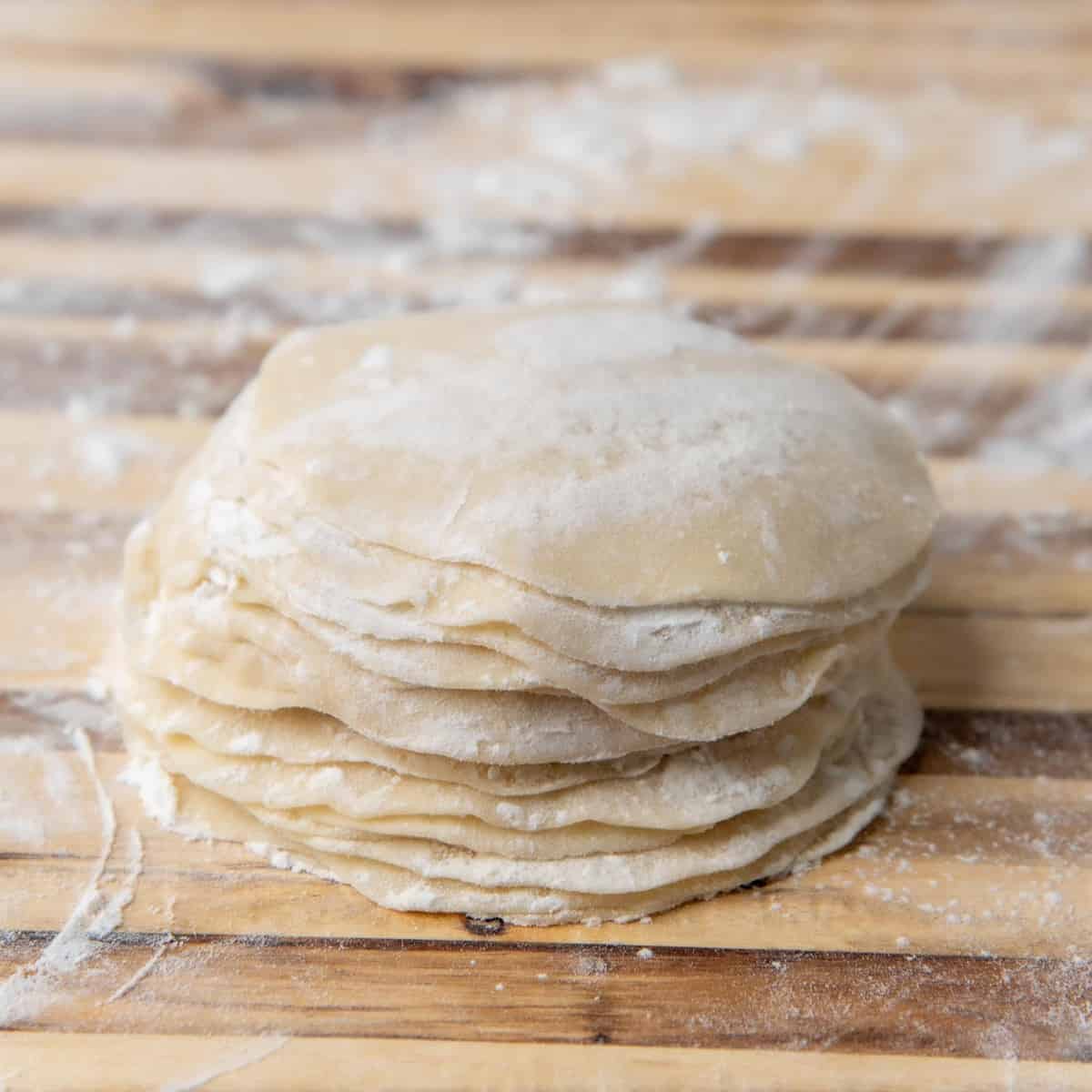
A stack of dumpling wrappers
Contents
 [hide]
  • Dumplings vs potstickers
  • How to make dumpling dough
  • How to make dumpling wrappers
  • How to store dumpling dough and/or wrappers
  • Tips on making perfect dough for dumpling/potsticker wrappers
  • Why I love this recipe

This post was first written in 2014, so an update with new photos and information is long overdue.

I really enjoy making dumplings for my family. However, I was still bit of a novice at it 7 years ago. The technique I used to make dumplings at the time served me very well. But over the years, my dumpling making skills have improved greatly!

But everyone’s gotta start somewhere. It’s not easy making dumpling wrappers the way pros do when you’re a complete novice. So, here’s my beginner’s guide to making dumpling dough for dumpling wrappers, along with ways to improve your skills over time!

Dumplings made with homemade dumpling dough, and wrappers

But do keep in mind, this isn’t a “quick” recipe. It’s not a short cut. Making dumplings is not a fast process. You got to put the effort in to reap the rewards. You could recruit the help of your family, and make a big batch of dumplings at once. I always make enough dumplings for at least 3 – 4 meals in one go, and then freeze the extra.

So make this a weekend project to do with friends or family. OR while you catch up on your favorite TV show. Precisely what I do whenever I make a big batch of homemade boba pearls (tapioca pearls) too!

What’s the difference between dumpling wrappers and potsticker wrappers?

There are two types of dumpling dough.

  • Hot water dough
  • Cold water dough

Traditionally, hot water dumpling dough is used to make potstickers and steamed dumplings (as well as Chinese scallion pancakes). This produces dumpling wrappers that are more delicate and can be rolled very thinly.

Cold water dough is used to make boiled dumplings. This dough produces wrappers that can be thicker and more sturdy. So it’s great for boiling.

I mostly make hot water dough because I LOVE potstickers!

How to make the dough for dumpling wrappers

Which type of flour is best for making dumpling dough?

You can buy flour that is specifically made for dumpling dough. This flour produces snowy white dumpling wrappers and have the right protein content to make soft, delicate dough.

However, if you live in an area where you can’t find this specialty dough (like me), you can mix 50% cake flour and 50% AP flour.

I make dumpling dough with all AP flour more often because that’s what I have available, and have great results each time.

Type of water to use

The ratio of flour to water is usually the same for either hot water or cold water dough.

For hot water dumpling dough, you have the option of mixing boiling water first, followed by regular water. This makes the dough a little easier to knead by hand, because regular temperature water cools down the dough a little.

But you can also add all hot water and mix the dough. Just be careful since the dough will be very hot.

How to mix the flour and water

Traditional method

Usually the dough is mixed in a bowl, first using chopsticks and then using your hands to knead until you achieve the right consistency.

There is one trick to avoid kneading for too long. Once the flour absorbs the water, cover the bowl containing the shaggy dough and let it rest for about 15 – 30 minutes. This softens the dough, so that it’s easier (and faster) to knead to a smooth ball.

Once the dough is kneaded, wrap it with plastic wrap, or place it in a ziploc bag, and let it rest for about 30 – 60 minutes. This will make the dough soft and easy to work with.

Flour in a bowl
Mixing hot water into the flour with chopsticks
Clumps of flour after water has been added
The dough mixed until a ball is formed
A rough looking dough ball covered with plastic wrap in the bowl
A smooth kneaded dumpling dough in the bowl

Stand mixer method

You can skip the chopsticks and hand kneading method, and use a stand mixer to knead the dough as well. Just note that if the mixer bowl is too big for a small amount of dough, it won’t be able to knead the dough effectively. The dough hook has to be able to catch the dough and move it around.

Food processor method

I use the food processor to bring the dough together by streaming the water into the flour while the food processor is running. However, with this method, I’d still need to knead the dough by hand to make it smooth.

Flour formed into clumps in the food processor

Which method do I use?

The food processor is how I began the fun journey of making dumpling dough, but quickly realized that making it by hand was more preferable. Unless I’m making a double batch of dumpling dough, in which case I’ll use a stand mixer to make the kneading process easier.

Making dumpling wrappers

Once the dough is made, and rested, you’re ready to make the wrappers.

There are two ways to make dumpling wrappers. I started off with the beginner’s method described below, because I just couldn’t roll out the wrappers the traditional way. But after plenty of practice over the years, I now make dumpling wrappers the traditional way.

Beginner method to making dumpling wrappers

Here you’ll be using a pasta sheeting machine to roll out the dough to the proper thickness for dumpling dough.

I divide the dough into 4 and work with smaller portions. Just like with pasta, the dough is passed through the pasta maker, starting with the thickest setting, and then make it thinner and thinner until it’s about 2 – 3 mm thick.

Once rolled out, use a large cookie cutter (about 4 – 4.5 inches), and cut out circles from the dough. These will be your dumpling dough wrappers.

Make sure to dust the wrappers well (with flour) before stacking them to prevent them from sticking to each other.

Pros

  • It’s an easy method for anyone to do, provided you have a pasta roller.
  • Each dumpling wrapper will be uniform in shape.

Cons

  • There’s some dough wastage.
  • Unlike traditional dough wrappers, the middle isn’t thicker than the edge here. So it’s more delicate to use and not as “stretchable” as the classic wrapper.
Dough being passed through the pasta machine
A sheet of dumpling dough
Dumpling wrappers being cut from the dough sheet
Thinning out the edges of the dumpling wrappers with fingers
Dumpling wrappers made with the pasta machine

Traditional method of making wrappers out of dumpling dough

The traditional method might be a little harder for beginners. But it certainly gets easier with practice!

The dough is divided into 4, so that you only work with a smaller portion at a time. Place the other portions in a ziploc bag or cover with plastic wrap to prevent them from drying out.

Dumpling dough divided into 4 pieces

Roll the dough portion into a log, with an equal width throughout (as pictured below). Cut each log into about 8 pieces (for larger dumpling wrappers) or 9 -10 (for smaller dumpling wrappers).

Cover all the small portions of the dough that you’re not working with (with a cloth napkin or plastic wrap) as well, to prevent them from drying out.

Rolling, the dough into a rope, and cutting portions
Dumpling dough cut into portions

Take one small portion of the dough, and flatten it with your palm. Make sure your work surface and the dough are always lightly floured to prevent the dough from sticking. Use a small rolling pin to roll it out until it’s about 3 inches in diameter, while maintaining the shape of a circle as much as possible.

Keep rolling it out until it’s about 4 – 4.5 inches in diameter, while maintaining the circle shape. It doesn’t have to be a perfect circle though.

The traditional way is to hold one edge of the wrapper with your fingers, while placing the other edge on your work surface. Then use a rolling pin to roll out that one edge. Please see photos and video below for reference.

Rotate the dumpling wrapper with your fingers to thin out the edge right around the circle. The final wrapper will be slightly thicker in the middle, with a thinner edge, and be about 4 – 4.5 inches in diameter.

A portion of the dumpling dough on a worksurface
The dough flattened by the palm of your hand
Roll out the dough a little, to make it easier to hold
How to hold the wrapper while rolling it out, and rotating it to make dumpling wrappers

It’s totally OK if your dumpling wrappers aren’t perfect circles. I’ve made hundreds (if not thousands) of dumplings with this dough, and my wrappers aren’t always perfect circles.

Make sure the wrappers are dusted well with flour, so that they don’t stick to each other. I prefer not to stack them directly on top of each other, and instead, I stagger them.

Repeat this process with the other dough portions.

A stack of dumpling wrappers

Pros

  • These wrappers have a thicker middle and a thinner edge. This makes the wrappers stronger in the middle (where the filling goes), with an edge that’s not too thick even after being pleated.
  • There is no dough wastage.
  • Can be quicker to do once you get the hang of it.

Cons

  • Needs practice to get it right, and to do it quickly.
  • May take longer for beginners.
  • The wrappers may not all be perfect circles, nor identical (at least until you become more familiar with the technique).

Video on how to roll out dumpling wrappers

Pleating techniques

Once you’ve made the dumpling wrappers with the dumpling dough, and your filling is ready, it’s time to make dumplings!

There’s a number of ways to seal the filling in the dumpling wrappers. This ranges from very easy to elaborate and advanced. In this post, I’ll show you 4 ways to seal or pleat your dumplings.

If your wrappers are dry, you may need to use some water to help seal the edges. But I find that wrappers made with homemade dumpling dough don’t need any water, while store-bought wrappers may need some water to help seal properly.

Beginner

For beginners, you don’t need to worry about creating pleats to seal your dumplings.

You can simply fold over the dumpling wrapper, and seal the edges to form a tight seal.

If you want to create crescent shaped dumplings with a simple seal,

  1. Fold over the dumpling wrapper and seal the edge in the middle.
  2. Then, hold the dumpling in both hands, with the two ends of the wrapper pressed between your thumb and the base of your index finger on either hand.
  3. Press the ends together with your thumbs (against your index fingers). See the short video clip below to see how it’s done.

Advanced

There are many other ways to seal dumplings that you made with either homemade dumpling dough or store-bought wrappers.

Here I’ll just go through a few of these folding styles.

Bi-directional pleated dumplings

These dumplings are first folded in half, and sealed in the middle only. Then they are pleated in both directions towards the middle. About 3 – 4 folds on either side are more than enough, if evenly spaced out.

This is my favorite way to prepare dumplings, whether I buy pre-made dumpling wrappers, or make my own with my dumpling dough. See video clip below for reference.

One directional pleated crescent shaped dumplings

Here you pleat the edge of the dumpling wrapper in one direction. Start from one end and pleat toward the other end. You don’t need a large number of pleats for this – about 5 to 8 pleats in one direction should do it. With practice, you will get better at evenly spacing out the pleats. See video clip below for reference.

Braided dumplings

This is a bit more difficult, and will require practice. But they do look absolutely beautiful when prepared this way!

Here’s a video to show you how I do it.

How to store dumpling dough and/or wrappers

I don’t normally store dumpling wrappers on their own. This is because they stick together very easily when stored for an extended period of time.

You could store them this way if you place wax paper between each wrapper to prevent them from sticking to each other. However, I simply prefer to make dumplings with the wrappers, as soon as I make them with my dumpling dough.

Once the dumplings are made, the can be frozen in batches, for months (that is if you don’t polish ’em off before that!).

How to freeze homemade dumplings

Line a baking tray with parchment paper, and place the dumplings on the tray, while making sure they are not touching each other. Then, loosely cover the tray with plastic wrap (or with a second baking tray, making sure it’s not crushing the dumplings).

Place the tray in the freezer for 2 – 4 hours (depending on the freezer and how big the dumplings are). When the dumplings are quite solid to the touch, place your homemade dumplings in a freezer bag, and store in the freezer until you’re ready to cook them.
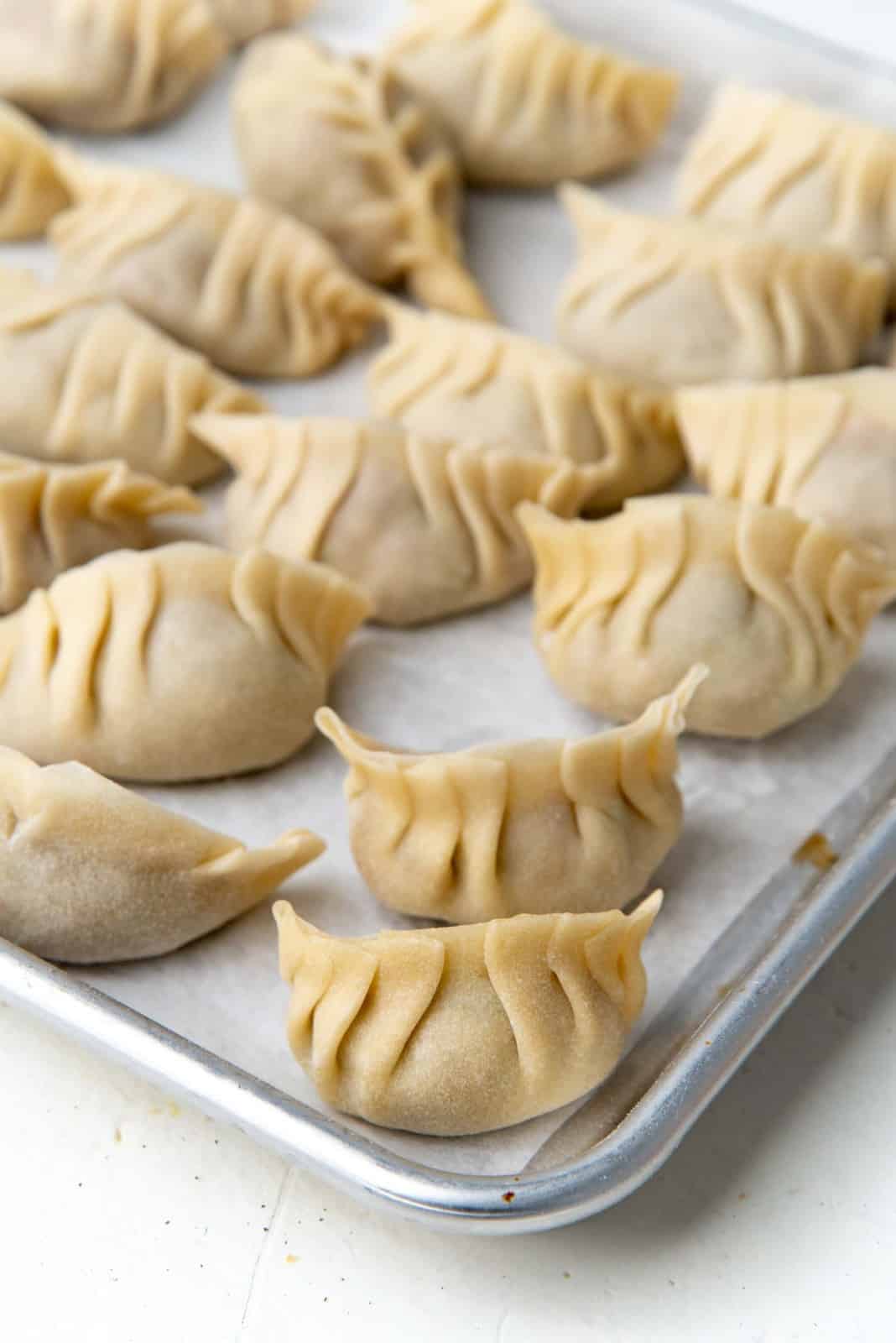
Folded dumplings on a lined tray

Tips on making perfect dough for dumpling / potsticker wrappers

  • Don’t add too much water. This leads to dumpling dough that is too soft. They need to have “ear lobe” softness. Not any softer or stiffer.
  • Allowing the dough to rest will make it easier to roll out your dumpling wrappers.
  • Dust your dough and work surface as you go. It’s important for the work surface to be lightly floured so that the dough doesn’t stick to it (or to the rolling pin), as you work quickly to roll out the wrappers. If the wrappers stick while being rolled out, it could distort the wrappers.
  • Make an evening of making dumplings! Making dumpling dough and homemade wrappers is a time-consuming process. But if you make a big batch at once, you can store these in the freezer for quick and easy meals for a good long while!

Why I love this recipe

I LOOOOVE eating dumplings! Homemade dumplings made with homemade dumpling dough is just that much better than store-bought!

The wrappers are silkier, softer, and all-around more delicious. They are a labor of love, with a fantastic pay-off!

Do I still buy store-bought dumplings? Sure, I do! But when I do make homemade dumplings or potstickers, I always enjoy them so much more, and I also make enough to last us for at least 3 or 4 meals. I even get my husband to help with the pleating.

You can also make a variation of fillings, so that you have a variety of dumplings and flavors to enjoy. To differentiate between the fillings, pleat each type of dumpling differently, before freezing.

And once you’re comfortable with making classic dumpling dough, you can get more creative and make colored dumpling dough too! Like this spinach dumpling dough that is naturally green, or replace some of the water with vegetable juice to make other naturally colored dumplings.
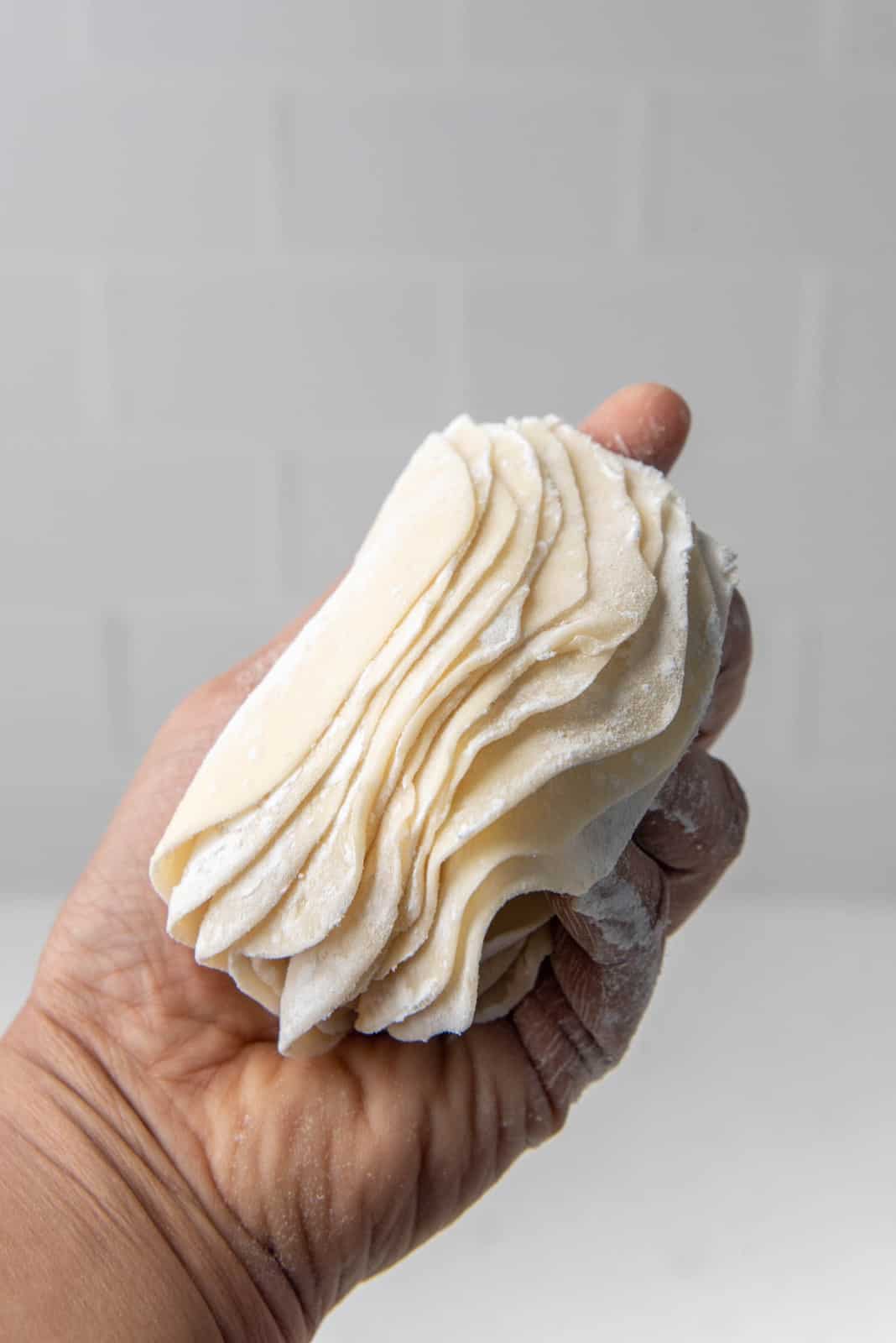
A stack of dumpling wrappers being held in a hand

Recipe

5 from 31 votes

Homemade Dumpling Dough

Author: Dini Kodippili
Yield: About 32 – 36 wrappers
Cuisine: Chinese, East Asian, Japanese, Korean
Dumpling dough social media

 Difficulty: 

Easy
Learn how to make perfect dumpling dough for potsticker and dumpling wrappers! The perfect guide for beginners with videos, and tips & tricks!
EASY & INTERMEDIATE – This is a beginner's guide to making perfect dumpling dough and wrappers for homemade dumplings. Includes a non-traditional method to making dumpling wrappers, that's easy for beginners. Also includes a guide to improve your skills to make dumpling dough and wrappers the traditional way.
This is an involved but easy recipe. Making wrappers and filling them to make dumplings is time consuming, so make sure you have a few hours to spare.
US based cup, teaspoon, tablespoon measurements. Common Measurement Conversions. Weight measurements are recommended for accurate results. The precise water amount will vary, so go by the feel of the dough when adding water.

US based cup, teaspoon, tablespoon measurements. Weight‌ ‌measurements‌ ‌are‌ ‌recommended‌ ‌for‌ ‌accurate‌ ‌results whenever available.

Common Measurement Conversions
Prep: 2 hours hrs
Cook: 2 minutes mins
Resting time: 1 hour hr 30 minutes mins
Total Time: 3 hours hrs 32 minutes mins
Print Recipe Rate SaveSaved!
Makes: 32 wrappers

Ingredients:
 

  • 300 g all purpose flour (or a mix of 50% cake flour and 50% AP flour)
  • 175 – 200 ml boiling water see recipe notes – use room temperature water if you're making boiled dumplings
  • ¾ tsp salt
  • Extra flour for dusting

Instructions:
 

By hand
  • In a bowl, mix the flour and salt together.
  • Create a well in the middle (like you would when making pasta).
  • Slowly add about 130 ml of the hot water, while mixing with chopsticks or a fork until the flour forms clumpy bits. You can alternate mixing and pouring water, if that's easier.
  • Add up to 70 mL of the rest of the hot water (or room temperature water, if using), while mixing, to form a clumpy dough. There will be dry spots and wet clumps of dough.
  • Gently mix the dough by hand to bring it together to form a scraggly dough, with no dry spots. Cover the bowl with plastic wrap and let it rest for 20 – 30 minutes. If it’s too wet, add a little more flour. If too dry, add just a little water (about ½ tsp at a time).
  • After 20 – 30 minutes, the dough will have completely hydrated, and be soft enough to knead.
  • Knead the dough for a few minutes until it looks smooth and feels supple (ear lobe soft).
  • Roughly separate the dough into 4 portions, and wrap them in plastic wrap (or place them in ziploc bags) and let the dough rest for at least 30 minutes at room temperature (I prefer to leave it for 1 hour).
  • You should get a dough that is soft, not sticky, and firm enough to hold its shape.
By stand mixer (works best for a double batch)
  • Place the flour and salt in the bowl of your mixer.
  • Stream in the 130 ml of hot water, while running the mixer on low.
  • Replace the mixer attachment with the kneading attachment. Add the rest of the hot water (or room temperature water) while kneading the dough. You should be able to form a scraggly dough.
  • Knead the dough until you have a soft, supple, smooth dough.
  • Portion the dough into 4, and wrap each portion in plastic wrap or put it in ziploc bags, and let the dough rest for at least 30 minutes (I prefer to leave it for 1 hour).
By food processor
  • Process the flour and salt for a few seconds to mix.
  • In a steady stream, pour about 130 mL of the hot water while the processor is running. Add the rest of the water, until the mix starts to resemble very coarse crumbs.
  • Turn the dough out onto a lightly floured surface.
  • Using your hands, bring the flour clumps together to form a soft but firm ball of dough. Adjust water or flour as needed (if the dough is too dry or too wet).
  • Knead the dough further on your work surface for a few minutes (2 – 5 minutes). Use flour sparingly if the dough is getting sticky. You're looking for a smooth, soft, and supple dough (ear lobe soft).
  • Divide the dough into 4, and wrap each portion in plastic wrap (or place it in ziploc bags). Let the dough rest for at least 30 minutes (I prefer to leave it for 1 hour).
Making the dumpling wrappers
  • If you're using the dough the following day instead, place it in the fridge (sealed in plastic bags), and then return it back to room temperature before handling it.
  • Lightly dust your work surface and rolling pin with flour, and have a clean cloth napkin and a well floured area ready to place your cut wrappers. I like to keep a little extra flour in a bowl or shaker, to use as needed.
Traditional method
  • Take one portion of dough, and roll it out into a tube that's about 1 ½ inches in diameter. Make sure the tube has an even thickness throughout.
  • Cut the tube into 8 or 9 equal portions. While you work with each individual portion, cover the other portions with a cloth napkin or plastic wrap to prevent them from drying out.
  • Place one portion of the dough on a lightly floured surface, with the cut side down.
  • Press down on the dough with the heel of your palm to flatten it slightly. Then, using a small rolling pin, roll out the dough into a circle that is about 2.5 – 3 inches in diameter.
  • While holding up one end of the wrapper with your fingers, use the rolling pin to roll out the opposite end of the dumpling wrapper. Apply light pressure with the rolling pin when rolling out the dough.
  • Rotate the dumpling wrapper with one hand (from the end that you're holding up), and roll out the edge of the dumpling wrapper right around the circle with your other hand (please see video below for reference).
  • This method will take some practice to get it right. You should end up with a dumpling wrapper that is about 4 inches in diameter, and slightly thicker in the middle.
    https://www.theflavorbender.com/wp-content/uploads/2021/03/Wrappers.mp4
  • EASIER OPTION – Place the flattened dough on a lightly floured surface and roll it out (while rotating) using a small rolling pin, until you have a round dumpling wrapper that is about 4 inches in diameter.
  • Store the dumpling wrappers on a lightly floured work surface, making sure there is a light dusting of flour between each wrapper. Stagger the wrappers, rather than stacking them directly on top of each other (otherwise they will all stick together!). Keep them covered in plastic wrap or a clean cloth napkin.
  • Repeat with the other dough portions. Use the dough wrappers as soon as possible, since they become stickier the longer they are kept.
Pasta machine (for beginners)
  • Set the pasta roller to the thickest setting. Flatten one portion of dough, and feed it through the pasta machine. Fold it in half, and roll it through the pasta machine again.
  • Repeat this process, while reducing the pasta thickness setting, until you have a dough sheet that is about 2 – 3 mm in thickness.
  • Once the dough is rolled out, place it on a lightly floured work surface. Cut out dumpling wrappers using a well floured cookie cutter (about 3.5-4 inches in diameter).
  • OPTIONAL – Re-knead the leftover dough and let it rest for about 45 minutes (while covered). This can be re-rolled in the pasta machine once more to cut out more dumpling wrappers. Make sure to let the dough rest further if it shows any resistance (or shrinkage).
  • Store the cut dumpling wrappers on a lightly floured surface, making sure there is a light dusting of flour between each wrapper. Stagger the wrappers, rather than stacking them directly on top of each other (otherwise they will all stick together!). Keep them covered in plastic wrap or a clean cloth napkin.
  • Repeat with the other dough portions. Use the dough wrappers as soon as possible, since they become stickier the longer they are kept.

Recipe Notes

Water for the dumpling dough
The amount of water you use will vary depending on the brand of flour you use, the amount of protein in the flour, and even the water temperature. So do keep an eye out for the right dough consistency.
The typical flour to water ratio is roughly 2:1.
You can also add 2 parts boiling water, and 1 part room temperature water to the dough as well. Make sure to add the boiling water first. Then add enough room temperature water to get the right consistency.
When using boiling water, boil the water first, and then measure the required amount. Do not measure water first and then boil, since obviously, evaporation = less water.
To make boiled dumplings, replace all the hot water with room temperature water. This produces wrappers that are thicker and more sturdy, so more suitable for boiling.

Nutrition Information:

Serving: 1wrapper Calories: 34kcal (2%) Carbohydrates: 7g (2%) Protein: 1g (2%) Fat: 1g (2%) Saturated Fat: 1g (6%) Sodium: 55mg (2%) Potassium: 10mg Fiber: 1g (4%) Sugar: 1g (1%) Calcium: 2mg Iron: 1mg (6%)

“This website provides approximate nutrition information for convenience and as a courtesy only. Nutrition data is gathered primarily from the USDA Food Composition Database, whenever available, or otherwise other online calculators.”

Tag me on Instagram!I love seeing what you’ve made! Tag me on Instagram at @TheFlavorBender or leave me a comment & rating below.
Dini Kodippili Avatar

About

Dini Kodippili

Dini Kodippili is a professional food writer, recipe developer, food photographer, cookbook author, and baker. Dini has been featured on HuffPost, Cosmopolitan, Forbes, Delish, Food & Wine and more. Learn More

I love hearing from you! Submit your question or recipe review here.

5 from 31 votes (1 rating without comment)

Leave a Reply Cancel reply

Your email address will not be published. Required fields are marked *

Made this? Rate this recipe:


This site uses Akismet to reduce spam. Learn how your comment data is processed.

103 responses

  1. Gabey Breshears
    May 4, 2026

    Hello: Just wondering can I refrigerate enrolled dough⁉️ I ran out of time. So I wanted to refrigerate the dough & make the potstickers 2mrw⁉️

    Reply
    1. Dini Kodippili
      May 4, 2026

      Hi Gabey
      Do you mean “unrolled” dough?

      You can wrap it up well and refrigerate it till the next day but you may need to let it come to room temperature to roll it out easily.
      I hope that helps

      Reply
  2. Pernilla
    May 18, 2025

    Sorry if this posts multiple times, since it doesn’t look like my question went through, so I’m trying again.

    Hello and thank you for the recipe! I have a question: in the recipe, it says 300 g flour to 175-200 ml water, but in the tips & tricks it says the flour to water ratio should be 2:1. What did I miss? Is the recipe amounts by measurement but the ratio by weight? I usually weigh ingredients, so that would be useful to know! Thank you!

    Reply
    1. Dini
      May 18, 2025

      Hi Pernilla
      Yes that is correct! The ingredients do indicate extra water only IF it’s needed. In the instructions I say to add 130 mL and only add more to get the right consistency. Ideally, you would only have to add a little more, but I do say you can add upto 70 mL depending on whether the type of flour used needs more hydration.
      I hope that helps.

      Reply
      1. Pernilla
        May 26, 2025

        I understand! Thank you for your reply!

        Reply
  3. Natalia
    January 7, 2025

    5 stars
    This was absolutely the BEST momo dough recipe that I have ever made. Went the traditional way, and they held the stuffing perfectly. I was able to roll the dough out really thin, and it was a huge hit with my family. Thanks so much. I’ve tried several recipes, but they always come out too thick and chewy. So grateful.

    Reply
  4. Beverly
    March 18, 2024

    Just a question – do you always use flour to dust the wrappers (after rolling out/cutting) so they don’t stick together when stacking? I have read a few other recipes similar to yours and they say to use cornstarch as the flour will just get absorbed by the wrapper. Love your recipe and instructions, very clear.

    Reply
    1. Dini
      March 19, 2024

      Hi Beverly
      You can use cornstarch instead too.
      If the dough is really wet, then using flour or cornstarch can cause the starch/flour to be absorbed or become pasty on the wrapper.
      I haven’t found an issue with using flour before, but cornstarch is also a great substitute to use as well!
      I hope that helps!

      Reply
  5. Brandy
    April 17, 2023

    I always find it difficult to work with pastry type doughs because my nails tend to leave marks and holes. Is there any way to avoid this?

    Reply
    1. Dini
      April 17, 2023

      Hi Brandy
      Unfortunately I don’t have a lot of experience with long fingernails because I keep them short for this reason.
      For some applications gloves could work, or to try and use the pads of your fingers. But unfortunately I don’t have any good advice on this.
      Sorry!

      Reply
  6. Vinnie B
    January 21, 2023

    Excellent detail! What is your tried and true method for cooking them?

    Reply
    1. Dini
      February 27, 2023

      Hi Vinnie
      I love making potstickers! They are my favorite way to eat dumplings! But steamed dumplings are also delicious!

      Reply
  7. Corinne
    November 26, 2022

    5 stars
    Wonderfully detailed instructions that leave no stone unturned. Thank you

    Reply
    1. Dini
      November 26, 2022

      Thank you so much Corinne, I’m glad the instructions were helpful! 🙂

      Reply
  8. Allen Zielnik
    September 26, 2022

    I love dumplings, too. Can you use a tortilla press instead of a pasta maker to make wrappers?

    Reply
    1. Dini
      September 26, 2022

      Hi Allen
      I haven’t tried to use a tortilla press, but it is possible if you can get the right thickness.
      The thicker the dumpling wrapper, the more doughy the dumpling.
      I hope that helps!

      Reply
  9. jessie
    February 14, 2021

    I would like to try this recipe, but can the dough be cut into the potsticker shape and then frozen to use the later? Thank you.

    Reply
    1. Dini
      February 15, 2021

      Hi Jessie
      I haven’t frozen potsticker wrappers before unfortunately, so I don’t know if it would work. They may stick to each other as they thaw out, so each wrapper will have to be separated at the very least (if you do try it).
      I usually only have frozen potstickers that have been filled and sealed, and then cook them from frozen.
      Hope that helps.

      Reply
    2. Julie
      February 18, 2023

      Way late, but for the next person: I’ve made potstickers with hot water dough many times, and rolled them out with the pasta machine. It’s been a while, so I was searching for the ratios, and ran across this website. Anyway, I had luck freezing these by dusting with cornstarch (not flour) in between, in stacks of about a dozen, well wrapped in plastic wrap. Handy when you have some random leftover you want to make a few dumplings from. 🙂

      Reply
  10. Mandi
    February 1, 2021

    5 stars
    Thank you- I have been using your recipe for ages with great success and have sparked a bit of a DIY potsticker trend in my small town (where one can’t buy ready-made wrappers. I am totally owning it). I tried making the dough this weekend but I don’t have a good processor and I’m heavily pregnant (I struggled to knead longer than 2minutes ) part unfit, part tummy gets in the way of the counter). Would I be able to make the dough in a stand mixer instead?

    One of your comments mentions you froze the potstickers after wrapping and sealing them. Do you cook them straight from frozen or let them thaw? If so how did you do it. Any tips would be greatly appreciated! Always nice to have a treat in the freezer!

    Thanks again

    Reply
    1. Dini
      February 1, 2021

      Hi Mandi!
      I’m so glad that you like this recipe! 🙂
      Yes, you can make the dough in a stand mixer! But depending on the stand mixer, the dough might be too small to be caught by the dough hook to knead successfully. You may need to double the dough recipe, if the dough hook isn’t catching the dough properly.

      The potstickers should be cooked from frozen. If you let them thaw, they dough will get soggy. You will need to steam the potstickers for a few minutes longer if you’re making them from frozen. This can change depending on the size of the dumpling, but for me it’s usually about 2 -3 minutes extra.
      I hope that helps!

      Reply
  11. Christina Hayes
    March 28, 2020

    I haven’t tried the recipe. I need to know if you can substitute cake flour or self rising flour instead of all purpose flour?

    Reply
    1. Dini
      March 28, 2020

      Hi Christina
      You wouldn’t be able to use self rising flour for this recipe because AP flour doesn’t have any raising agents. The raising agents in self rising flour will interfere with the texture of the potsticker wrappers.
      I also haven’t used cake flour for this recipe before, as the gluten content is lower than AP flour. It is possible in theory (although you may need less water), but there is a chance that the texture (without as much gluten), will turn out to be too soft.
      Hope that helps!

      Reply
  12. Pomegranate
    December 13, 2019

    5 stars
    Store didn’t have wrappers so I used this recipe last night and it worked out perfect!! Best potstickers i’ve made. Thanks

    Reply
  13. Maggie Mae
    November 2, 2019

    I attempted this recipe today. I used premium Spelt Flour as I can digest spelt flour but not regular flour. This was far to sticky to work with. I had to keep adding more and more and more and more flour. Spelt flour is EXTREMELY expensive compared to regular flour so it made this recipe costly for me. I also found that using my pasta roller on number 1 and then 2 the dough was the correct thickness for dumplings but still stuck to everything so dusting was a huge waste of additional flour, there was NO WY the circles could be stacked one a top the other. I will stick with Won Ton wrapper recipes and cut the dough into a circle.

    Reply
    1. Dini
      November 2, 2019

      Hi Maggie!
      I’m sorry the substitution you made didn’t work for you.
      Using spelt flour would definitely be why the dough didn’t have the same consistency. As you can see in the recipe, flour is the main component and is really important. Spelt flour changes the consistency of the dough and absorbs water differently than AP Flour. As such, it would not give you the same results as AP Flour.

      I would highly recommend looking for a dumpling wrapper recipe that specifically uses spelt flour to make dumplings for next time. This way you know it will work, and you won’t waste good ingredients. Substituting a key ingredient with spelt flour wouldn’t work for a recipe like this (unlike maybe a bread recipe).

      Reply
    2. Annie
      October 24, 2020

      5 stars
      Maggie Mae, your tone though. SMH.

      Reply
  14. Odette Del Rio
    January 28, 2018

    Thank you for the recipe! I’ve enjoyed store bought frozen pot stickers, but had the desire to make my own. Today on “Create TV” a Chinese 95 year lady (Cecilia) shared it originated in China & was teaching a younger chef how to make them the old fashioned way. Had moved to San Francisco where she started a Chinese restaurant: “The Mandarin.” I watched the entire episode & it’s pretty much just as you shared. Then I found your recipe. Looking forward to making them soon.

    Reply
  15. Cindy Tan
    November 2, 2017

    Hi Dini,

    Your dumplings looks very juicy. I tried it but how come mine was not as juicy as it is? Have you tried to freeze the leftover of the dumplings before? Do you encounter this problem whereby the dumplings tends to have some ice flakes on the dumplings when you freeze them?

    Reply
    1. Dini
      November 2, 2017

      Hi Cindy!
      Thank you very much! 🙂 If the dumplings dry out, that means they are probably overcooked. If you reduce the temperature or cook it for a shorter time (till the filling is just cooked through), the filling will be really juicy too.
      When I freeze the dumplings, I cannot completely avoid freezer burn. However, you can reduce it by making the dumplings with completely cooled filling and placing the dumplings in one layer on top of parchment paper on a tray, and wrapping the tray tightly with plastic wrap until they are frozen. Then I place the frozen dumplings in an air tight bag or container until I need them.
      I hope that will help you for next time! Let me know how it goes 🙂

      Reply
      1. Cindy Tan
        November 3, 2017

        Hi Dini, thank you so much for the info. I’ve tried reducing the cooking time and yes you are right, it’s so juicy. . Thanks again.

        Reply
  16. MK
    April 22, 2017

    5 stars
    super great

    Reply
  17. cheryll
    March 3, 2017

    I have got to try these. I love pot stickers! And chances are high that I’ll be the only one eating them, since I’ve got picky kids. So I’m glad they can be frozen. But just to be sure, the meat is not cooked ahead of time? No matter what meat you use? What if you want to add some veggies like julienne carrots? Looking forward to trying this recipe!

    Reply
  18. Judy
    February 20, 2017

    5 stars
    While wandering aimlessly through recipes in the pre-dawn hours I found pics of your pot stickers then read the recipes. Can’t wait til later to make them!! I just bought ground pork to make egg rolls in a bowl (easier, quicker and no frying), so one pack will be pot stickers!!

    Reply
  19. Paz Portales-Morris
    July 17, 2016

    5 stars
    Oh dear Dini , thank you so much , you are a life savior !! Where we live now don’t sell this wrappers , so we are going to make a big batch and freeze them , I figure to put some plastic in between to prevent them from sticking together , but my big question is , if we want to make them “gluten free” , what kind of ” flour” or starch should we use to make them gluten free ? Some of our friends have no tolerance for gluten and it would be such a treat for them to serve them this wonderful tasty ” pillows”
    Thank you so much and keep doing your wonderful recipes !!
    Cheers !!

    Reply
←Older Comments
1 2 3

Hey There!

Hi! I’m Dini, a third culture kid by upbringing and a food-geek by nature. I was born in Sri Lanka, grew up in New Zealand and lived in Australia, and then the US, before moving to and settling down in Canada. My food is a reflection of those amazing experiences!

Read More
Front cover of the Secret Layer Cakes cookbook by Dini Kodippili.

The Flavor Bender

Cookbook

Buy now on Amazon!

Recipe Basics

  • How To Make Perfect Choux Pastry

    How To Make Perfect Choux Pastry

  • Flaky All Butter Pie Crust Recipe

    Flaky All Butter Pie Crust Recipe

  • How To Make Homemade Marshmallows (Foolproof Guide)

    How To Make Homemade Marshmallows (Foolproof Guide)

  • The Best Homemade Bread (White Bread Recipe)

    The Best Homemade Bread (White Bread Recipe)

  • Homemade French Croissants (Step By Step Recipe)

    Homemade French Croissants (Step By Step Recipe)

  • The BEST Pavlova Recipe (Step by step recipe and video)

    The BEST Pavlova Recipe (Step by step recipe and video)

Featured On

Master the science of baking!

Get my FREE Printable Cake Pan Conversion Chart!

So you’ll know how to substitute cake pans of different shapes, sizes & volumes in a pinch!

A must have resource for all pro bakers, novice bakers, and aspiring bakers alike!

Download now!

Reader Faves

  • How to make the Best Instant Pot Short Ribs

    How to make the Best Instant Pot Short Ribs

  • Perfect Quick and Easy Rough Puff Pastry

    Perfect Quick and Easy Rough Puff Pastry

  • The Best Spicy Sweet Chili Sauce (Easy Recipe!)

    The Best Spicy Sweet Chili Sauce (Easy Recipe!)

  • The Best Homemade Bread (White Bread Recipe)

    The Best Homemade Bread (White Bread Recipe)

The Flavor Bender

I love baking, cooking, experimenting with flavors and ingredients, and passing on all my tips and tricks to you!

Read More

About

Meet Dini
My Book
Work With Me
Contact

Browse

Recipes
Measurement Guide
Baking How-To’s
Shop My Faves
Privacy
Disclosure
Terms

Branding by MRD

Theme by OC

Back to Top
  • Facebook
  • Instagram
  • Pinterest
  • X
  • YouTube
53537 shares

Rate This Recipe

Your vote:


A rating is required
A name is required
An email is required

Recipe Ratings without Comment

Something went wrong. Please try again.