


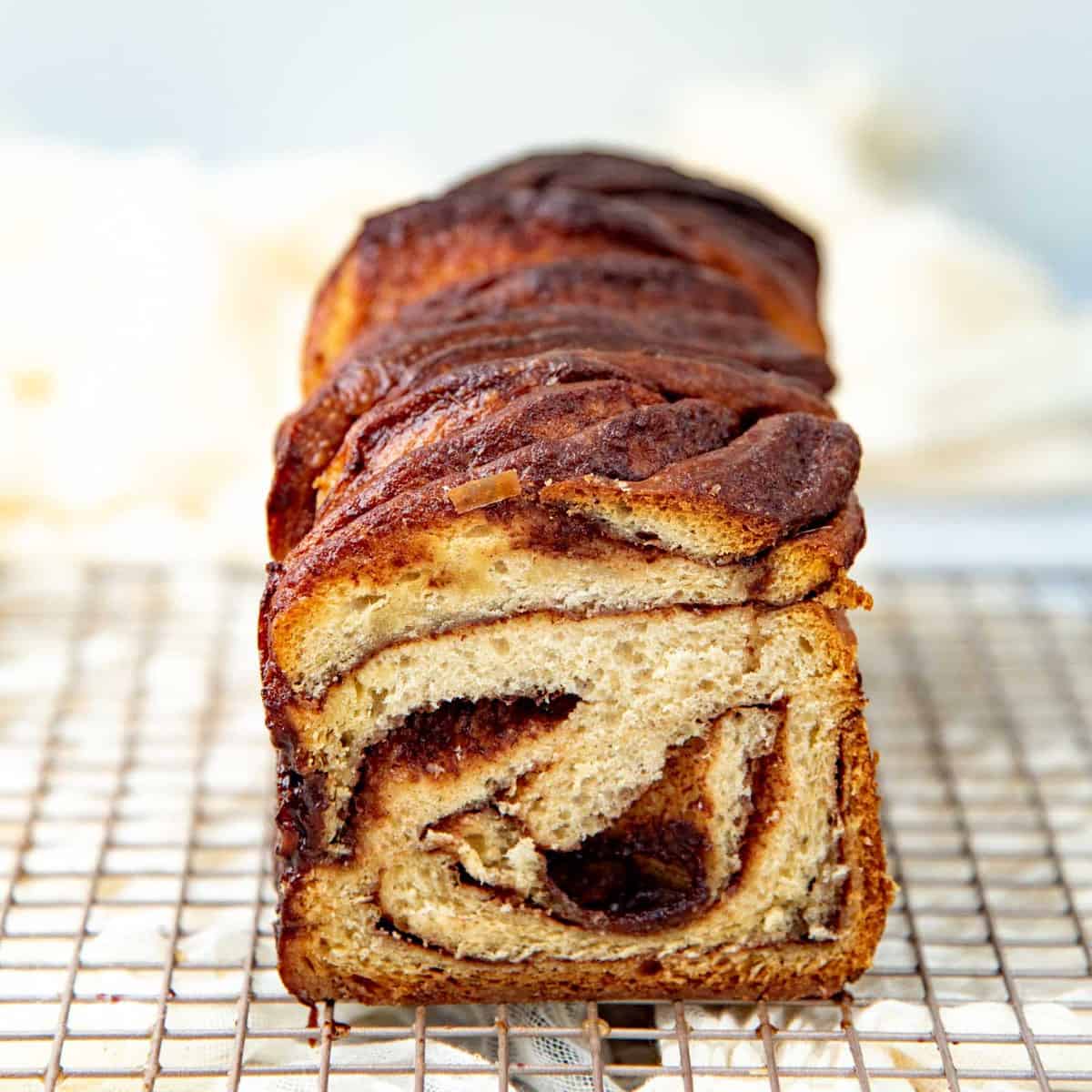
A rich, buttery and soft bread loaf with swirls of sweet cinnamon, topped off with a delicious streusel topping. Learn how to make the most amazing cinnamon babka with this well-tested, step by step recipe!
Rich and buttery, with lots of cinnamon! Or try my chocolate babka for another delicious flavor variation.

I adore making babka. It’s such a versatile pastry / bread / cake, that always guarantees delicious and beautiful results. Slicing into a warm babka loaf to discover the gorgeous swirls of your filling nestled between the soft and buttery bread is a special kind of culinary satisfaction.
My chocolate babka recipe is obviously a favorite for many, but cinnamon babka is actually my personal favorite.
What to expect with this recipe
- Two cinnamon babka loaves. Or you could use one half to make a cinnamon babka, and the other half to make chocolate babka.
- An enriched bread with cake-like softness.
- Delicious, sweet cinnamon swirls inside the bread. The cinnamon flavor is strong, but you can reduce it to your liking.
- The recipe is a two day process. The enriched bread is extremely similar to my brioche bread, so chilling the dough overnight will help you shape the babka more easily and develop more flavor.
- This babka is perfect for gift-giving!
- Equally delicious with coffee or tea in the afternoon, or as a cinnamon roll (or almost like brioche cinnamon rolls!) substitute for brunch.
- You could even use stale cinnamon babka to make brioche French toast too!
This brioche-like enriched dough is not hard to make with the help of a stand mixer. But you’ll need some patience because this dough takes time to come together and build enough gluten.

Ingredients to make cinnamon babka
Apart from a weighing scale and a stand mixer, you will also need TWO 9 x 4 x 4 inch loaf pans. You could also use TWO 9 x 4 inch pans that are 3 inches in height as well, which should be just enough in size.
However, if you’re using a standard loaf pan (8 x 4 x 3 inches), you could make 3 – 4 loaves with this recipe (3 big loaves or 4 small ones).
Enriched bread dough
- Milk
- Active dry yeast (see recipe notes for substitutions)
- Honey
- Sugar
- Eggs
- All purpose flour (you can also use bread flour or a mix of the two)
- Salt
- Unsalted butter
Cinnamon filling
- Cinnamon – Use good quality cinnamon for the best cinnamon flavor. Regular supermarket-brand cinnamon is often less strong, so you may need to use more cinnamon for equivalent flavor. You can also use Ceylon cinnamon for a more floral cinnamon flavor.
- Butter
- Salt
- Brown sugar
How to make cinnamon babka (step by step overview)
Enriched bread dough
Enriched dough bread is bread that is made with added eggs and/or butter. Because of these fat-rich additions, the gluten takes longer to develop.
So it’s important to make sure that you take the time to knead the dough until the dough can pass the window pane test.
First, activate the yeast in warm water. Second, add the rest of the ingredients, except for the butter. Knead the dough for about 5 – 7 minutes until it starts to look smooth.
Add the butter in four additions, making sure to knead in each butter portion before adding the next. Adding the butter will make the dough seem more runny, sticky, and soft. This is normal!
Keep kneading the dough and it’ll start to become shiny and smooth. This must be done at mid speed, because the low speed will not knead the dough properly to form gluten.
You can tell that your dough was kneaded enough when the dough passes the window pane test.
Let the dough proof at room temperature for about 1 – 2 hours, until it’s about 1.5 – 2 times the initial size. Not more than doubled in size.
De-gas the dough gently (don’t punch the dough!) by turning the dough out onto a lightly floured surface and folding the edges towards the center, and then pressing down lightly. This will remove excess gas from the dough. Then turn the dough over again and form a smooth surface on top, and place it back in the mixing bowl.
Refrigerate for about 8 – 12 hours. This cold proof will develop more flavor in the dough, plus a chilled dough will be much easier to work with as well.


Cinnamon filling – this is made the following day, before assembling
Some babka bakers will spread the butter over the dough, and then sprinkle the sugar over the butter. If you prefer to do this, that is A-OK.
However, I personally prefer to make a cinnamon butter by mixing softened butter with sugar and cinnamon, and then spreading this mixture over the dough instead.
This ensures a nice even layer of butter, cinnamon, and sugar!
If it’s winter and cold where you live, you may need to slightly soften the butter in the microwave first (just a few seconds). The butter should then be soft enough to be mixed with the sugar and cinnamon to form a spreadable paste.

Assembly – after making the cinnamon filling
This is also done on the second day, after the dough has chilled in the fridge overnight.
Remove the chilled dough from the fridge. Take the dough out of the bowl, and place it on a lightly floured and smooth surface, and lightly flatten the dough. Weigh the dough and divide it into two equal portions. Place one portion back in the bowl, cover, and chill until needed.
Make sure the other portion of dough is chilled when you work with it. It’s much easier to handle the dough and shape the cinnamon babka while it’s chilled. If it gets too soft, pop it in the freezer for a few minutes, so that it’s nice and chilled again.
Roll out this dough portion into a rectangle (10 – 11 x 15 – 16 inches), with a fairly even thickness. Spread the cinnamon butter in a thin layer over the surface of the dough, making sure to leave a 1 inch border along one of the long edges.
Next, roll up the dough towards the 1 inch border with no filling, and seal by pinching the edge. The dough is usually too soft for me by this point, so I carefully place the rolled up dough on a baking tray, cover it with plastic wrap, and freeze it for about 20 minutes until the dough becomes firm again. I’ve tried to shape the cinnamon babka when the dough is too soft, and it quickly becomes a sticky disaster! So definitely make sure you chill the dough roll before shaping it.
When the dough is firm again, it’s ready to be shaped. Cut the tube of dough in half (lengthwise) with a sharp knife. If you like, you can trim the edges. Twist the two pieces of chocolate babka dough together, and tuck it in the prepared loaf pan.
Then repeat this with the second portion of dough.


Baking cinnamon babka
It’s very important to let the cinnamon babka loaves proof before baking. If the babka dough doesn’t proof properly, the dough will “tear” as it bakes in the oven.
Cover the loaf pans with plastic wrap or cloth, and keep them in a warm place until they have doubled in size. This can take as little as 1.5 hours in the summer, or can be as long as four hours in the winter! Just make sure to find a warm area in your house to proof the loaves during winter.
When the babka loaves have proofed, they are ready to be baked!


You have the option of baking the loaves without an egg wash, especially if you’re going to brush the loaves with syrup after baking. However, if you’d like to skip the syrup, you can brush the tops with an egg wash instead for a lovely shine on the cinnamon babka loaves.
You also have the option of adding a streusel topping before baking the babka.
Bake the babka for 50 – 60 minutes, or until the internal temperature reaches about 190 – 200 F. If the loaf is browning too much on the surface, tent the pan with a piece of foil.
Once the cinnamon babka is baked, you can brush the loaf with a sugar syrup. This is not essential, but the syrup does add more moisture to the babka and a lovely sheen on top.


How to serve cinnamon babka
Cinnamon babka is a rich and indulgent treat on its own! It’s also one of our favorite tea time snacks.
I really enjoy eating a slice of cinnamon babka after warming it up in the microwave for several seconds. But I’ve also eaten and served this at room temperature and straight out of the fridge, and it’s a treat either way!
Plus, you could easily use stale cinnamon babka to make this super easy and comforting baked brioche French toast recipe!

How to store babka
Freshly baked cinnamon babka should be stored in an air-tight container.
Honestly though, this babka loaf never lasts too long in our house. While one babka loaf is stored in the fridge for about 5 days, the other is stored in the freezer until my family is ready to eat it.
To store in the freezer
If you want to store the cinnamon babka for about 2 weeks in the freezer, you can just wrap the babka well and place it in an airtight container or freezer bag.
However, if you’re storing it in the freezer for any longer than that (up to 2 months), you need to make sure to prevent freezer burn on your babka. Wrap the babka with plastic wrap tightly (even two layers), followed by foil. Reduce the chance of the babka being exposed to any cold air.
Then finally place the loaf in an airtight container or freezer bag and store in the freezer. And make sure you don’t slice the bread before storing as well! This will make the babka go stale faster.

My favorite tips to make perfect cinnamon babka
- Use weight measurements. This will guarantee consistent results. Volume measurements of dry ingredients vary too much and can result in dry bread.
- Be patient with the kneading process. This is an enriched bread, so it’ll take time for the dough to develop gluten. You can read my comprehensive post on brioche bread for more information about enriched dough. Look for the window pane to know that your dough is done.
- The fridge and freezer are your friend. Chill the dough overnight, both for flavor and to make it easier to work with. Any time the dough gets soft and sticky, transfer it to the freezer (covered) for a few minutes to make it firm again.
- Cinnamon comes in varying strength depending on the brand. I like my cinnamon babka with LOTS of cinnamon, so taste the cinnamon butter and add more cinnamon just in case the cinnamon you use isn’t as strong.
- I use a conventional oven. If you have a convection oven, then you will need to reduce the temperature of the oven by 25 F / 15 C to bake the loaf.
- Use a 9 x 4 x 4 inch loaf pan. With this pan, you can make TWO loaves. You can also use a 9 x 4 x 3 inch pan.
- If you’re using 8 x 4 x 2.5 inch loaf pans, you will be able to make FOUR smaller loaves. If your loaf pan is higher than 2.5 inches, you’ll get THREE loaves instead of four.

Recipe
Cinnamon Babka
US based cup, teaspoon, tablespoon measurements. Weight measurements are recommended for accurate results whenever available.
Common Measurement ConversionsIngredients:
Enriched dough
- 120 mL warm milk ½ cup
- 9 g active dry yeast about 2 ½ tsp
- 10 mL honey 2 tsp
- 5 large eggs
- 10 mL vanilla
- 100 g granulated white sugar ½ cup
- 575 g AP flour about 4 ⅔ cups (measured by spoon and level method)
- 10 g sea salt finely ground, about 1 ½ tsp
- 226 g unsalted butter soft and roughly divided into four portions, about 1 cup / 2 sticks
Cinnamon butter
- 115 g unsalted butter softened, ½ cup / 1 stick
- 200 g brown sugar 1 cup, light or dark brown sugar
- 3 tbsp korintje cinnamon or any ground cinnamon
- ½ tsp ground nutmeg
- ¼ tsp sea salt I prefer to use ½ tsp for a salty, sweet filling
- 10 ml vanilla 2 tsp
Streusel topping (optional)
- 50 g white sugar ¼ cup
- 50 g brown sugar ¼ cup
- 1 tsp ground cinnamon
- Pinch of salt
- 30 g AP flour ¼ cup
- 40 g unsalted butter cold and cut into cubes, 3 tbsp
- Milk to brush the tops of the babka loaves
Sugar syrup
- 150 g white sugar ¾ cup
- 150 mL water ½ cup + 2 tbsp
- 2 tsp cinnamon optional
- 1 tsp vanilla optional
Instructions:
Making the dough
- This is a two day process. So make the dough the day before you want to serve your babka.
- Measure out all the ingredients first.
- Add the milk, yeast, and honey into the mixing bowl, and gently whisk to combine. Set aside for 10 minutes to allow the yeast to activate.120 mL warm milk, 9 g active dry yeast, 10 mL honey
- Add the eggs, vanilla, sugar, flour and sea salt, and mix to form a scraggly dough.5 large eggs, 10 mL vanilla, 100 g granulated white sugar, 575 g AP flour, 10 g sea salt
- With the dough hook attachment, knead the dough on speed 3 for about 5 minutes. The dough should start to look smooth.
- Roughly divide the butter into 4 portions. Add the first portion of butter after the first 5 minutes of kneading. Each butter portion should be mixed in for at least 2 minutes at a time until it has incorporated well into the dough.226 g unsalted butter
- Repeat with the other 3 portions of butter, kneading the dough for about 2 -3 minutes after each addition. Make sure to stop the mixer to scrape down the sides of the bowl (and the bottom if needed) between kneading as well. You will have incorporated all the butter in about 12 – 15 minutes of kneading time.226 g unsalted butter
- Once all the butter is incorporated, scrape down the sides of the bowl (and bottom if needed), and knead the dough for a further 5 – 15 minutes on speed 5 or 6. If you lower the speed, this can take longer, so it’s best to knead until the dough has reached the correct consistency.
- The dough will have been kneaded enough when it can be lifted fairly cleanly off the bottom of the bowl when picked up with the dough hook. Please note that the dough will still be very soft and tacky to the touch, but shouldn’t stick to your fingertips.
- You can also do the window pane test with the dough to check if enough gluten has developed.
- Flour your work surface lightly, and turn the dough out onto the floured surface. Lightly flour your hands to prevent the dough from sticking to your palms.
- Fold in the edges of the dough towards the middle, and gently press them into the dough to form a smooth ball. Flip the dough over, and then with the heel of your palms, shape the dough to form a tight ball.
- Carefully pick up the dough ball and place it back in the mixer bowl (or another large bowl).
- Let it rise until it has almost doubled in size, in a warm place (72°F), for about 1 hour. It can take longer in winter and/or if your kitchen is colder.
- Turn the dough out onto a lightly floured surface, and press down gently with your hands to deflate the dough. Fold in the edges again as before towards the middle and press them in. Carefully flip the dough over (seam side down now), and tighten the ball of dough to get a smooth taut surface on top. Transfer the dough into the mixer bowl again.
- Cover and let it chill in the fridge for at least 8 hours, or up to 24 hours. The dough WILL RISE in the fridge, so make sure the bowl is large enough to contain the dough properly.
- The dough will be ready to be used the following day. You will be using the dough while it's chilled, so do not let it come to room temperature before working with it.
Cinnamon butter
- Place the softened butter in a bowl. Mix the butter with a spatula until it’s soft and creamy.115 g unsalted butter
- Add the sugar, cinnamon, nutmeg, salt and vanilla. Stir to combine.200 g brown sugar, 3 tbsp korintje cinnamon, ½ tsp ground nutmeg, ¼ tsp sea salt, 10 ml vanilla
- Mix until the sugar and cinnamon have mixed evenly with the butter.
- Set aside until needed.
Streusel topping (optional)
- In a bowl, mix both types of sugar, salt, cinnamon and flour.120 mL warm milk, 50 g white sugar, 50 g brown sugar, 1 tsp ground cinnamon, Pinch of salt, 30 g AP flour
- Add the butter cubes.40 g unsalted butter
- Cut the butter with the dry ingredients to form a coarse, crumbly texture. You can use a pastry cutter or fork to do this. I sometimes use my fingers, but you need to make sure that the butter isn’t melting.
- Keep the mixture in the fridge until you’re ready to use it.
Assembling the cinnamon babka
- Butter and flour TWO 9 x 4 x 4 inch loaf pans. I prefer to butter and line them with parchment paper, but you can do whichever is easier for you. Set aside.
- Remove the chilled dough from the fridge.
- Flatten the dough gently to remove excess air in the dough.
- Measure the weight of the dough. Evenly divide the dough into TWO portions by weight (to make 2 loaves).
- Return one of the portions back into the bowl, cover, and let it chill in the fridge until you’ve assembled the first portion.
- Place the first portion of the dough on a floured, smooth surface.
- Roll out the dough until it’s a rectangle that is about 10 x 15 inches.
- Spread a layer of the cinnamon butter (about ⅓ – ½ of the filling) over the surface of the dough. Make sure to leave a 1 inch border along one of the long edges.
- Roll the dough along the 10 inch side, towards the 1 inch border (so that you end up with a 14+ inch long bread roll).
- Once rolled up, pinch the end into the dough roll to create a seal.
- At this stage, the dough can be very soft and sticky and hard to manage. So carefully place the bread roll on a parchment paper-lined baking tray and cover with plastic wrap and freeze for about 20 minutes until the dough is firm. While the dough is firming up in the freezer, you can repeat the whole process with the second dough portion.
- When the dough is firm enough to handle again, remove it from the freezer.
- Trim the two ends of the roll (optional), then slice the roll in half lengthwise.
- Twist the two halves to form a twisted braid (see pictures in the post).
- Carefully place the twisted loaf in the prepared loaf pan, making sure to tuck in the ends.
- Cover the loaf pan with plastic wrap, and let it proof at room temperature for about 1 hour or until it’s about doubled in size. The time for proofing will depend on the ambient temperature in your kitchen. In a cooler place, it could take as long as 3 hours to proof.
- Repeat the cutting and twisting of the babka loaf with the second portion of dough, and let it proof in the second loaf pan.
- While the babka is proofing, preheat the oven to 325°F / 163°C (conventional oven).
- OPTIONAL – When the cinnamon babka has proofed, brush the top of the babka with some milk and sprinkle the streusel topping over the top of the loaf.Milk
- Bake the proofed cinnamon babka in the preheated oven for about 50 minutes. If the surface is caramelizing too fast, you can tent a piece of foil on the surface to prevent further browning.
- The internal temperature of the dough should reach about 190 – 200°F when it’s done baking.
- Remove the pan from the oven, and carefully use a skewer to poke several holes through the loaf from the top.
- While hot, generously brush the babka with the sugar syrup (recipe below) to glaze the top and to allow some of the syrup to be absorbed by the babka as well (optional).
- Let the cinnamon babka cool down in the loaf pan. Once at room temperature, or only slightly warm, remove the babka loaf from the pan.
- Slice and serve the babka while warm or at room temperature.
Sugar syrup
- Make the sugar syrup either while proofing or baking the babka loaf. The syrup can be used warm or hot.
- Add all the ingredients in a saucepan and heat over medium high heat.150 g white sugar, 150 mL water , 2 tsp cinnamon, 1 tsp vanilla
- Stir to dissolve the sugar and bring it to a boil.
- Lower the heat to simmer the sugar syrup for about 5 minutes. Set aside until you're ready to use it.
Recipe Notes
Note about yeast
I prefer to use active dry yeast, and this recipe is designed to use this type of yeast. I use Bob’s Red Mill active dry yeast. You CAN substitute with instant yeast (1:1 substitution by weight), but keep in mind that instant yeast is more active and it can proof much faster. So keep an eye on the dough as it proofs. The bread may also have more oven spring, so the loaf can also be larger. You can also use instant yeast at 75% the amount of active dry yeast to lower the activity level, but you will still need to keep an eye on proofing times.Baking in other loaf pans
If you’re using a standard loaf pan that is 8 x 5 x 2.5 inches, you will need to divide the dough into FOUR portions. The loaves won’t be as tall due to the lack of height in this loaf pan. If you have 8 x 5 inch loaf pans with higher sides (at least 3 inches), then you could make THREE loaves, so divide the dough into three portions instead.Storing the babka loaves
Always store the babka in an air-tight container. You can keep it in a cool, dry place for about 4 – 5 days (fridge is fine too). To store for longer, slice the babka (I prefer thicker slices), and freeze them in an air-tight container or ziploc bag for up to 3 or 4 weeks. To enjoy, allow the bread to thaw out to room temperature, or slightly warm the bread in the microwave.Nutrition Information:
“This website provides approximate nutrition information for convenience and as a courtesy only. Nutrition data is gathered primarily from the USDA Food Composition Database, whenever available, or otherwise other online calculators.”












Leave a Reply