




If you like classic French toast, you will LOVE this upgraded brioche French toast recipe! Made with buttery, soft, enriched brioche bread, this French toast is creamy and custardy on the inside, with perfect caramelization on the outside!
This baked brioche French toast will ensure that you can serve all your French toast slices at the same time, deliciously fresh and warm. Super easy, adaptable, customizable recipe!

- Why this brioche French toast recipe is a keeper!
- Brioche French toast vs regular French toast
- Ingredients and substitution notes
- How to make brioche French toast
- Importance of soaking vs dipping for perfect French toast
- My best tips for recipe success!
- Recipe variations
- Storage tips
- Commonly asked questions
Why this brioche French toast recipe is a keeper!
- Absolutely perfect French toast that is caramelized on the outside and custardy and creamy on the inside!
- Very adaptable and customizable recipe. Makes the BEST brioche French toast casserole and French toast sticks as well!
- I share the basics of this simple recipe so you know how to make the BEST French toast with perfect results, every time.
- You can make this baked brioche French toast ahead of time, but also serve it hot for everyone at the same time!
- Can be stored for later, and frozen too. So it’s perfect as a cozy breakfast for relaxing weekend mornings. It’s one of our very favorite breakfast recipes. Perfect for mother’s day brunch as well.

Brioche French toast vs regular French toast
French toast has many variations! I talk about the difference between French toast, eggy bread, and French toast casserole in my classic French toast recipe.
French toast is,
- More custardy than eggy bread. So I use the same ratio of egg to milk as I do for my French toast recipe. This is 1/4 – 1/3 cup of milk per 1 egg.
- Made with thicker slices of toast. You can use thin slices, but they get soggy way too fast and disintegrate. A thicker slice will give you better results.
- Caramelized on the outside, and delicious, soft, and custardy on the inside.
- Super simple to make.
The main difference between regular French toast and brioche French toast is the type of bread used to make it.
Using regular white bread will still produce a delicious custardy French toast. But brioche bread is an enriched bread that’s rich, buttery, and soft!
This adds a more luxurious and rich flavor to the brioche French toast! It’s also why brioche works best for honey butter toast. The custard center is more buttery and rich, and even tastes like a slightly less sweet tres leches cake slice.
Authentic brioche dough is made with 50% butter (sometimes even more), and produces a cake-like bread. You can make your own with my very popular homemade brioche bread recipe, but you can also use brioche from the bakery or store. The more enriched the brioche bread is, the more rich, soft, and delicious your French toast will be.
Ingredients and substitution notes

- Brioche bread – stale bread is preferred, but you can dry out fresh bread in the oven for this recipe as well.
- Eggs
- 10% cream or half and half
- Cornstarch – this is optional, but it’s an ingredient that was used to make French toast when I was growing up, and I still like to add it. The cornstarch helps to create a custardy thick texture once cooked.
- Maple syrup or brown sugar
- Salt
- Vanilla or lemon zest
- Cinnamon – optional
Substitutions
Brioche bread
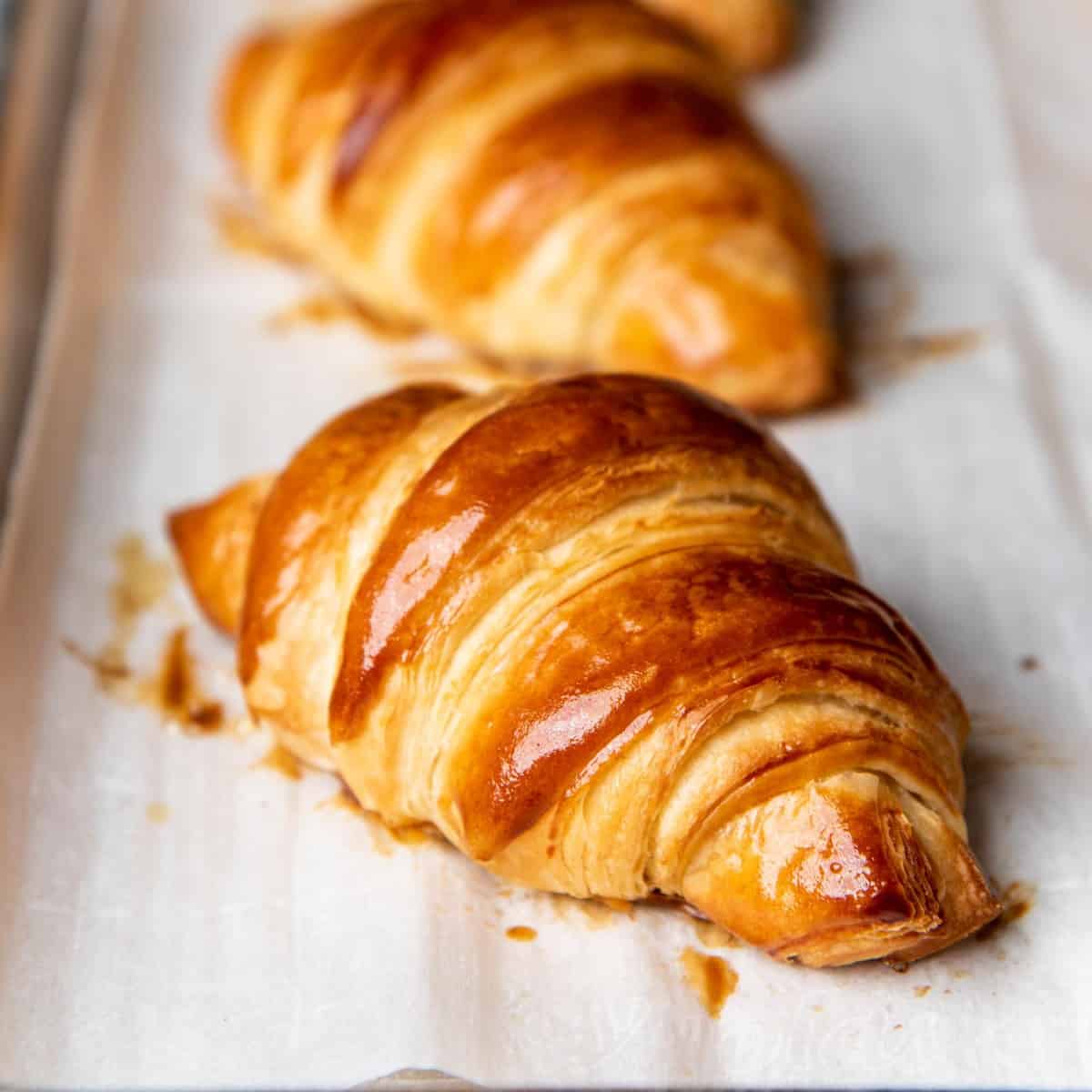
You can use challah instead if you like. Challah is also an enriched bread, but it isn’t as rich as brioche. Another close alternative is croissants or pain au chocolat, but croissants cannot be sliced like brioche.
You could also use my chocolate babka (chocolate brioche) or cinnamon babka for a couple of different flavor variations if you prefer. These are also made with an enriched bread dough, much like brioche.
Stale bread is much better suited to make French toast than fresh bread. Stale bread is drier, and will absorb the custard much better. But there are ways to make fresh bread feel stale faster as well. I share that tip below!
10% cream
Half and half is a North American product, and isn’t as common in other parts of the world. You can also use half milk and half cream (35% fat) to get a similar fat content. You can absolutely use whole fat milk as well. But this brioche French toast is a special occasion baked French toast, and the extra fat will help make it richer and more delicious.
Maple syrup or brown sugar
Any kind of sweetener can be used. I use maple syrup here, because I’m serving the French toast with maple syrup. But you can use brown sugar, white sugar, or even honey to sweeten the custard base.
You can check out my guide to types of sugar to see how different sugars are used in baking and how their substitutions work.
Vanilla / lemon zest
I add vanilla to the custard to make the French toast more fragrant. This is sometimes needed so that the custard doesn’t smell “too eggy”. Vanilla also adds depth of flavor and complexity to the sweetness. However, lemon zest also adds a really wonderful complex flavor to the custard base. So it can be used as a substitute for vanilla.
You can use lime zest or almond extract, or even any citrus extract as well. Other subtle flavors you can add include bourbon or rum (when serving this dish to adults, of course), rose water or orange blossom water (for a more floral flavor).
How to make brioche French toast
How to make stale bread quickly
Stale bread is simply bread that’s been aged for a few days and dried out. Since brioche bread is a rich bread, it takes about 3 day for the bread to become stale.
But if you bought fresh bread and need it to be dried out, follow this simple method to stale bread faster in the oven.
Slice the bread into the thickness / size you want. Place the bread on a wire rack, and place the wire rack on a baking tray.
Preheat the oven to about 250 F. Some recipes use 350 F, but the high heat will brown the bread too quickly rather than drying it out. The toasted side of the bread will not absorb as much custard, so I prefer to avoid toasting the bread. A low oven heat for a slightly longer time will create a drier bread without toasting it.
Once the oven is preheated, place the baking tray (with the bread slices) in the oven. Let the bread bake for about 10 – 20 minutes OR until the bread has dried out slightly. The time will depend on how thick / big the bread slices are, how fresh the bread was at the start, and how much moisture is in the bread.
Once the bread is stale / slightly dried out, remove the bread from the oven and let it cool down. Warm bread will soak up custard faster, and make it too soggy.

Step 1 – Prepare the bread
Slice the brioche bread loaf into thick slices. Ideally about 3/4 – 1 inch thick (image 1). Thicker French toast can also be made, but it will take longer to cook.
If your bread is not stale, you can place them in the oven to dry them out (image 2). But if your bread is already stale, proceed to the next step.
Step 2 – Prepare the egg custard
You can either use a whisk or a stick blender to make the custard.
With a whisk, make sure to mix the cornstarch with a little of the milk / cream to help dissolve it better as the first step (image 3). Next, you can add the rest of the cream, eggs, sugar, salt, and other ingredients, and whisk until smooth and well combined (images 4 – 6).
If using a stick blender, place all the ingredients in a jug or tall container and blend until everything is mixed through and homogenous.
I like to leave the custard mix to sit for a few minutes (about 5 minutes at least), to allow all the eggs and ingredients to mix well and settle. But if you’re pressed for time, you can skip this.

Step 3 – Soak the bread
It’s imperative that the bread slices soak the egg custard mixture. Otherwise, you end up with French toast that has a light coating of egg, and the inside is just stale bread.
To make sure that the brioche achieves a soft, rich texture in the middle, the brioche slices must be soaked in the custard for a few seconds each side. I prefer to soak each side of the slice for about 10 – 20 seconds (images 7 – 8). Depending on how thick the slices are.
Place the soaked brioche bread on the wire rack and let them sit for 5 – 10 minutes (image 9). This step allows the bread slice to completely absorb the egg mixture throughout the slice. This also avoids the egg mixture from pooling in the frying pan, creating an omelet on the French toast.

Step 4 – Cook the brioche French toast
Preheat the oven to 300 F / 150 C. Heat a non-stick pan on medium heat.
Once the pan is heated, place a little butter in the pan (image 10). Then place the soaked brioche slice in the pan (image 11). Cook the slice of bread until one side is caramelized and golden brown. Then flip the bread over and cook for an equal amount of time to caramelize the other side (image 12) .
How long to cook the bread
The length of time to cook the bread through will vary depending on the thickness of your slice and your stove.
A 3/4 inch thick slice will obviously cook faster than a 1 inch thick slice. To completely cook the bread on the stove, it can take about 2 -3 minute PER SIDE, for a total of 4 – 6 minutes per slice of French toast. This is done on low heat, so that the egg mixture that is soaked through ALSO has a chance to heat and cook through.
However, to make it convenient, I like to cook the bread for about 1 – 2 minutes per side until each side is caramelized on a slightly higher heat, and then allow the French toast to cook all the way through in the oven.

Step 5 – Finish cooking the brioche French toast in the oven
Once the brioche bread slices are caramelized on both sides, and partially cooked, place the slices back on the wire rack (that’s on the baking tray) (image 13). Transfer the baking tray back into the oven to allow the French toast to cook all the way through.
Tip – If you have an instant read thermometer, insert the probe into the middle of the toast slices to check if the internal temperature reaches 165°F / 75°C. This indicates that the custard is cooked through.
Importance of soaking vs dipping for perfect French toast
There’s a reason why stale bread, and making sure the bread has had enough time to soak in the egg custard are recommended for perfect French toast. Both factors result in French toast with a melt-in-your-mouth soft, delicious, custard-like interior!
Some recipes call for just dipping the bread in the egg mixture and then frying it. This method results in a dry interior, because the bread simply doesn’t soak up the custard. So it’s just a piece of bread with a layer of egg on the outside, and just stale bread in the middle. That obviously isn’t French toast.
But if you take the time to soak the bread before pan frying it, and then cooking the French toast throughout, the results are drastically different AND tastes so much better! The custard mixture sets as it cooks, creating a soft, creamy, custardy interior that literally melts in your mouth as you eat it!
See the difference below!

Why do we have to finish cooking French toast in the oven?
Eggs must be cooked to 165°F / 75°C before consumption. Since the bread slices are soaked in the custard, there is egg inside the bread slice as well. So the inside of the bread should also reach 165°F as it cooks, to fully cook the custard.
This can be done on the stove, but each slice of bread must be cooked on very low heat, for a long time. For a 3/4 inch slice of bread, this can take about 3 – 4 minutes per side on medium low heat.
To make it easier, especially if I want to make French toast ahead of time for a crowd, I prefer to cook the slices on a slightly higher heat, and caramelize the slices a little faster, about 1 – 2 minutes per side. And then allow the oven to cook the interior of the bread the rest of the way.
If the interior is not properly cooked, the French toast will end up super soggy in the middle, and not soft and custard-like.
This baked brioche French toast also allows you to serve all of your French toast slices at the same time, while still being deliciously fresh and warm!

My best tips for recipe success!
- Make sure to use a really good brioche bread! The more cake-like and soft, the better your French toast will taste. A homemade brioche bread with 40 – 50% butter will give you the best results! My homemade brioche recipe has 50% butter and is just so good! It also makes the BEST brioche buns and brioche cinnamon rolls.
- Cut thick slices of bread. At least 3/4 inch, up to 1.5 inches. This will give the French toast a contrast in texture between the crisp and caramelized outside and the custardy and soft inside.
- Full cream milk will be great, but cream in the custard will add more richness and flavor! That’s why I prefer to use half and half (10% fat).
- Remember to soak the bread in the custard for a few seconds. The bread slice shouldn’t be soggy, but the bread should go from being stale and dry to being a little soft but still hold together. If you dip your bread instead of soaking, the French toast won’t taste great.
- To get a lovely golden color on both sides of your brioche French toast, don’t forget to add a little butter when you cook the toast on both sides.
- Use the oven to finish cooking the brioche French toast. Yes, you can go low and slow on the stove, but this takes a long time. Searing the French toast and then letting it bake in the oven until done will save you time at the stove AND serve all brioche toast slices at the same temperature.
Recipe variations
There are many ways to add flavor to your brioche French toast. This includes adding flavor to the custard base, adding flavor to the bread slices, and the changing the topping!
- Stuffed brioche French toast – Slice the brioche into 1 – 1.5 inch thick slices. Then very carefully cut it in the middle to create a pocket lengthwise, and stuff the middle of the slice. Cream cheese filling is a popular filling option, but Nutella or any chocolate hazelnut spread (like my homemade vegan Nutella spread) is also very popular!
- Chocolate brioche French toast – Add cocoa powder and extra sugar to the custard base to make a chocolate custard. This will make a chocolate brioche French toast! Drizzle the top with more chocolate fudge sauce to make it taste even more chocolatey! Or you could use my chocolate babka recipe for a similar flavor variation.
- Cinnamon brioche French toast – If you add the cinnamon in the recipe to the custard, you will have cinnamon brioche French toast! I personally don’t always like to add cinnamon, which is why I provided cinnamon as an optional step. Alternatively, you can use my cinnamon babka recipe to make this French toast.
Other topping options
- Whipped cream or creme fraiche
- Maple syrup
- Pancake syrup
- Fresh fruits
- Fruit compote

Storage tips
Cooked brioche French toast can be stored in an airtight container in the fridge for up to 3 days. But it must be reheated in the oven before eating.
French toast can also be stored in the freezer for up to 1 month. Make sure to wrap each French toast slice with foil or parchment paper, so that it’s easier to take out only the slices you need. Thawing and refreezing repeatedly will shorten the life span. Frozen brioche French toast can also be reheated in the oven.
To reheat
Place the bread slices on a wire rack that’s placed on a baking tray. Then preheat the oven to 250°F, and reheat the bread in the oven until heated through.
The low heat is especially important if you’re reheating the toast from frozen. The low heat also allows the brioche French toast to reheat thoroughly without burning the surface of the bread.
More breakfast and brunch favorites

Commonly asked questions
What type of bread is best for French toast?
Any bread is good for easy French toast, as long as the slices are thick. But for the best tasting, rich French toast, an enriched bread is required.
For this recipe, you need to use brioche to get the same results. But, challah is a close second.
Should you dry out brioche before making French toast?
Brioche bread should be slightly dry when making French toast. That is why I recommend using stale brioche, which is already dried out, due to time and exposure.
You should only dry out the bread in the oven if the brioche bread you use is fresh and hasn’t had time to go stale.
How long should you soak brioche for French toast?
There is no set time for soaking bread for French toast. This will depend on how thick the brioche bread slices are, how stale or dry the slice will be, and what your preferences are.
Personally, I soak my 3/4 inch thick brioche bread for at least 15 seconds per side, up to 20 seconds if I want the egg custard mix to get right to the center of the bread. If the bread isn’t stale enough, this soaking time can increase slightly.
For the custard to not soak through the bread (and not have a custard-like center), then I only soak it for 5 – 10 seconds per side.
My recommendation is to test your first slice, and find out how long you will need to soak it without it disintegrating.
How to prevent soggy brioche French toast?
If your brioche bread slices are so soggy that you cannot lift it out of the custard without the toast completely disintegrating or breaking into pieces, then the bread has been soaked too much.
If your brioche French toast is soggy in the middle after cooking, that means the bread has not been cooked through. The custard will firm up and set inside the bread once it’s cooked through. But if the custard remains raw, it will seem soggy and wet.
Heat the French toast slices longer in the oven to allow them to cook through.
Should brioche French toast be cooked on high or low heat?
French toast should never be cooked on high heat. The highest heat setting I prefer will be medium, or slightly higher. But you can cook French toast at low heat OR a slightly higher heat, depending on how many slices or how much time you have.
You can cook French toast on low heat and let the slices cool for a longer time to ensure that your French toast is cooked through. This will take a longer time; about 3 – 4 minutes per side.
I prefer to cook French toast on medium heat to caramelize each side for 1 – 2 minutes, per side. Then I finish cooking the French toast in the oven to make baked French toast.
Can I make this ahead of time?
Absolutely!
I love making French toast and cooking it fully the day before, and then keeping it in the fridge overnight. Then, I simply reheat the French toast in the oven in the morning and serve.
I often even freeze the slices (individually wrapped), and reheat what I need for breakfast. So these are perfect as a meal prep recipe and to make ahead of time!
Recipe

Brioche French Toast
US based cup, teaspoon, tablespoon measurements. Weight measurements are recommended for accurate results whenever available.
Common Measurement ConversionsIngredients:
Custard
- 3 large eggs see recipe notes
- 240 mL half and half (10% fat) 1 cup, see recipe notes
- 15 g cornstarch 1 ½ tbsp, OR 2 ½ tbsp AP flour
- 50 – 66 g maple syrup or brown sugar ¼ – ⅓ cup
- ¼ tsp sea salt
- 2 tsp vanilla extract
- ½ tsp lemon zest optional
- 1 tsp cinnamon optional
- ½ tsp ground nutmeg optional
Bread
- 6 thick slices of brioche bread about ¾ – 1 inch thick, preferably stale (you can soak up to 8 slices, depending on their thickness)
- Butter and / or oil for frying
For serving
- Berries
- Maple syrup
- Butter
- Whipped cream or yogurt
Instructions:
How to quickly stale fresh bread in the oven
- Preheat oven to 250°F / 120°C (conventional oven). Line a half sheet pan with parchment paper and place a wire rack on top.
- Slice the brioche loaf into ¾ – 1 inch thick slices. I use my brioche bread recipe.6 thick slices of brioche bread
- Place the bread slices on the wire rack and transfer the baking tray into the preheated oven. Bake the slices for about 10 – 15 minutes, or until they feel stale and a little dried out.
- Be careful not to let the bread slices brown or dry out too much.
- Remove the tray from the oven and allow the brioche to cool down to room temperature before dipping in the custard. You can also do this step the day before you need to make brioche French toast.
Prepare the custard
- In a small bowl, whisk together the cornstarch with just enough half and half / milk to create a smooth paste with no lumps. Place this in a shallow dish that's suitable to soak the brioche slices.15 g cornstarch
- Add the rest of the half and half into the cornstarch slurry, while whisking.240 mL half and half (10% fat)
- Add the eggs, sugar, salt, vanilla, zest, and spices (if using). Whisk until the eggs have no “gloopy” texture. Let it rest for about 5 minutes (ideally).3 large eggs, 50 – 66 g maple syrup or brown sugar, ¼ tsp sea salt, 2 tsp vanilla extract, 1 tsp cinnamon, ½ tsp ground nutmeg, ½ tsp lemon zest
- STICK BLENDER – You can also place all the ingredients in a taller container and use a stick blender to blend the ingredient together to form a smooth mixture. Let it rest for 5 minutes and then pour it into the shallow dish.
Soak the slices
- Soak each slice of brioche in the custard for about 10 – 15 seconds, per side. If your brioche slices are very dry or thick, you can soak them up to 20 seconds per side as well.
- Once each slice is properly soaked, remove it from the custard and place it on the wire rack again. Although the bread is soaked, you should be able to lift it out of the custard in one piece. If the bread breaks apart, then the bread was soaked for too long.
- Repeat with all the slices, and let the slices sit on the wire rack for about 5 – 10 minutes to absorb and distribute the custard properly throughout the brioche slice. This will prevent the custard pooling in the pan when you're trying to cook it, AND create a more evenly soft, custardy center that is not soggy.
Cook the French toast
- Preheat the oven to 300°F / 150°C (conventional oven). See recipe notes on how to cook brioche French toast on the pan without the oven.
- Preheat a large non-stick skillet or griddle on medium heat. The heat level might be different depending on your stove.
- When the pan is hot, add a little butter to the pan and let it melt and spread it on the bottom of the pan. Place the custard soaked brioche bread on the pan.Butter and / or oil for frying
- Cook the bread slice for about 2 minutes. The bread slice should slowly caramelize and turn golden brown in that time. If the bread is caramelizing too fast, then turn the heat down. If the bread is caramelizing slower, then increase the heat a little.
- Flip the brioche slice over and let it cook for another 2 minutes until it's caramelized on the other side. Add a little butter to help add color to the other side as well (optional, but recommended).
- Place the caramelized brioche French toast on the wire rack.
- Repeat with the rest of the bread slices. You can cook multiple slices of bread, as long as you have room on the pan WITHOUT over-crowding.
- Once all the slices have caramelized on both sides, place them all on the wire rack that's placed on the half sheet baking pan.
- Place the baking pan in the oven to cook the French toast through. This will take about 15 – 20 minutes. The bread should puff up just a little bit, and the internal temperature should register at 165°F / 75°C.
- Remove the brioche French toast from the oven and let it rest for just a few minutes to cool down slightly.
- Serve your French toast while still warm with whipped cream, fruits, and maple syrup.Berries, Maple syrup, Butter, Whipped cream or yogurt
Recipe Notes
Note on eggs and milk
I like to use 1 egg per ⅓ cup / 66 mL. But for a more eggy flavor, you can add an extra egg to the recipe, so that you use ¼ cup per egg. While you can use whole milk in this recipe, I like to use half and half for richer French toast, as this brioche French toast recipe is a special French toast that is perfect for special occasions. If you can’t find half and half, mix 50 % milk and 50 % whipping cream (35% fat) to get half and half.Note on cooking time for brioche French toast on the pan
This brioche is cooked partially on the stove and cooked the rest of the way in the oven. If you prefer to completely cook your brioche French toast in the pan or griddle, you can do this too. Follow these instructions. Heat the pan on medium low or low heat. When the pan is hot, melt some butter, and place the bread slice in the pan. The soaked brioche slice should be cooked slowly, and caramelize slowly, so that it cooks through without burning. I cook the slices on one side for about 3 – 4 minutes per side, for the slices to fully cook through, and not be soggy.Nutrition Information:
“This website provides approximate nutrition information for convenience and as a courtesy only. Nutrition data is gathered primarily from the USDA Food Composition Database, whenever available, or otherwise other online calculators.”












Leave a Reply