


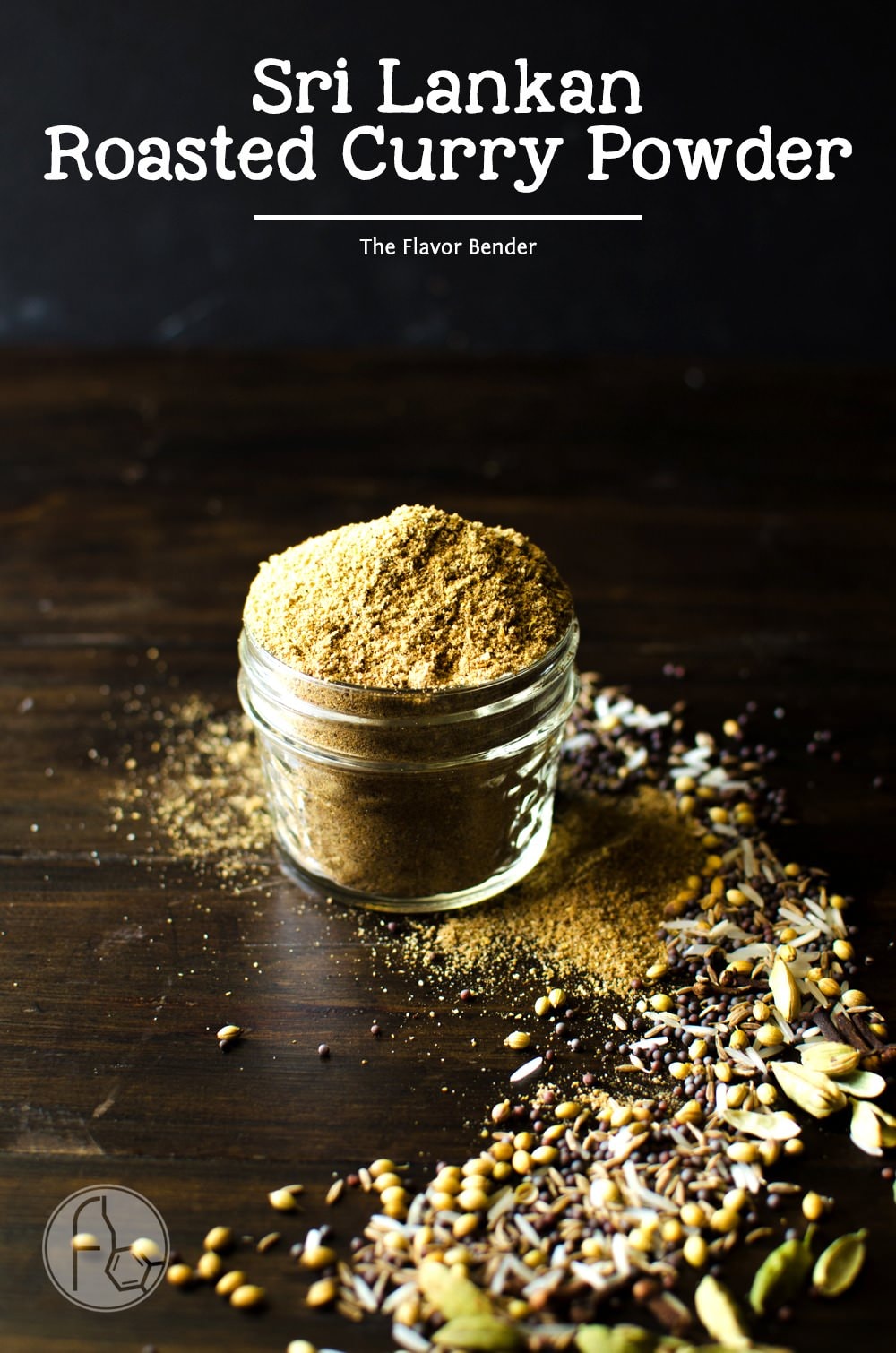
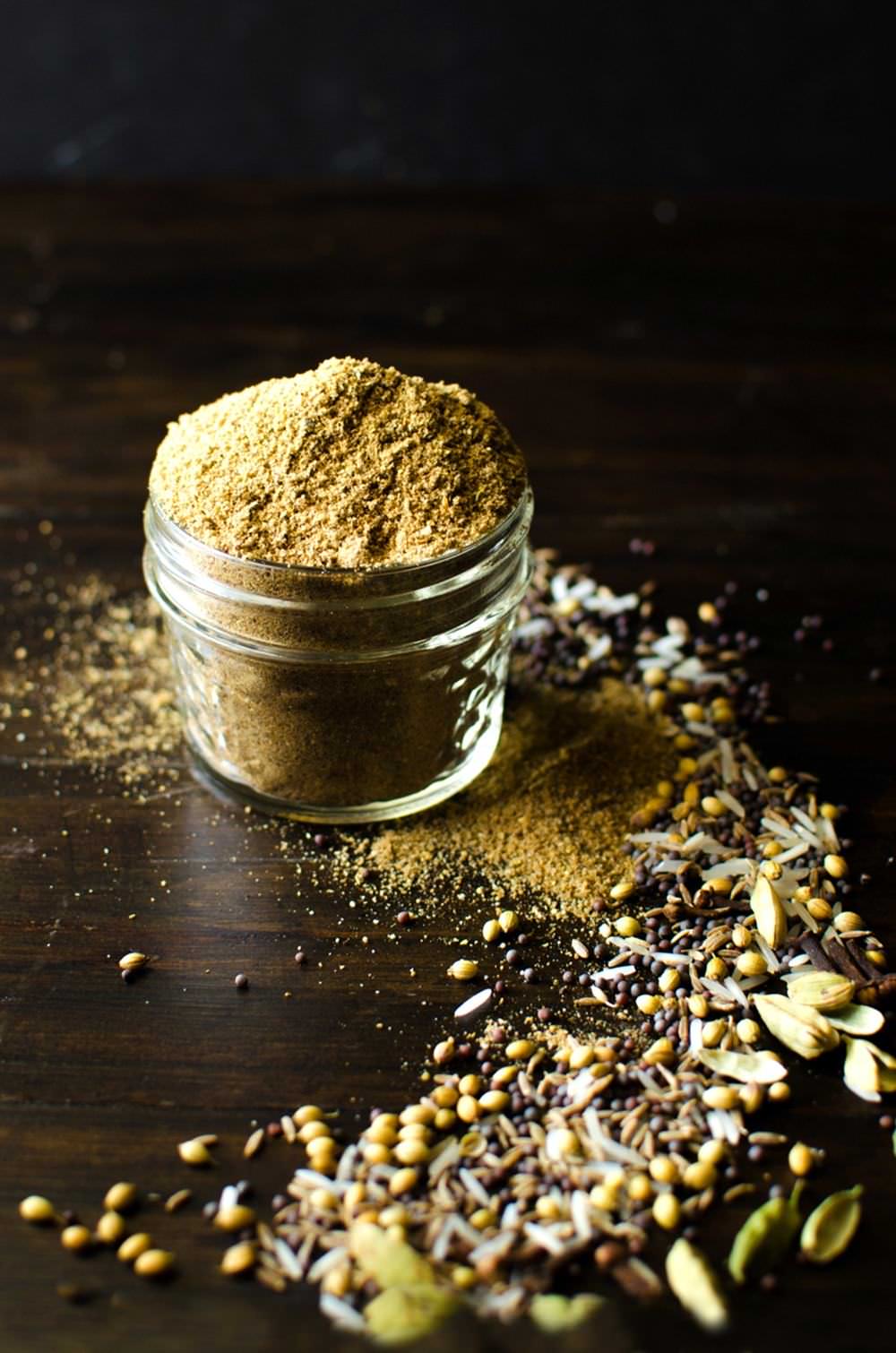
An adaptable, fragrant, easy curry powder that truly transforms every one of your meat, seafood, vegetable, and fruit curry recipes!
Plus, this Sri Lankan curry powder is made with whole spices, which makes for the most robust flavor imaginable, and it lasts longer as well. The perfect base for the best curry recipes from the comfort of your home.
- Why an easy curry powder should be a staple in your pantry
- What is curry powder?
- What’s special about this Sri Lankan curry powder
- Ingredients to make this curry powder
- How to make curry powder (step by step instructions)
- Recipe tips
- How to use curry powder in your cooking
- Storage
- Frequently asked questions
Why an easy curry powder should be a staple in your pantry
- This curry powder recipe is one of the most adaptable and easy curry powders you can make with common ingredients. Having such a flexible curry powder allows you to impart great flavor to your curries, with just a spoonful of curry powder. AND you can add more spices to make it even better.
- Curry powder is a great way to add flavor to any food (not just curry) that needs an extra flavor boost. Add it to popcorn, chips, grilled cheese and more!
- Since this curry powder is made with whole spices, the flavor is stronger, and it lasts longer than curry powders made with ground spices.
- The range of curry recipes you can make with just this one easy curry powder is truly mind-boggling! From chicken curry, beef curry and fish curry to seafood curries (like crab curry, shrimp curry etc.), vegetable curries (carrot curry, cauliflower curry, beetroot curry etc.) and fruit curries (apple curry, mango curry) too!
- This easy Sri Lankan curry powder doesn’t contain chili powder or cayenne pepper, so it’s a mild curry powder that is used to introduce spices to kids too. This way, you can adjust the spice levels to your taste for individual curries.
- An easy curry powder that has been made for generations in South Asian cuisine, this is a truly authentic curry powder that is big on flavor.
What is curry powder?
Curry powder is a mix of dried spices that have been ground and can be used to flavor many dishes, from vegetarian to meat to seafood dishes.
There is no ONE curry powder recipe. Each culture, each country or region, and even each household and recipe may use a different curry powder or mixture of spices.
A common misconception is that curry powder HAS to be spicy. That’s not true. These homemade spice blends can be mild in heat, or have lots of heat and be spicy.
It can have as little as 2 – 3 individual spices, or as many as 10 spices or more! It depends on the type of curry you wish to make, and the flavor that you’re looking for.
Some believe that all curry powders MUST contain turmeric, which isn’t true either. For example, THIS curry powder does not contain turmeric. Instead, it’s made with very flavorful and fragrant spices, and it isn’t too spicy either!
Where does curry powder come from?
Curry powders originated in South Asia. As a result of colonization, spice mixes from India, Sri Lanka, Bangladesh and other neighboring countries made their way to the lands of the British, Portuguese and others. To make it more palatable to the British, these spice mixes were generically labeled as “curry powder”.
The word “curry” is also thought to have originated from Tamil ‘kari”, which means “black” or “blackened”. While that could refer to the roasting of spices to make a curry, a simpler explanation is that it meant black pepper, which was and still is a prized spice from South India and Sri Lanka, where many Tamil people live.
Growing up, we used different types of curry powder for different recipes, which is why we kept a blend of simple spices in our pantry cupboards, and then add different spices as needed to the dish to get the flavor we liked.
Different types of curry powder
Madras curry powder – Example of an Indian curry powder or blend originating from Chennai (previously, Madras), the capital of Tamil Nadu (a state in South India). It’s a curry powder that includes a lot of chili powder, so it’s quite spicy.
Garam masala – Quite popular in the Western world. Masala simply means “a mix of spices”, so technically garam masala is a mix of spices that is also a type of curry powder. It usually contains very fragrant spices like cinnamon, cardamom, star anise, and nutmeg.
Jamaican curry powder – Turmeric is the main spice for Jamaican curry powders. For heat, scotch bonnet powder is added (which shows how curry powders can be adapted to use ingredients that are readily available in a specific region). Curries were introduced to Jamaica by Indians who arrived there as workers. This is why curries in the Caribbean have a lot of similarities to those from the Indian subcontinent.
Thuna paha or Sinhala curry powder – Sri Lanka, like India, also has different types of curry powder. This varies from region to region and dish to dish. Thuna paha is the blend of spices that is used in most households in the southern part of Sri Lanka. The curry powder recipe that I’m sharing here is this thuna paha recipe (aka Sri Lankan curry powder).
Coriander, cumin, black pepper, and cardamom are the main spices in this blend, and the other spices can be adjusted and/or omitted according to your preference.
Both the roasted or unroasted curry powders can be used interchangeably, but there is a preference in terms of how they are used.
- Roasted curry powder – Absolutely fantastic for meat curries, where you want the spices to have a more robust flavor to hold up to the flavors of the meat.
- Unroasted curry powder – The spices are not toasted, so the flavor is a little milder. Unroasted curry powder is perfect for fish or seafood curries.
Jaffna curry powder – Another important curry powder blend from Sri Lanka. This curry powder originated in the northern part of Sri Lanka. Jaffna curry powder is used in Sri Lankan Tamil households, and like Madras curry powder, it’s spicy due to the higher dried chili content. Black pepper is very prominent in this spice blend and it’s also darker in color than thunapaha.
British curry powder – These curry powders usually use a lot of turmeric, and can be very bland in flavor because there aren’t a lot of flavorful spices added to it. Mediocre curry powder often includes garlic powder and even ginger powder, which aren’t ingredients used in South Asian kitchens (since we add fresh garlic and ginger instead).
However, more boutique brands may use a better blend of spices, but turmeric is still the main spice.
Japanese curry powder – Japanese curry comes as a paste (or cube), but is also available as a powder (S&B curry powder). This includes a range of difference spices. For the traditional yellow color, turmeric is one of the main spices. In addition, allspice and star anise are added for smoky and sweet flavors. The spice level can vary depending on how much cayenne pepper one adds to it.
Yellow curry powder or red curry powder – These curry powders are just about the color of the resulting curry. Yellow curry powder contains more turmeric and is mild. Red curry powder has more chili powder or cayenne pepper, and consequently, more spicy.

What’s special about this Sri Lankan curry powder
This Sri Lankan curry powder is near and dear to my heart! It’s such a versatile, adaptable, and flavor-packed curry blend that I’ve been making for decades.
Over the years, I’ve tweaked it a little here and there, but as someone who has been making this curry powder every week for a long time, I can very comfortably say that this is ABSOLUTELY the best curry powder you need to have in your kitchen.
With this curry powder, you can make SO MANY authentic and delicious Sri Lankan recipes.
I used to make this curry powder with 4:3:2:1 ratio, but I have since opted for using weight measurements because the potency of some spices can vary due to freshness, and affect individual tolerance levels.
With this amazing homemade curry powder, you can make mild curries, super spicy curries, extravagant curries, and super simple curries. Flexibility is one of its biggest strengths.
Plus, without turmeric, which can be overpowering in large amounts, the flavors of the all the spices truly shine through. But, you can also add turmeric in addition to this curry powder if you’d like to, like I’ve done in my carrot curry and beetroot curry recipes.
You can also choose to roast the spices, as per the recipe. Or if you’re a little lazy like I am most of the time, you can choose not to roast it too. Simply sauté the spices while making the curry.
Ingredients to make this curry powder

Essential ingredients
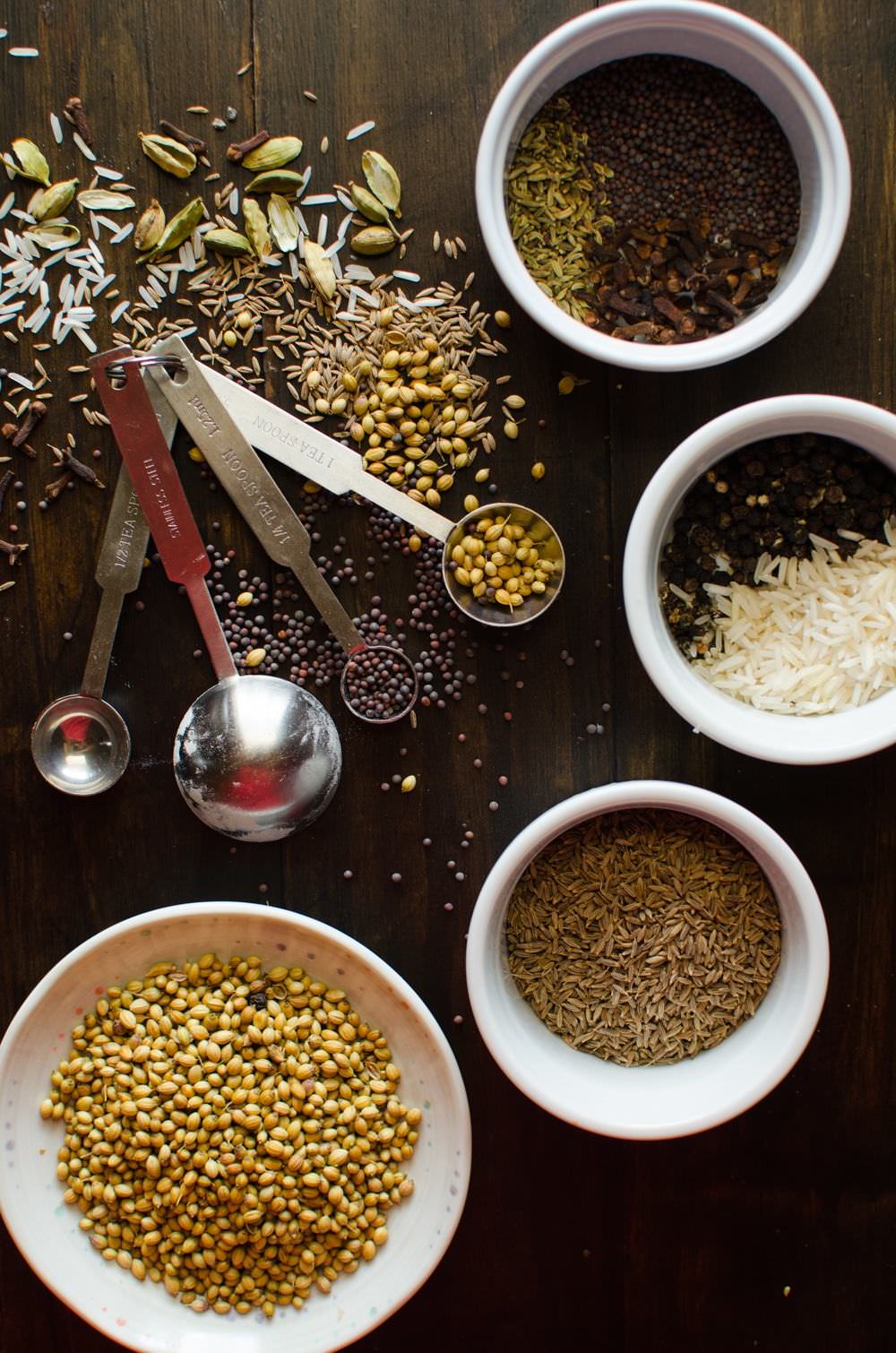
- Coriander seeds
- Cumin seeds
- Whole black pepper
- Green cardamom
Recommended spices
- Cloves
- Fennel
- Black mustard seeds
Other additions
I usually add these to the curry separately, but they can also be added to the curry powder if you like.
- Turmeric
- Cinnamon (Ceylon cinnamon is traditional, but cassia is OK too)
- Dried chili
- Dried curry leaves – Some store-bought curry powders also include curry leaves. I usually prefer to add fresh curry leaves straight into the curry. However, it does add a lovely earthy flavor to the curry powder, so you can go ahead and do so, if you have access to curry leaves.
Is there a difference between using whole or ground spices to make curry powder?
Whole spices are more fresh and more potent than ground spices.
For convenience, you can absolutely use ground spices to make this curry powder. However, ground spices lose their flavor MUCH faster than whole spices do. Which is why I use whole spices and grind them fresh every time I make this powder.
I make smaller batches of curry powder, more often, so that the flavor of my curry powder is much better than that of store-bought blends, OR when made from ground spices.
There are many recipes that do use ground spices to make curry powder, but if you’re looking for the absolutely best and most authentic flavor – use whole spices!
Whole spices can be easily found in South Asian stores, and it’ll be cheaper than buying from the supermarket. That’s a win – win.
But if you do not own a spice grinder, then use pre-ground spices. But do make smaller batches so that the curry powder doesn’t lose its flavor over time.
How to make curry powder (step by step instructions)
In this curry powder recipe, I include weight measurements and volume measurements, but honestly a little variation is OK. It doesn’t have to precise, BUT the proportions have to be similar. If you don’t like cloves, add less. Want a spicy curry powder? Add chili.
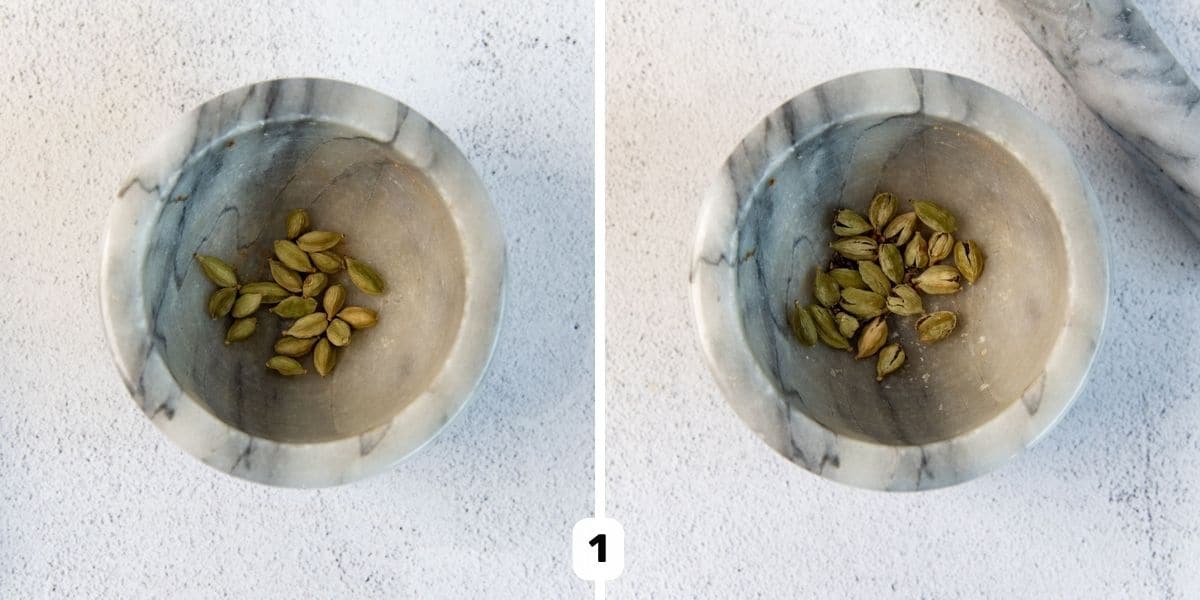
The first step is to measure and prepare the spices. This is mostly for the green cardamom. Measure out the whole pods, and then remove the seeds from the pod.
To do this, crack the pods with a mortar and pestle or by hand, and then remove the seeds and discard the husks (images labeled 1 above and below).
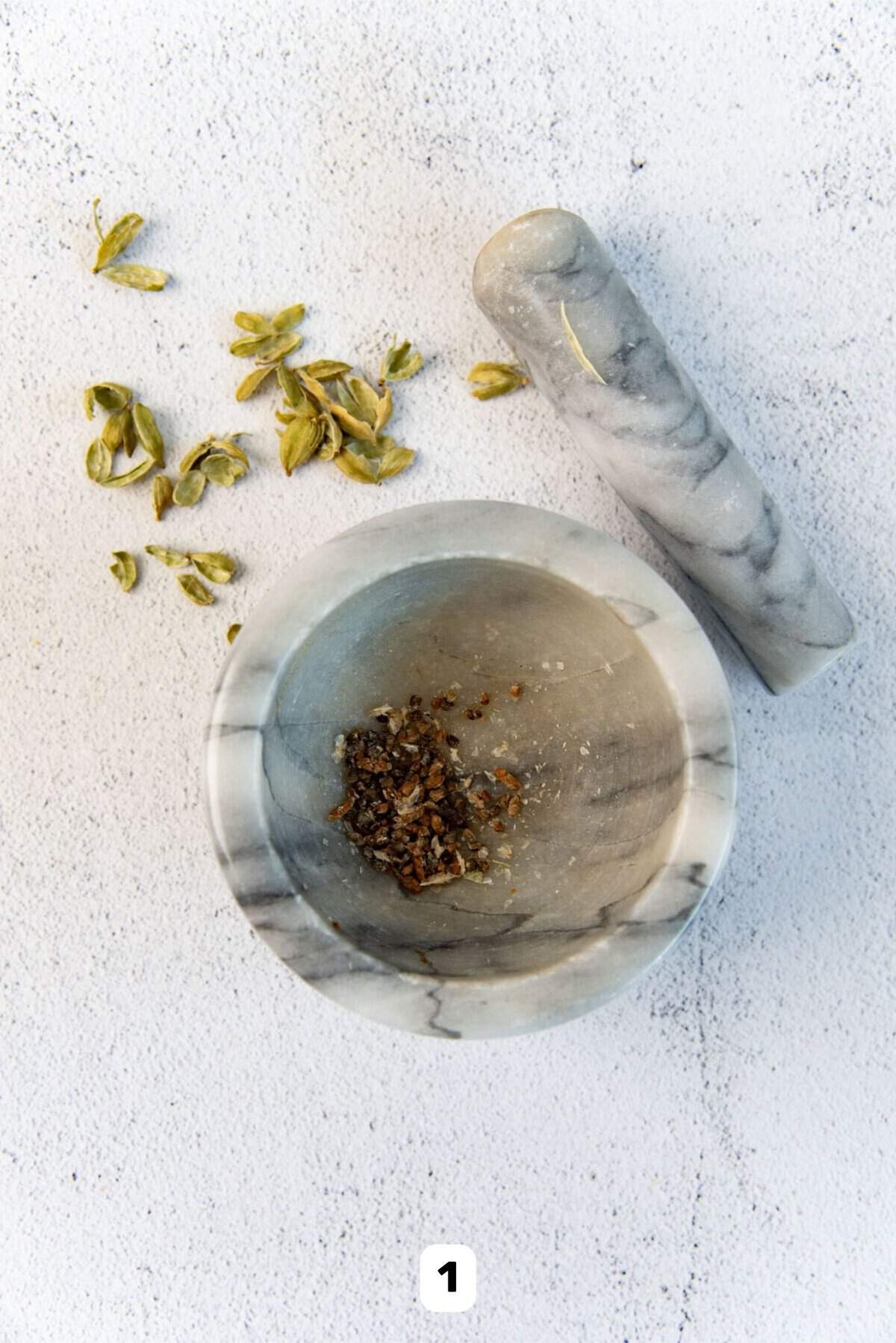
However, if you’re making unroasted curry powder, you can even keep the pods whole. I’ve done this many times and have had no issues.
Heat a stainless steel or nonstick pan on medium or medium low heat. Put the curry leaves in there and allow the leaves to dry out on low heat (image 2).
Make sure to move the leaves around to prevent them from burning. Using curry leaves is optional, so you can leave them out if you prefer. To make it even easier, you can purchase already dried curry leaves too.
Next, remove the dried curry leaves.

Steps for unroasted curry powder
For unroasted curry powder, you can mix all the spices (including the dried curry leaves – if using), and then use a spice grinder to grind all the spices (in batches if necessary).
For roasted curry powder
Add the rice to the heated skillet. Move the rice around with a spatula or by shaking the pan, and toast the rice until it starts to brown (image 3).
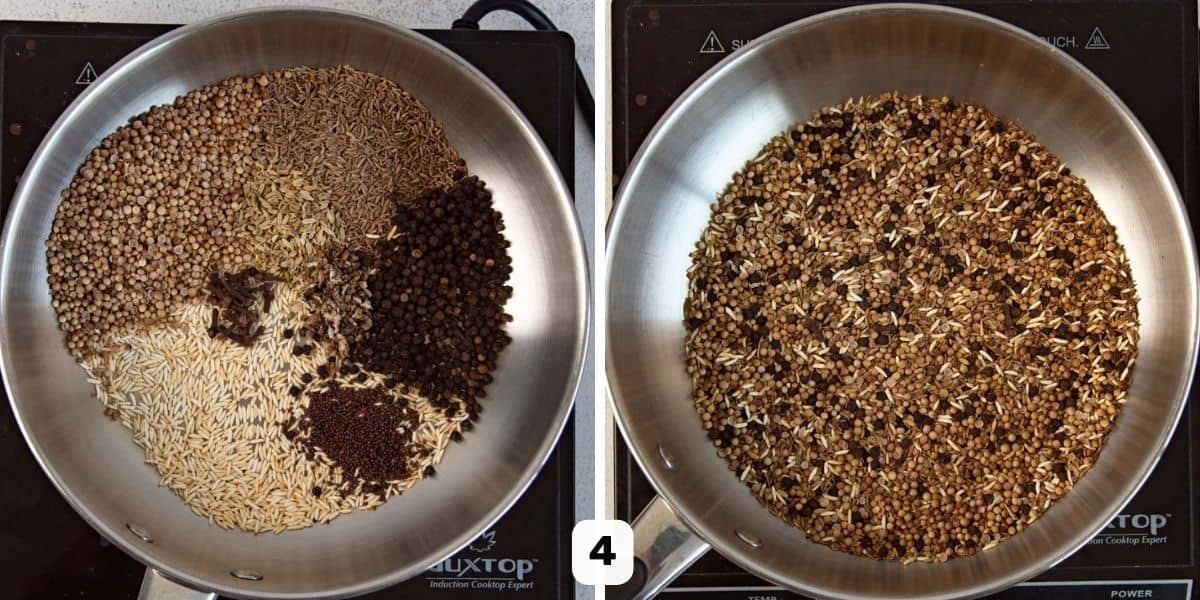
Remove from the heat and add all the rest of the spices. Then return to the stove and toast the spices for a further 2 – 3 minutes until you can start to smell the toasty spices (image 4). Make sure they do not burn.
Burnt spices will result in a bitter curry! To prevent the spices from burning, move the spices around in the skillet throughout the whole toasting process.
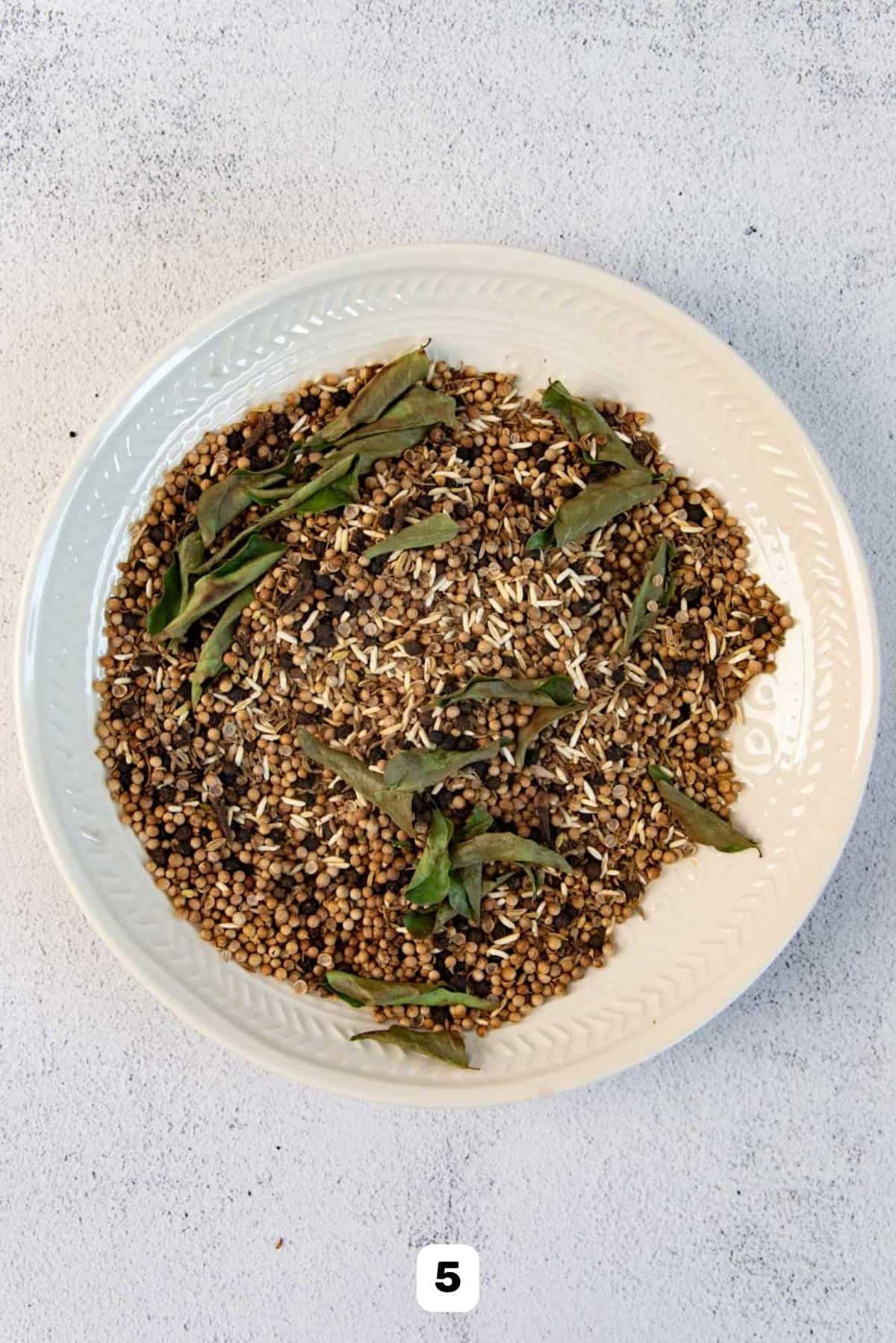
Transfer all the toasted spices onto a plate and let them cool down. Add the curry leaves as well. Mix the spices around to allow them to cool faster (image 5).
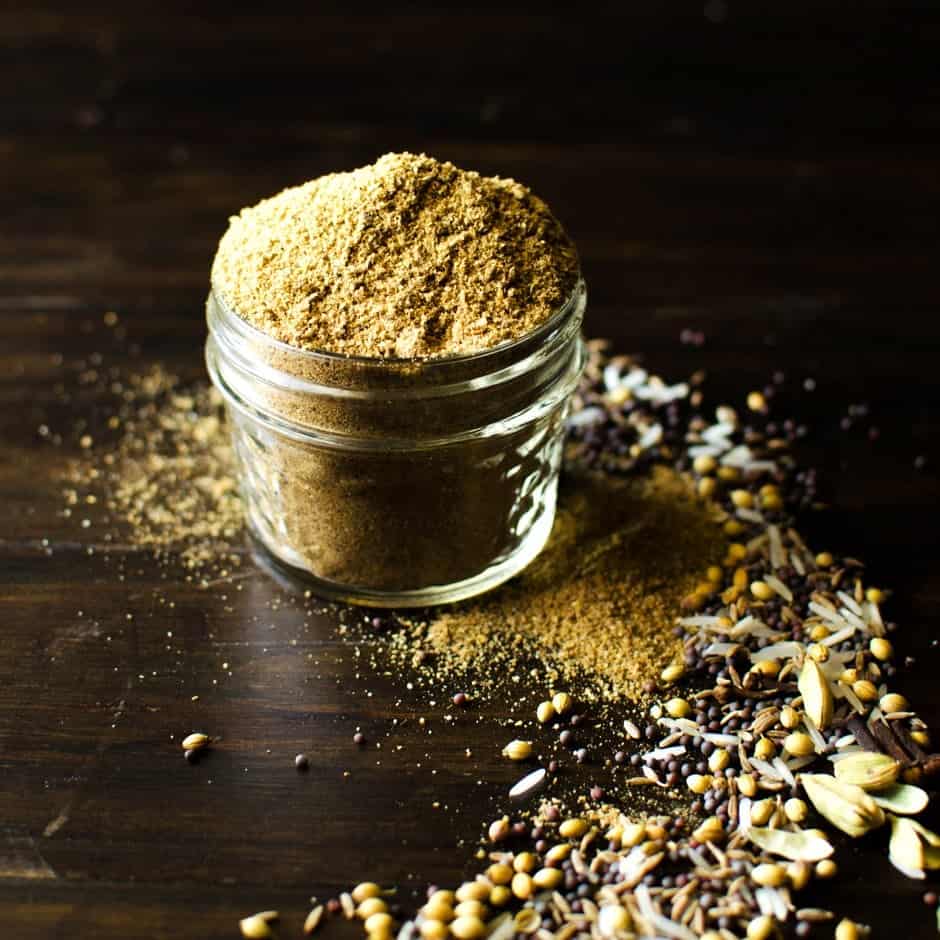
When the spices have cooled down, grind them in a spice grinder. I have my trusted grinder that I’ve been using for 8 years now, and I use this to ONLY grind spices with savory and spicy notes.
Since it’s a smaller grinder, I add the spices in batches until I have the curry powder finely ground and ready to be used (image 6).
Store the curry powder blend in a glass bottle or container with an airtight lid.

Recipe tips
- Make smaller batches, more often! This will ensure that you always have the freshest flavor from your spices.
- Preferably use whole spices. They taste better AND are cheaper to buy in bulk.
- Roasting the spices gives you a deeper, more complex flavor. BUT, to save time, it’s OK to use unroasted curry powder as well.
- This curry powder is adaptable (within reason). If you don’t like a particular spice, you can add less of it. Keep the main spices, but adjust the other spices, as long as you keep the proportions the same. I sometimes leave out the cloves and mustard if I feel like it. If I’m making a curry for someone who doesn’t love heat, I’d reduce the black pepper a little. I even reduce the cardamom sometimes, but still ALWAYS include some cardamom. I don’t always add curry leaves either.
- If you’re using pre-ground spices, then the flavor of the curry blend might not be as strong as when using whole spices.
- Do NOT add salt to your curry powder. Salt will make the spice blend go stale much faster.

How to use curry powder in your cooking
There are many ways to use curry powder in your cooking.
- Marinating meats. Curry powder can be added to raw meat to marinate it (like in this meatball curry for example). You can even mix it with yogurt and marinate meat for a curry, or even to grill.
- To make curries. Obviously. Adding curry powder to meat or vegetarian dishes is a great way to make your favorite curry recipe. Roasted curry powder is perfect for meats, while unroasted is more suitable for vegetable or fish curry. But, I also sauté unroasted curry powder with a little oil to deepen the flavor for meat curries.
- To finish dishes. Roasted curry powder is fantastic as a finishing spice for dishes. Sprinkle a little unroasted curry powder on top of meat curries, or lentil curry (dhal curry) for a fresh hit of the spices when you serve it to people.
- Adding spice to any meal. I love using curry powder for other types of meals that are not traditionally “curries”. Add some curry powder on your fried egg for a little extra flavor! Mix the curry powder into your chicken salad or egg salad.

Storage
Curry powder should be stored in an airtight container. This will prevent the spices from going stale too soon.
While curry powder doesn’t expire, it can go stale over time as the spices lose their potency. The time for this will depend on how fresh the spices were at the start.
If the curry powder is a lacking in flavor a little, you can still use it! But you may have to add more to get the same flavor.
Frequently asked questions
What’s the difference between curry powder and garam masala?
The term curry powder is a generic name for most spice blends. Whereas garam masala is the name of a particular spice blend. Masala means “mix of spices”, so it is a type of curry powder, just with a specific name! It can be used to make curry dishes, but usually other spices are also added to get a good balance of flavor.
Even this particular Sri Lankan curry powder is known as “thuna paha”, but the rest of the world knows it as “Sri Lankan curry powder”.
How to choose a good curry powder
Avoid using curry powders that include sugar and salt. These seasoning blends go stale much faster. Also avoid curry blends that include only turmeric, garlic, ginger, and onion powder (unfortunately several superstores in North America carry these less than mediocre “curry powders”).
Curry powder MUST include other spices such as coriander, cumin, black pepper, or chili powder.
What is a good substitute for curry powder?
A blend of spices is a great substitute for curry powder. Just the mix of coriander, cumin, and cardamom together is a great curry powder.
But please remember that ground turmeric is NOT a substitute for curry powder on its own, because turmeric powder is not the same as curry powder. But you can absolutely add turmeric to your curry powder blend.
Does curry powder expire?
Not really, but it will lose its flavor as the spices become stale and lose their potency. Salt can make the curry powder go stale even faster.
To make curry powder last longer, use whole spices and store the curry powder in an airtight container. Also, make smaller batches (more frequently), so that you have the freshest curry powder at all times.

Recipe
Easy Curry Powder (Sri Lankan Curry powder)
US based cup, teaspoon, tablespoon measurements. Weight measurements are recommended for accurate results whenever available.
Common Measurement ConversionsIngredients:
- 30 g coriander seeds 4 – 5 tbsp
- 30 g cumin seeds 3 tbsp
- 20 g black peppercorns 2 tbsp
- 20 g basmati rice 1.5 – 2 tbsp
- 5 g green cardamom seeds from about 20 – 30 green cardamom pods. Reduce by half for a more subtle cardamom flavor
- 6 g fennel seeds about 2 tsp
- 4 g whole cloves about 20 – 30 cloves. Leave out if you don't like cloves or reduce to 10– 15 for a more subtle clove flavor
- 4 g black mustard seeds optional, about 1 tsp
- 16 leaves curry leaves optional, you can use either dried or fresh leaves
Instructions:
- Remove the seeds from the cardamom pods and discard the husks.5 g green cardamom seeds
- Optional (if using fresh curry leaves) – Heat a skillet over medium low heat. When the pan is hot, add fresh curry leaves to dry them out on low heat. Keep moving the leaves around in the skillet so that they dry out evenly, and don't burn. Skip this step if you're not using curry leaves OR if you're using dried curry leaves. Remove the dried leaves and set aside.16 leaves curry leaves
- Place the rice in a dry non-stick pan. Heat over medium heat until the rice starts to turn light brown in color.20 g basmati rice
- Add the rest of the spices and the cardamom seeds to the rice, and pan roast for a further 2 – 4 minutes until the spices start to brown, toast, and become aromatic. The time will vary depending on the heat of your stove and the amount of spices in your skillet.30 g coriander seeds, 30 g cumin seeds, 20 g black peppercorns, 4 g whole cloves, 6 g fennel seeds, 4 g black mustard seeds
- Keep moving the spices around to prevent them from burning. I like to shake the pan to keep the spices moving, and doing this off heat from time to time will also help to evenly toast the spices. Make sure not to burn the spices, as this will result in a bitter curry powder.
- Remove from the heat and place all the toasted spices in a plate or bowl for the spices to cool down.
- Add the dried curry leaves to the spices and mix once or twice to allow the spices to cool down faster.
- Once the spices cool down, use a spice grinder (or a mortar and pestle) to grind the spice mix into a powder (in batches if needed), and mix well. Store in an airtight container.
- Use as needed.
Recipe Notes
Unroasted curry powder
Unroasted curry powder is the same as this, but the spices are not toasted in the pan. They are simply placed in a spice grinder and pulsed until finely ground.Which spices are the most important?
Coriander, cumin, black pepper, cardamom. Other ingredients can be left out if you don’t have them, or reduced to your liking. You can also use yellow mustard instead of black/brown mustard (if that is all you have access to).Notes about cloves
The ingredient ratio here is more of a guideline. If you don’t like cloves, please feel free to leave them out or add less. If you’re sensitive to the flavor of cloves, feel free to leave them out. The same goes for other spices as well.What is my curry powder is bitter?
If you find your curry powder to be bitter, it’s most likely because you toasted the spices for too long and burned them. It can also be bitter if your spices have gone rancid (especially mustard).How long can I keep this?
Please note that ground spices don’t retain their freshness as well as whole spices do. This is why I prefer making small batches of this with whole spices when needed. Every time I make the curry powder, the longest it has lasted in my kitchen is 2 weeks before I need to make a new batch, but usually I make this once a week. I make a double batch because we make a lot of curry recipes at home. I personally prefer making small batches every time, to keep each batch fresh at all times.Nutrition Information:
“This website provides approximate nutrition information for convenience and as a courtesy only. Nutrition data is gathered primarily from the USDA Food Composition Database, whenever available, or otherwise other online calculators.”














Leave a Reply