


Skip to content
About
My Cookbooks
Work With Me
Contact
  • Facebook
  • Instagram
  • Pinterest
  • X
  • YouTube
The Flavor Bender

Master the Science of Delicious

  • Recipe Index
    • All Recipes
    • Desserts
      • Cakes & Cupcakes
      • Candy & Bite Sizes
      • Chocolate
      • Cookies, Brownies & Bars
      • Frozen Desserts
      • Fruit Desserts
      • Puddings & Custards
      • Dessert drinks
      • No Bake
      • Pastries & Breads
      • Sweet Syrups & Spreads
      • Tarts & Pies
      • Cheesecakes
      • Healthy sweets
    • Breakfasts
      • Tarts, Quiches, & Pies
      • Waffles, Pancakes & Crepes
      • Quick Breads, Scones & Muffins
      • Breakfast Sandwiches
      • Breakfast Pastries
      • Eggs
      • Breakfast & Brunch Drinks
      • Make Ahead Breakfasts
      • Healthy Breakfasts
      • Coffee and Tea drinks
      • Breakfast Smoothies & Juices
      • Breakfast Sides
      • Casseroles
      • Jams & Spreads
    • Courses
      • Main Meals
        • Bread, Sandwiches & Burgers
        • Curries
        • Salads
        • Roasts & BBQ
        • Soups & Stews
        • Casseroles
      • Bread
      • Lunch
      • Beverages
      • Appetizers & Tapas
      • Sides
      • Dips & Condiments
      • Tea Time & Snacks
      • Desserts
      • Meal Prep
      • Cocktails
      • Pet Friendly Recipes
    • Cuisines
      • American
      • European
      • Australasian
      • Sri Lankan
      • East Asian
      • Mexican
      • Middle Eastern
      • South Asian
    • Sri Lankan
      • Main Meals
      • Drinks
      • Desserts
      • Breakfasts
      • Snacks
    • Skill Level
      • Easy
        • Easy Desserts
        • Easy Cooking
        • Easy Breads
        • Easy Breakfasts
        • Easy Dinners
      • Intermediate
        • Intermediate Desserts
        • Intermediate Cooking
        • Intermediate Breads
        • Intermediate Breakfasts
        • Intermediate Dinners
      • Advanced
        • Advanced Desserts
        • Advanced Cooking
    • Recipes by Season
      • Christmas
      • Fall & Winter
      • Halloween
      • Spring & Summer
      • Thanksgiving
      • Valentines Day
    • Recipes by Diet
      • Dairy Free
      • Eggless
      • Gluten Free
      • Paleo
      • Vegan & Vegetarian
    • Recipe Basics
      • Baking Basics
      • Cooking Basics
      • Baking & Cooking 101
  • New? Start Here
  • Measurement Conversions
  • How-To Posts
  • About
  • My Cookbooks
  • Work With Me
  • Contact
The Flavor Bender   ›   Recipes   ›   Delicious Desserts   ›   Fruit Desserts   ›   How to Make Passion Fruit Curd (Filling & Topping Recipe)

How to Make Passion Fruit Curd (Filling & Topping Recipe)

Author:

Dini Kodippili


Jump to Recipe


Updated: 11/7/2026
Total Time35 minutes mins
Quick and Easy Recipes
Fruit Desserts
Passion Fruit Curd - A deliciously creamy and tangy passion fruit curd! A great addition to any dessert and adds a refreshing tropical flavor. Freezer friendly too. 

If you enjoy passion fruit and want to preserve the wonderful tropical flavor of this fruit for longer, this deliciously creamy, rich, buttery passion fruit curd (passion fruit butter) is the perfect recipe!

Only 5 ingredients and 35 minutes of total time for a spreadable fruit curd that’s packed with tangy, refreshing citrus flavor. And use it as a filling or topping or spread on a variety of desserts and snacks!
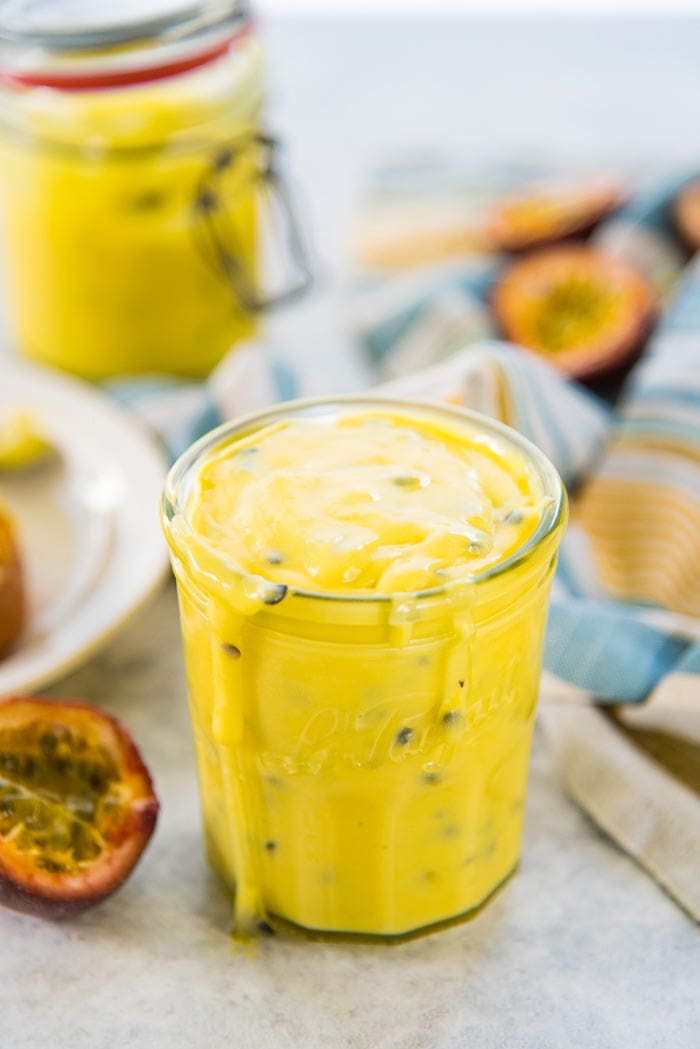
Creamy passion fruit curd in a glass with seeds visible. Fresh passion fruit halves seen in the background.

I absolutely adore passion fruit. Growing up in Sri Lanka, it was a fruit that we enjoyed in abundance. This passion fruit mango compote was one we made often as a fruity, delicious topping for a variety of desserts.

Living in Missouri now though, it’s not a fruit that I come by often these days unfortunately, and even when I do fine them, they are ridiculously expensive. So, I usually buy enough to preserve them for later use.

Ingredients for passion fruit curd on a grey table, including fresh passion fruit pulp, unsalted butter, lemon juice and egg yolks.

Preserving passion fruit

There are TWO main ways that I use to preserve this gorgeous fruit. One is to make passion fruit syrup that I can freeze for later. I love making fruit syrups, and my summers are usually spent making a variety of them (like this rhubarb syrup, lychee syrup, grilled pineapple syrup, lemon syrup etc.)

OR my second favorite way is to make passion fruit curd (which is also sometimes referred to as passion fruit butter).

You can freeze both of these for later, which makes them ideal ways to preserve passion fruit.

Sugar and passion fruit pulp with seeds in a large glass bowl.
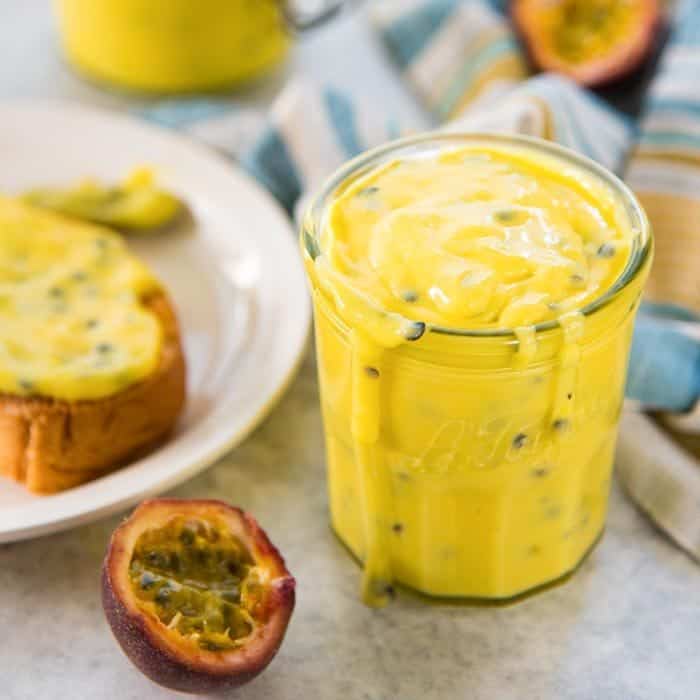
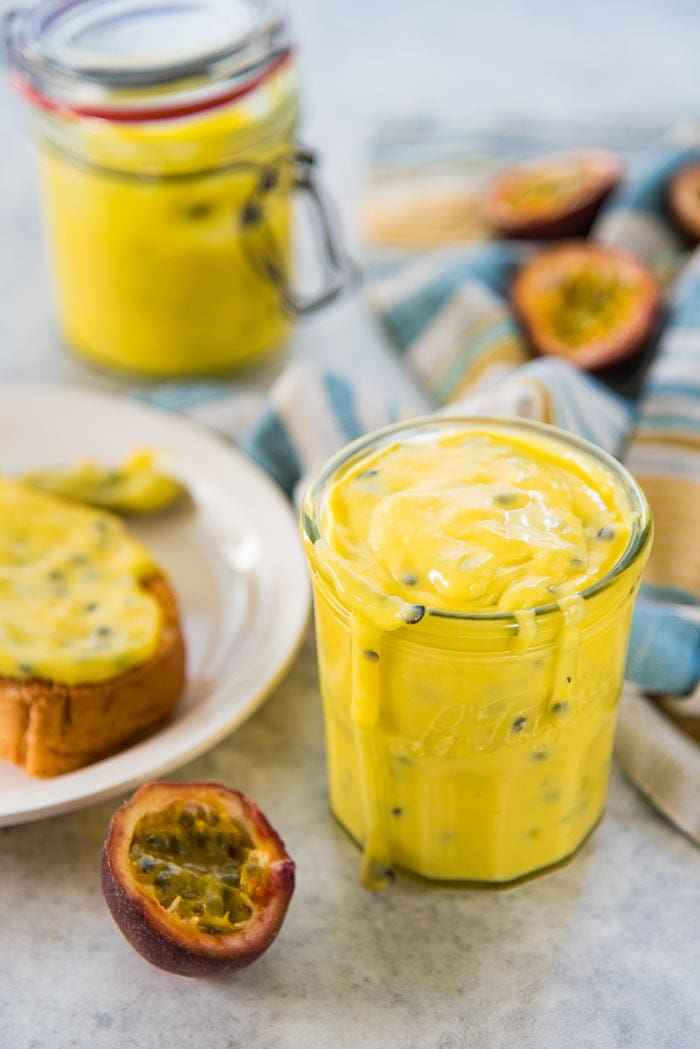
Creamy passion fruit curd in a glass jar, and a toast spread with the fruit curd next to it on a small plate.

What is passion fruit curd?

Passion fruit curd is basically a type of fruit preservative made with passion fruit, lemon, sugar, butter, and thickened with eggs and/or egg yolks.

If you like lemon curd or lime curd, then you’ll LOVE passion fruit curd. It’s basically a passion fruit custard that’s packed with tropical citrus flavor, and delightfully creamy and buttery! I put it on pretty much everything! 🙂

Whatever you put lemon curd on, will be even better with this passion fruit curd. With the added floral, tropical flavor of passion fruit, it really enhances the flavor profile of anything that you pair it with.

Passion fruit curd vs lemon curd

Lemon curd is made with just lemon juice as the citrus flavor. Whereas, for passion fruit curd, we use passion fruit pulp / juice as the main flavor, with the addition of lemon or lime to bring out the tangy citrus flavors of passion fruit!

They both are made in a similar way, where you mix the juice together with eggs, sugar, water (sometimes), and butter to make a thick, creamy, sweet, tangy, spreadable condiment. Which is why it’s also called passion fruit butter sometimes.

It’s like custard or pastry cream, where the milk or dairy is replaced with citrus juice, or a combination of other fruits and citrus (as explained in this custard desserts roundup post).

Butter added to the warm passion fruit pulp in a large glass bowl, and whisked to melt and emulsify it.

Ingredients you’ll need

  • Passion fruit pulp – I prefer to use pulp with the seeds, IF I can find them. If I can only find passion fruit juice (100% juice), then I will use that instead, but the curd might not be as thick then.
  • Lemon juice – You can also use lime juice. The addition of lemon or lime juice will increase the acidity and bring out more of the fruity flavors of tropical passion fruit.
  • Sugar – To add sweetness. I like my curd to be more tangy, so I add less sugar than other recipes. You’re welcome to add double the amount of sugar if you want it sweeter.
  • Butter – This adds to the creaminess of the curd! Makes the final curd rich and creamy.
  • Yolks – The egg yolks also add to the creaminess and richness, and also helps with thickening the curd.

How to make passion fruit curd

Usually, when you make lemon curd, there’s room for small mistakes. If the curd starts to lump up, you can rescue it by passing the curd through a sieve.

But with passion fruit curd, it’s harder to pass it through a sieve because of the seeds, so you have to be more careful to not let any lumps form. So you will need to cook the passion fruit curd over low heat, very slowly.

But the good news is that there’s a way for even complete novices to make this passion fruit curd perfectly!

Two methods to make this passion fruit curd recipe

  • Method 1 – Direct heat cooking on the stove. This is for more confident and experienced cooks. If you’re confident with your custard making skills (with cornstarch), or lemon curd making skills, then follow this stovetop method. This way is quicker, but requires you to stay near the stove, stirring the curd the whole time. The direct heat can cause lumps to form easily (because the eggs are scrambling), so it’s important to keep the curd moving and stirring constantly to prevent that from happening.
  • Method 2 – Indirect heat cooking in a double boiler. This is the best way for less experienced cooks who prefer to be more careful. Cooking the passion fruit curd this way allows the curd to cook over a lower, less harsh heat. You still have to stir the curd, but not continuously. This method is less likely to scramble the eggs. The trade off is that it takes longer to cook the curd this way.
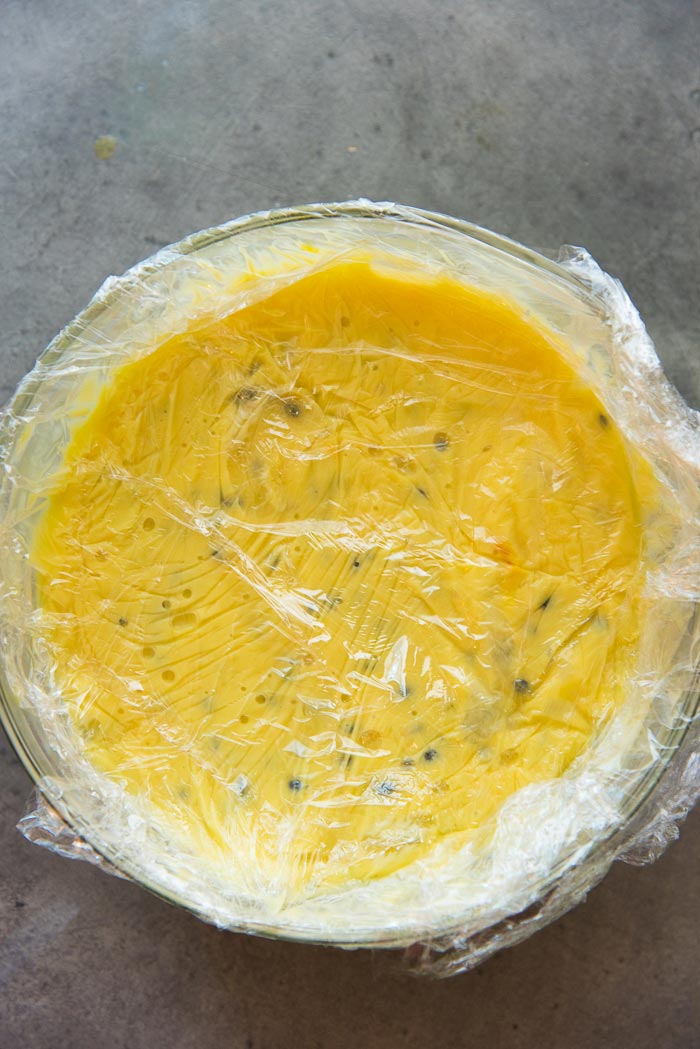
Cooked and thickened passion fruit curd in a large glass bowl covered with plastic wrap.

I prefer to use the first method when I’m making a big batch of this passion fruit crud. Mostly because it’s actually faster this way when I’m making large portions. The large quantity of ingredients acts as a buffer against the heat.

HOWEVER, if I’m making a single batch, then I usually go with the double boiler method because there’s not enough ingredients to form a buffer against the heat, and it’s more likely to scramble the eggs and result in lumps.

And since passion fruits are hard to come by AND expensive, I want to be extra careful that I make the best of my precious passion fruits! 🙂

A creamy, bright yellow, passion fruit curd (passion fruit butter) in a jar with a spoon. Fresh passion fruits seen next to it.

Should I use whole eggs or egg yolks?

I prefer to add egg yolks because it yields a richer and thicker passion fruit curd. But if you prefer it runny, then you can reduce the amount of egg yolks, OR replace 2 of the egg yolks with 2 whole eggs.

Conversely, if you want the passion fruit curd to be very thick and spoonable (like Greek yogurt or pastry cream), then you will need to add more egg yolks (about 2 more than directed in the recipe here).

Bright yellow and creamy passionfruit curd in a glass jar with a spoon resting on top with some curd in it.

Why is it important to cook the fruit curd up to 160°F?

I like to be able to make this passion fruit curd and then store it in the freezer for up to 3 months. To be able to do this, then I need to make sure that the eggs are completely pasteurized, so that they don’t go bad early.

So the eggs need to be cooked to a temperature of 160°F. I use my temp. probe to keep track of the temp. of the passion fruit curd because it’s simply the most accurate way to do so.

But you can still make this passion fruit curd even if you don’t have a temp. probe, just make sure to cook it until it’s thickened as much as possible, and for this recipe, it needs to be cooked at least 15 minutes (over direct heat), and 20 – 30 minutes (over indirect heat).

A thin layer of passion fruit curd spread on a piece of toast, and served on a white plate.

How to use and serve passion fruit curd

This delicious passion fruit preserve is super versatile!

  • Use it to top your toasts, toasted English muffins or crumpets.
  • Top French toast, brioche French toast, sheet pan pancakes, or waffles.
  • Mix a spoonful with Greek yogurt for an awesome afternoon snack.
  • Add a spoonful to your breakfast granola bowl.
  • Mix the passion fruit curd with vodka for a creamy and delicious cocktail (like this lemon meringue pie cocktail, but with passion fruit!).
  • Fill sweet shortcrust pastry tart shells or phyllo cups or macarons with the passion fruit curd for an easy tropical dessert, perfect for potlucks and dinner parties.
  • Make a stunning passion fruit pie with this curd and meringue topping.
  • Passion fruit curd is the perfect topping for desserts like ice cream, panna cotta, croissant bread pudding, meringues cookies, or pavlova.
  • It’s the perfect filling or topping for cakes (including angel food cakes, sponge cakes or layered cakes). For example, I made this lemon raspberry cake with a lemon curd filling.
  • Top a bowl of freshly cut fruits with this tangy fruit curd.
  • Or just eat it by the spoonful! 🙂
A thick and luscious passion fruit curd in a glass jar with fresh passion fruits seen next to it.

Recipe FAQs

How long does passion fruit curd last?

Since passion fruit curd contains eggs, it’ll only last about 5 – 7 days in the fridge. However, if stored in unopened, sterilized jars, they should last about 3 weeks in the fridge. It’s important to follow proper food handling guidelines, such as using clean spoons, and not leaving out the curd at room temperature for long periods of time.

You can also freeze it for about 3 months! The consistency might be a little different, so it’s important to mix it really well once you thaw it out.

Why is my passion fruit curd runny?

This happens if the curd wasn’t cooked long enough, or cooked on too low of a heat where it didn’t reach the correct temperature.

It can also happen if you used too much liquid or if you used margarine instead of butter.

Can I make passion fruit curd without eggs?

You can follow a vegan passion fruit curd recipe for a recipe without eggs. Usually, the thickener used instead of eggs is cornstarch.

However, I haven’t tested it myself, so I can’t recommend how much cornstarch to use in place of eggs in this recipe.

Recipe
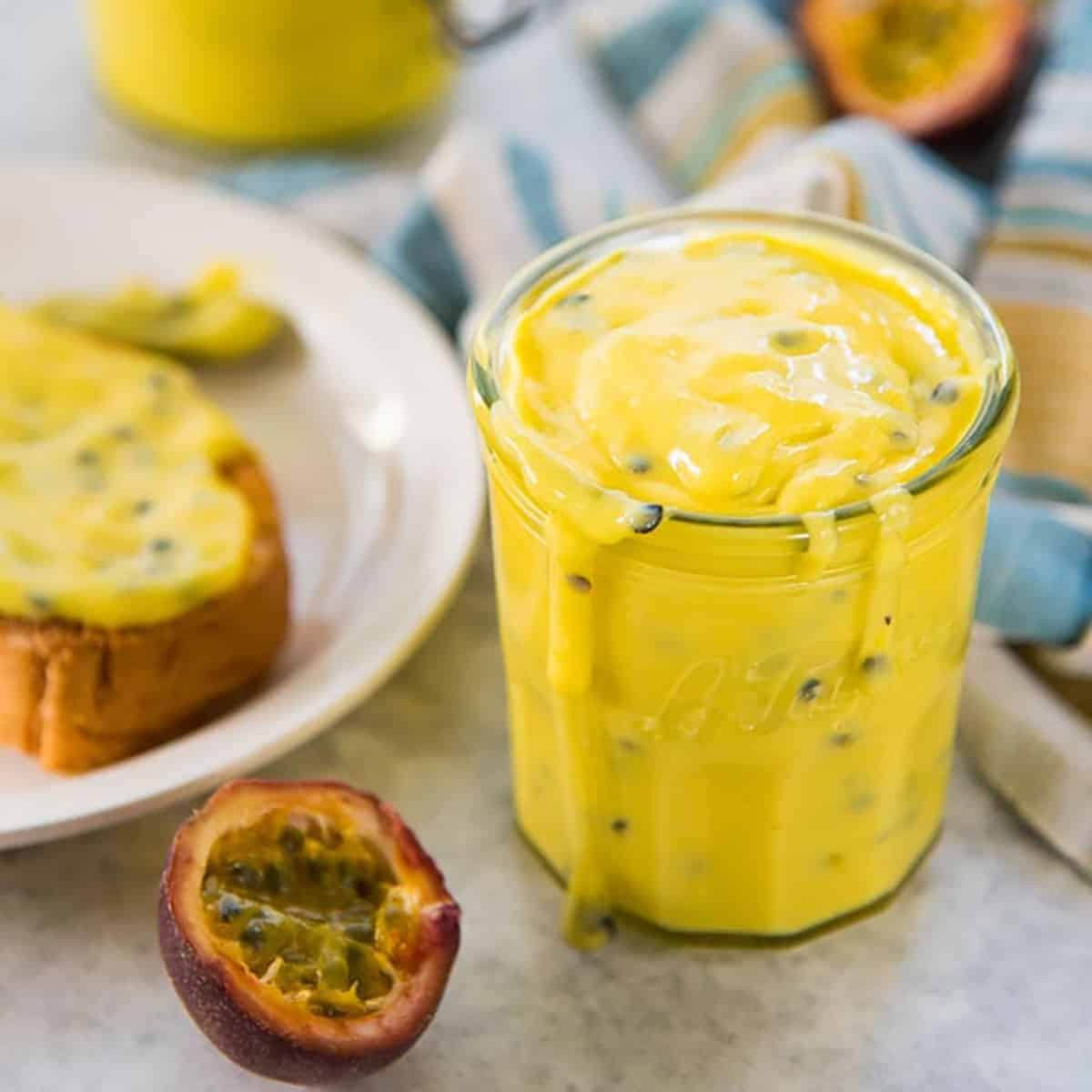
Creamy passion fruit curd in a glass jar, and a toast spread with the fruit curd next to it on a small plate.
4.9 from 49 votes

Passion Fruit Curd

Author: Dini Kodippili
Cuisine: European
Passion Fruit Curd - A deliciously creamy and tangy passion fruit curd! A great addition to any dessert and adds a refreshing tropical flavor. Freezer friendly too. 
Flask image

 Difficulty: 

Easy
An easy, creamy, rich, buttery passion fruit curd that tastes like a passion fruit custard packed with tropical citrus flavor! Made with passion fruit, lemon, sugar, and butter, and thickened with eggs and / or egg yolks.
EASY – Easy recipe, perfect for beginner cooks. I provide two methods to make it: the direct heat method for more experienced cooks or if you're making a bigger batch, and the indirect heat double boiler method for a single batch.
Makes about 1 1/4 cups of passion fruit curd.

US based cup, teaspoon, tablespoon measurements. Weight‌ ‌measurements‌ ‌are‌ ‌recommended‌ ‌for‌ ‌accurate‌ ‌results whenever available.

Common Measurement Conversions
Prep: 5 minutes mins
Cook: 30 minutes mins
Total Time: 35 minutes mins
Print Recipe Rate SaveSaved!
Makes: 10 servings (2 tbsp each)

Ingredients:
 

  • ½ cup passion fruit pulp 3 – 4 passion fruits, depending on the size
  • 2 tbsp lemon juice
  • ¼ cup sugar
  • 6 tbsp unsalted butter
  • 4 egg yolks (from large eggs)

Instructions:
 

Indirect heat method (ideal for a single batch)
  • Place the passion fruit pulp and sugar in a heat-proof glass bowl or the top of a double boiler.
  • Heat a few inches of water in a saucepan or in the bottom part of a double boiler, and bring the water to a boil. Then lower the heat to a simmer.
  • Place the bowl of passion fruit pulp and sugar on the saucepan or the double boiler, and whisk for a few minutes to warm up the ingredients and dissolve the sugar.
  • Add the egg yolks and lemon juice into a separate jug or bowl, and whisk to form a smooth paste.
  • Pour the warm passion fruit and sugar in a thin stream into the eggs, WHILE constantly whisking to temper the eggs.
  • Next, pour the egg and passion fruit mix back into the bowl, and return the bowl to the double boiler.
  • Add the unsalted butter to the warm passion fruit curd. The butter will melt as the passion fruit curd heats, and the whisking / stirring will help emulsify the butter into the passion fruit curd. 
  • Stir well (or whisk) frequently, while cooking the passion fruit egg mix.
    Make sure to not let the mixture set at the bottom of the bowl (this will cause the eggs to overcook).
    Stir or whisk frequently until the passion fruit curd thickens. This can take up to 10 – 20 minutes (the time depends on the bowl and the heat).
  • The most accurate way to ensure the passion fruit curd is cooked well is to use a temperature probe and check the temperature of the curd often, in between whisking. When the passion fruit curd registers 160°F, it's ready!
Direct heat method (better for double batches)
  • Place the passion fruit pulp and sugar in a small saucepan. Then place the saucepan over low-medium heat and heat while stirring until the sugar has dissolved.
  • Add the egg yolks and lemon juice into a separate jug or bowl, and whisk to form a smooth paste.
  • Pour the warm passion fruit and sugar in a thin stream into the eggs, while constantly whisking to temper the eggs.
  • Next, pour the egg and passion fruit mix back into the saucepan, and return the saucepan to the stove.
  • Add the unsalted butter to the warm passion fruit curd. The butter will melt as the passion fruit curd heats, and the whisking will help emulsify the butter into the passion fruit curd.
  • Stir well (or whisk) constantly, while cooking the passion fruit egg mix. I prefer to use a rubber spatula to prevent any scratching of the saucepan. Make sure to scrape the bottom and sides so that the egg doesn’t cook and stick to the bottom. It's very important to keep the passion fruit curd constantly moving to prevent curdling (i.e. eggs cooking).
  • Stir or whisk frequently until the passion fruit curd thickens. This can take up to 10 minutes (the time depends on the heat of the stove, lower heat gives you better control over the cooking process, but will take longer). It can take up to 15 – 20 minutes for double batches.
  • If you feel that the curd is heating too fast, remove the saucepan from the heat and mix well to disperse the heat.
  • The most accurate way to ensure the passion fruit curd is cooked well is to use a temperature probe and check the temperature of the curd often, while stirring. When the fruit curd registers 160°F, then it's ready!
Cooling and storing passion fruit curd
  • Sterilize a 1 x 11 oz glass jar (324 mL) and sealable lid in boiling water.
  • Remove the sterilized jar from the water and pour the hot passion fruit curd into the jar.
  • Close the jar with the lid. Store in the fridge overnight to completely chill the curd.
  • The passion fruit curd will last in the fridge for about 3 weeks (with unopened sterilized jars), or about 5 – 7 days with unsterilized jars or bowls.
  • OR it will last longer in the freezer (up to 3 months). Once opened, use within 7 days for best results.

Nutrition Information:

Calories: 100kcal (5%) Carbohydrates: 8g (3%) Protein: 1g (2%) Fat: 8g (12%) Saturated Fat: 5g (31%) Cholesterol: 96mg (32%) Sodium: 7mg Potassium: 48mg (1%) Fiber: 1g (4%) Sugar: 6g (7%) Vitamin A: 465IU (9%) Vitamin C: 4.7mg (6%) Calcium: 13mg (1%) Iron: 0.4mg (2%)

“This website provides approximate nutrition information for convenience and as a courtesy only. Nutrition data is gathered primarily from the USDA Food Composition Database, whenever available, or otherwise other online calculators.”

Tag me on Instagram!I love seeing what you’ve made! Tag me on Instagram at @TheFlavorBender or leave me a comment & rating below.

Dini Kodippili Avatar

About

Dini Kodippili

Dini Kodippili is a professional food writer, recipe developer, food photographer, cookbook author, and baker. Dini has been featured on HuffPost, Cosmopolitan, Forbes, Delish, Food & Wine and more. Learn More

I love hearing from you! Submit your question or recipe review here.

4.92 from 49 votes (5 ratings without comment)

Leave a Reply Cancel reply

Your email address will not be published. Required fields are marked *

Made this? Rate this recipe:


This site uses Akismet to reduce spam. Learn how your comment data is processed.

124 responses

  1. Lisa
    November 12, 2026

    Easy and delicious but barely made 1 serving. Am I missing something?

    Reply
    1. Dini Kodippili
      November 16, 2026

      Hi Lisa
      Unless the ingredient amounts were changed, it is impossible for this recipe to only make one serving. If it were cooked down too much, then the curd also risks becoming lumpy due to the egg yolks too.
      The recipe makes at least 1 cup of passion fruit curd.
      I hope that helps!

      Reply
  2. Rebecca Chavez
    September 18, 2026

    5 stars
    Can I use frozen passion fruit pulp from the grocery? I’m sure it will work fine, but I was wondering if you’ve had experience with the frozen kind?

    Reply
    1. Dini Kodippili
      October 31, 2026

      Hi Rebecca
      If it is 100% pulp, then it should work.

      Reply
  3. Shan
    June 10, 2026

    5 stars
    Made this today using the double boiler method. Absolutely sensational. I can see why a serving suggestion is to eat it straight from the jar. Swoon 🥰

    Reply
  4. Kelly
    April 3, 2026

    Hi Dini, can this be made with salted butter? Do you think it will have a significant impact on flavour? Or will it impact how it cooks/sets at all?

    Really looking forward to trying this!

    Reply
    1. Dini Kodippili
      April 6, 2026

      Hi Kelly
      You can use salted butter, as it won’t affect the consistency of the curd. However, it will add a saltiness to the curd flavor.
      How much saltiness, will depend on the salt level in the butter.
      If this change in flavor is ok with you, you can absolutely use salted butter.
      I hope that helps!

      Reply
  5. Z
    January 31, 2026

    Hi Dini, how much is 6 tbsp unsalted butter in grams ?

    Thanks you for letting me know !

    Reply
    1. Dini Kodippili
      February 6, 2026

      Hi Z
      It’s about 85 g. 1 tbsp of butter is about 14.125 g. The metric measurements are included in the recipe card (you can access it with the Metric / US Customary toggle button under the ingredients list).

      I hope that helps! 🙂

      Reply
  6. Kristina
    October 22, 2025

    I’d love to make this recipe and I’m wondering if I can use freeze dried passion fruit? We don’t have fresh passion fruit locally (ever, sadly) but I can buy freeze dried online. Would this recipe work if I make powder from them or rehydrate them?

    Reply
    1. Dini Kodippili
      October 22, 2025

      Hi Kristina
      I can’t think of a reason why it wouldn’t work, especially if it’s reconstituted prior to making the curd. But, I haven’t tried it myself so I can’t be 100% sure.
      My only concern would be if the freeze dried powder will dissolved fully and not lead to a grainy mouthfeel.
      But if you do try it, please let me know how it came out!

      Reply
  7. Julie Baird
    September 23, 2025

    5 stars
    I’ve used this recipe a few times and it my passion fruit curd has come out perfectly delish each time. In addition to the fresh squeezed lemon i did add a squeeze of lime.
    Perfect way to use these yummy fruits!

    Reply
  8. Cher Stephen
    July 19, 2025

    5 stars
    So easy and so tasty!

    Reply
  9. Sarah
    July 12, 2025

    Unfortunately this recipe didn’t work for me. I followed the directions exactly using indirect heat but it had a very eggy and mettalic flavour

    Reply
    1. Dini
      July 17, 2025

      Hi Sarah
      This recipe has worked for many readers, so I’m not sure what happened for it to not work for you.
      The curd is only usually eggy, when the eggs are old, scrambled or not cooked properly. The metallic flavor comes from the bowl and whisk that you used reacting with the acidic ingredients.
      That is why non reactive metals are generally used to with acidic ingredients.
      I hope that helps

      Reply
  10. Norma schreuder
    May 9, 2025

    5 stars
    This is the easiest and best curd I have ever made

    Reply
  11. Scott
    April 10, 2025

    5 stars
    Just made this today and it’s exquisite!!

    Reply
  12. Namali
    January 25, 2025

    5 stars
    This is my go-to passion curd recipe. I do the double-boiler method even for big batches and it always comes out great! Thank you.

    Reply
  13. Eli
    January 13, 2025

    The consistency was so beautiful, the only thing is the lemon was very overpowering. Is there a reason to add the lemon or is it just to give it more of a flavor punch and can you use less of it so the passion fruit comes through ?

    Reply
  14. Andrea Usher
    October 15, 2024

    5 stars
    Hi! I accidentally used whole eggs instead of just egg yolks! I got distracted. Will this still be okay to eat?

    Reply
    1. Dini
      October 16, 2024

      Hi Andrea
      It will absolutely be ok to eat if it was cooked properly. But it won’t be as thick because of the additional liquid from the egg whites. And the flavor might not be as strong because it’s diluted more due to the extra egg whites as well.

      Other than that, it is safe to eat!

      Reply
  15. Mimi Rippee
    July 18, 2024

    This is outstanding! I could just eat it with whipped cream!

    Reply
  16. Brenna
    May 10, 2024

    Ok, this is amazing! I did add a bit more sugar and I strained the seeds too but I used this as a filling for vanilla cupcakes and everyone was obsessed. Definitely going to try to find other creative ways to use this passion fruit curd!

    Reply
  17. MJ
    April 1, 2024

    5 stars
    Super delicious

    Reply
  18. Mayreen
    March 1, 2024

    5 stars
    Best recipe I’ve come across. Tried lots as well. Everyone tells me how nice it is.

    Reply
  19. Rochelle
    February 13, 2024

    5 stars
    Absolutely perfect

    Reply
←Older Comments
1 2 3 4

Hey There!

Hi! I’m Dini, a third culture kid by upbringing and a food-geek by nature. I was born in Sri Lanka, grew up in New Zealand and lived in Australia, and then the US, before moving to and settling down in Canada. My food is a reflection of those amazing experiences!

Read More
Front cover of the Secret Layer Cakes cookbook by Dini Kodippili.

The Flavor Bender

Cookbook

Buy now on Amazon!

Recipe Basics

  • How To Make Perfect Choux Pastry

    How To Make Perfect Choux Pastry

  • Flaky All Butter Pie Crust Recipe

    Flaky All Butter Pie Crust Recipe

  • How To Make Homemade Marshmallows (Foolproof Guide)

    How To Make Homemade Marshmallows (Foolproof Guide)

  • The Best Homemade Bread (White Bread Recipe)

    The Best Homemade Bread (White Bread Recipe)

  • Homemade French Croissants (Step By Step Recipe)

    Homemade French Croissants (Step By Step Recipe)

  • The BEST Pavlova Recipe (Step by step recipe and video)

    The BEST Pavlova Recipe (Step by step recipe and video)

Featured On

Master the science of baking!

Get my FREE Printable Charts!

So you’ll know how to substitute cake pans of different shapes, sizes & volumes, and how to convert ingredient measurements in a pinch!

Must have resources for all pro bakers, novice bakers, and aspiring bakers alike!

Download now!

Reader Faves

  • How to make the Best Instant Pot Short Ribs

    How to make the Best Instant Pot Short Ribs

  • Perfect Quick and Easy Rough Puff Pastry

    Perfect Quick and Easy Rough Puff Pastry

  • The Best Spicy Sweet Chili Sauce (Easy Recipe!)

    The Best Spicy Sweet Chili Sauce (Easy Recipe!)

  • The Best Homemade Bread (White Bread Recipe)

    The Best Homemade Bread (White Bread Recipe)

The Flavor Bender

I love baking, cooking, experimenting with flavors and ingredients, and passing on all my tips and tricks to you!

Read More

About

Meet Dini
My Book
Work With Me
Contact

Browse

Recipes
Measurement Guide
Baking How-To’s
Shop My Faves
Privacy
Disclosure
Terms

Branding by MRD

Theme by OC

Back to Top
  • Facebook
  • Instagram
  • Pinterest
  • X
  • YouTube
4044 shares

Rate This Recipe

Your vote:


A rating is required
A name is required
An email is required

Recipe Ratings without Comment

Something went wrong. Please try again.