



About
My Cookbooks
Work With Me
Contact
  • Facebook
  • Instagram
  • Pinterest
  • X
  • YouTube
The Flavor Bender

Master the Science of Delicious

  • Recipe Index
    • All Recipes
    • Desserts
      • Cakes & Cupcakes
      • Candy & Bite Sizes
      • Chocolate
      • Cookies, Brownies & Bars
      • Frozen Desserts
      • Fruit Desserts
      • Puddings & Custards
      • Dessert drinks
      • No Bake
      • Pastries & Breads
      • Sweet Syrups & Spreads
      • Tarts & Pies
      • Cheesecakes
      • Healthy sweets
    • Breakfasts
      • Tarts, Quiches, & Pies
      • Waffles, Pancakes & Crepes
      • Quick Breads, Scones & Muffins
      • Breakfast Sandwiches
      • Breakfast Pastries
      • Eggs
      • Breakfast & Brunch Drinks
      • Make Ahead Breakfasts
      • Healthy Breakfasts
      • Coffee and Tea drinks
      • Breakfast Smoothies & Juices
      • Breakfast Sides
      • Casseroles
      • Jams & Spreads
    • Courses
      • Main Meals
        • Bread, Sandwiches & Burgers
        • Curries
        • Salads
        • Roasts & BBQ
        • Soups & Stews
        • Casseroles
      • Bread
      • Lunch
      • Beverages
      • Appetizers & Tapas
      • Sides
      • Dips & Condiments
      • Tea Time & Snacks
      • Desserts
      • Meal Prep
      • Cocktails
      • Pet Friendly Recipes
    • Cuisines
      • American
      • European
      • Australasian
      • Sri Lankan
      • East Asian
      • Mexican
      • Middle Eastern
      • South Asian
    • Sri Lankan
      • Main Meals
      • Drinks
      • Desserts
      • Breakfasts
      • Snacks
    • Skill Level
      • Easy
        • Easy Desserts
        • Easy Cooking
        • Easy Breads
        • Easy Breakfasts
        • Easy Dinners
      • Intermediate
        • Intermediate Desserts
        • Intermediate Cooking
        • Intermediate Breads
        • Intermediate Breakfasts
        • Intermediate Dinners
      • Advanced
        • Advanced Desserts
        • Advanced Cooking
    • Recipes by Season
      • Christmas
      • Fall & Winter
      • Halloween
      • Spring & Summer
      • Thanksgiving
      • Valentines Day
    • Recipes by Diet
      • Dairy Free
      • Eggless
      • Gluten Free
      • Paleo
      • Vegan & Vegetarian
    • Recipe Basics
      • Baking Basics
      • Cooking Basics
      • Baking & Cooking 101
  • New? Start Here
  • Measurement Conversions
  • How-To Posts
  • About
  • My Cookbooks
  • Work With Me
  • Contact
The Flavor Bender   ›   Recipes   ›   Recipes by Course   ›   Homemade Bread Recipes   ›   Brioche Bread Recipe

Brioche Bread Recipe

Author:

Dini Kodippili


Jump to Recipe

Jump to Video


Updated: 9/5/2020
Total Time1 day d 1 hour hr 45 minutes mins
Intermediate Recipes
Homemade Bread Recipes

This brioche bread is ultra soft, rich, and buttery! Not only delicious to eat, but easy to make too! Perfect for sandwiches, French toast and just to eat on its own.

Learn how to make authentic brioche bread with this step by step recipe. Plus, now you can make Brioche Burger Buns or Brioche Cinnamon Rolls too!

Overhead view of two brioche loaves on a blue and white cloth napkin.

A few weeks ago, I was able to live one of my life-long dreams! Granted, it’s only a small part of my dream, but it was still an amazing, fun experience!

A short course in Viennoiseries at Le Cordon Bleu was everything I dreamed it would be, and more!

Contents
 [hide]
  • What is brioche?
  • Why this is the best brioche bread recipe
    • Professional recipe vs my brioche recipe
    • Understanding dough
    • Can I make brioche bread without a stand mixer?
  • So let’s make brioche
    • Shaping the bread loaves
    • Braided brioche loaf
    • Nantaise brioche loaf
    • What to do if your brioche was over-proofed?
  • How to enjoy brioche bread
    • What to do with leftover brioche?
  • Brioche; Frequently Asked Questions
JUMP TO RECIPE

Living a dream

Going to Le Cordon Bleu had been a dream since I realized there was a profession called “pastry chef”. After I completed my bachelors, I was itching to enroll at Le Cordon Bleu in Sydney, Australia for a grand diploma, but had to change my plans because my parents didn’t approve of that career path. I should’ve stuck to my guns in hindsight, but hindsight is 20/20 as they say.

So I chose my next love for grad school – science. I still have regrets about not living out that dream, but there still may be an opportunity on the horizon for me. Especially, if I get chances to do short courses like this at the Le Cordon Bleu in Ottawa from time to time! 🙂

So if you’re reading this, and contemplating about your dreams, it’s never too late, and don’t compromise on a dream that you’re passionate about.

Learning the techniques, tips and tricks for making viennoiseries was a fantastic experience! And today, I’ll be sharing all of that with you, so you can make the best brioche bread at home too!

Cross section of a perfectly baked French croissant showing the honeycomb crumb.
The crumb of the croissants I made.

What is brioche?

Brioche bread is a French bread, and a cross between a pastry and bread.

This is because the bread is enriched with butter and eggs. It belongs to the family of viennoisseries (think croissants, pain au chocolat, bostock pastry, Danish pastries, sweet rolls etc.).

It’s a very buttery, soft and delicious bread and can be made into sweet brioche or savory brioche.
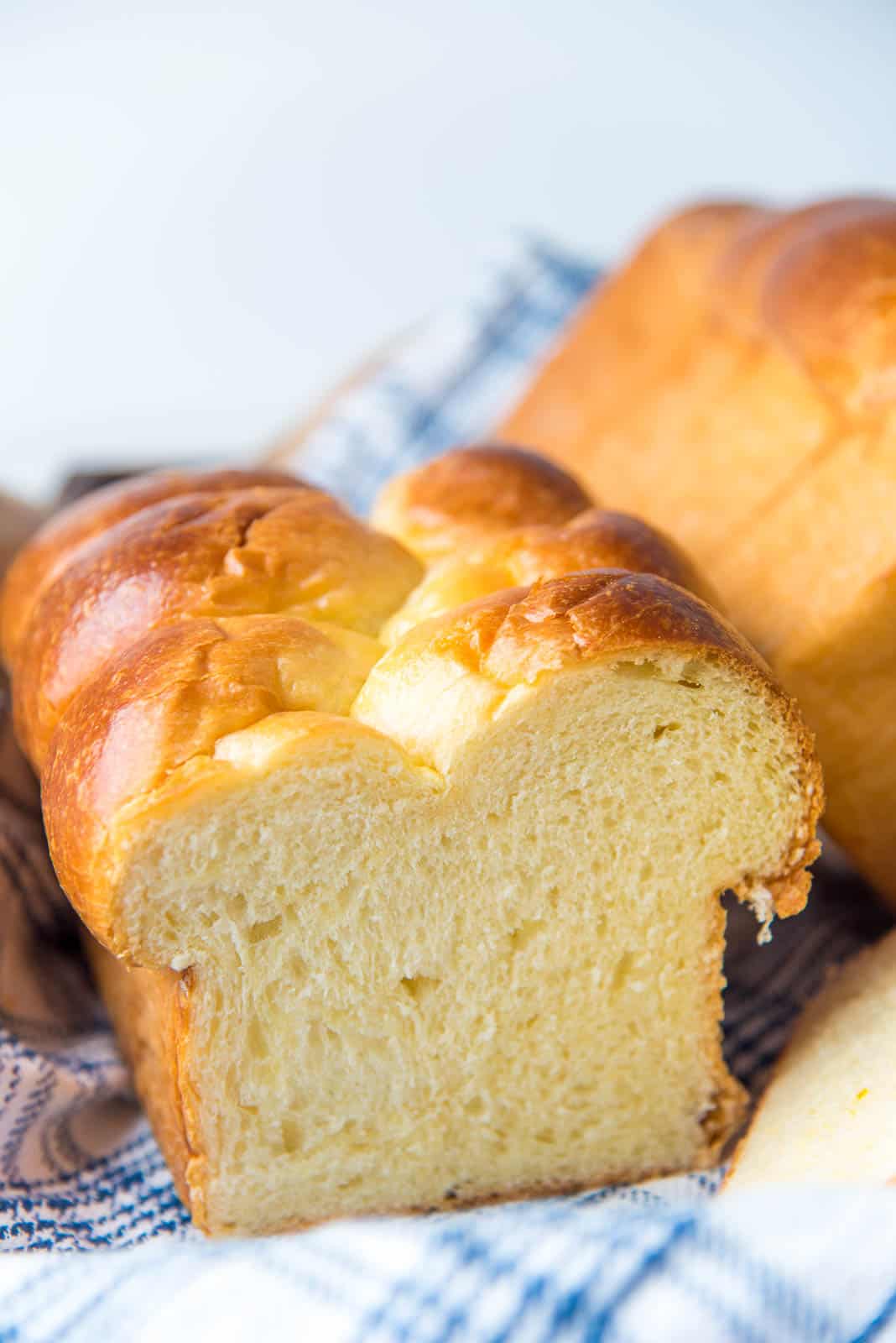
Cross section of a baked brioche bread loaf showing the perfect crumb.

Why this is the best brioche bread recipe

  • This is a tried and true brioche dough recipe from Le Cordon Bleu, but adapted it for home bakers.
  • I’ll be sharing step by step instructions, so you know what to look for at each step.
  • Details on how to tell when the brioche is ready after kneading and proofing, so you won’t get gluey and under-baked brioche, or dry and crumbly brioche.
  • Three shaping techniques for your brioche loaf are also included here.
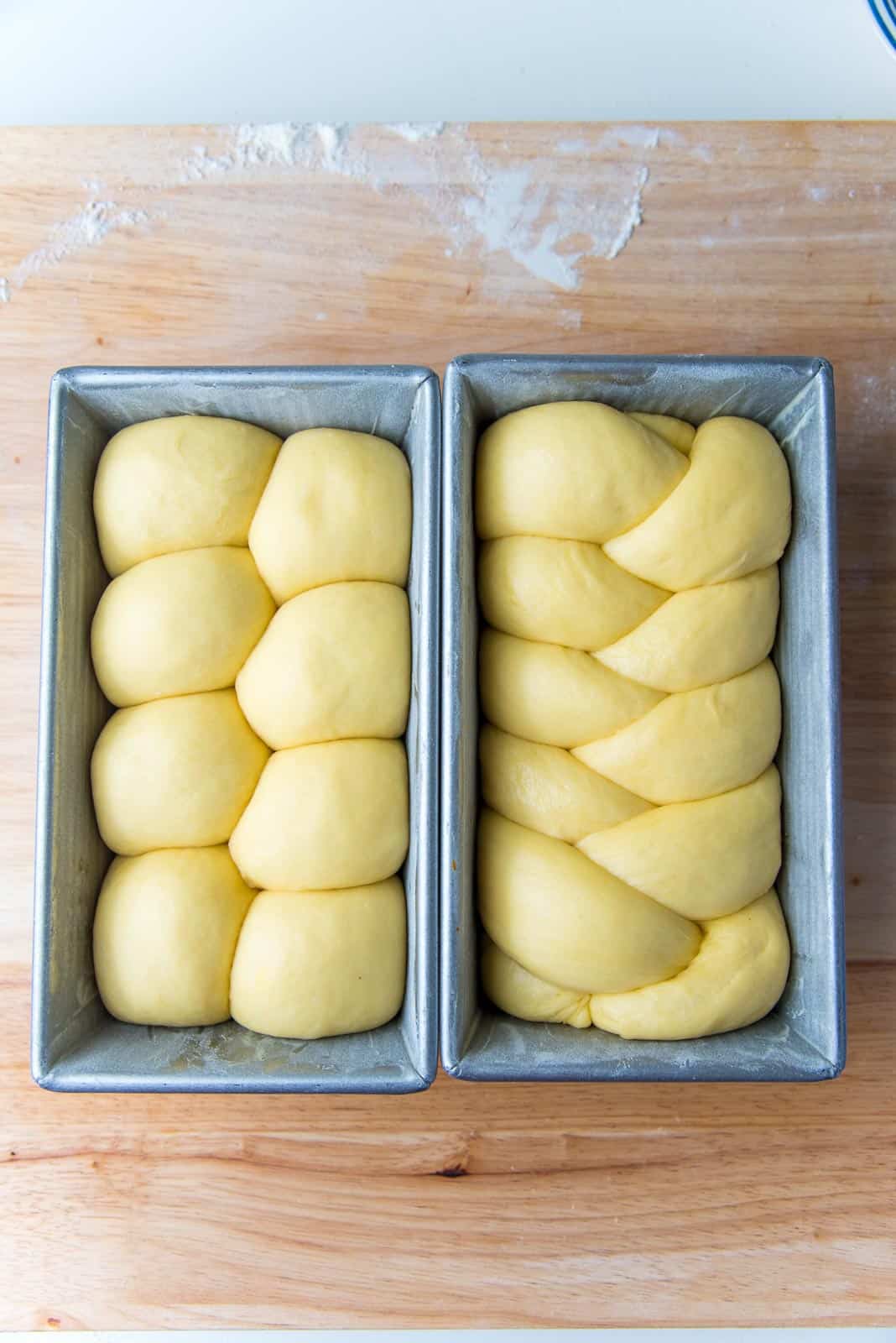
Proofed nantaise and braided brioche loaves in two loaf pans.
Nantaise & braided brioche loaves

Professional recipe vs my brioche recipe

Here, I’ll be sharing my recipe for making amazing brioche dough at home! I had to make some changes to the recipe I tried at Le Cordon Bleu, in order to make it more accessible and convenient for home bakers, but still maintain the authentic richness and taste of classic brioche dough.

The biggest challenge was that the orignal recipe didn’t use any water or milk, and used fresh yeast. Here’s the problem with that,

  • While fresh yeast doesn’t need liquid to dissolve, fresh yeast also isn’t very accessible to a home baker.
  • And to use any other kind of yeast, the dough will need liquid to dissolve the yeast, and that has a big impact on the recipe too.

So to fix this issue, we will be,

  • Using active dry yeast instead of fresh yeast – since active dry yeast is concentrated, you will only have to use about 1/2 the amount by weight. Active dry yeast will require liquid to be activated and dissolved in.
  • Substituting some of the egg with milk. Eggs play a big role in adding richness to brioche – especially egg yolks. So, instead of removing a whole egg, I’m removing ONE EGG WHITE, and substituting it with warm milk instead. This will allow the yeast to properly dissolve, while still keeping the richness of the dough.
Dissolving yeast in lukewarm milk in the mixer bowl.
Yeast dissolved in milk
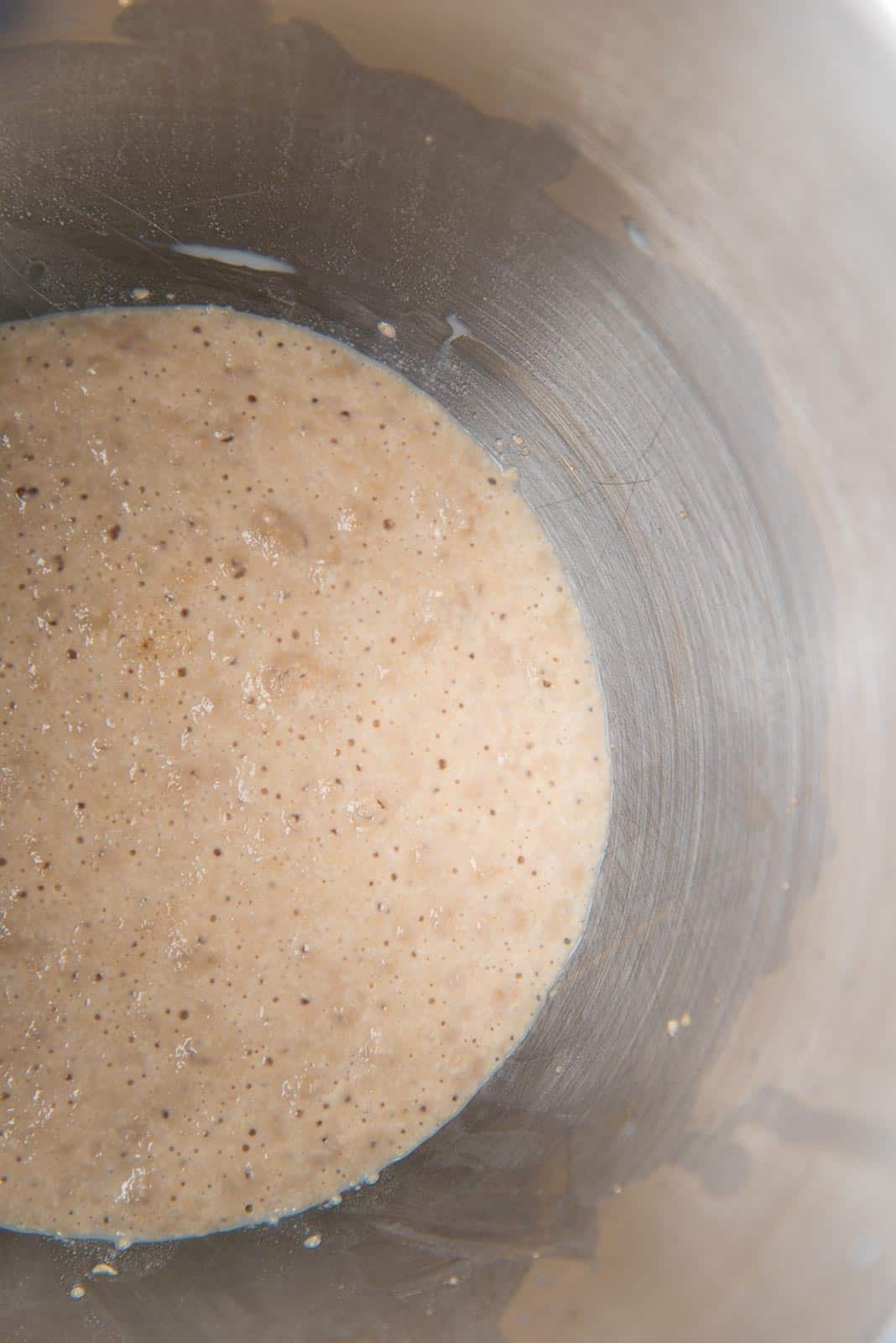
Activated yeast is frothy and bubbly in the milk in the mixing bowl.
Yeast activated & frothy in the milk

Understanding dough

  • Gluten and yeast are what make bread. Gluten gives bread the structure it needs. The gluten in the flour develops in the presence of a liquid like water, and that gluten development is faster when the dough is kneaded. The yeast in the dough will emit CO2 as it multiplies, and the gluten matrix will in turn expand as it traps more and more CO2.
  • Gluten develops well in water, but fat hinders gluten development. With an enriched dough like brioche, all the fat from the yolks and butter works against its gluten development. However, it also keeps the dough super soft and rich in flavor giving it an almost cake-like texture!
  • That is why brioche dough needs to be kneaded for much longer for good gluten development. Since the dough will be quite slack and sticky, a stand mixer is highly recommended to knead the dough until smooth and velvety.
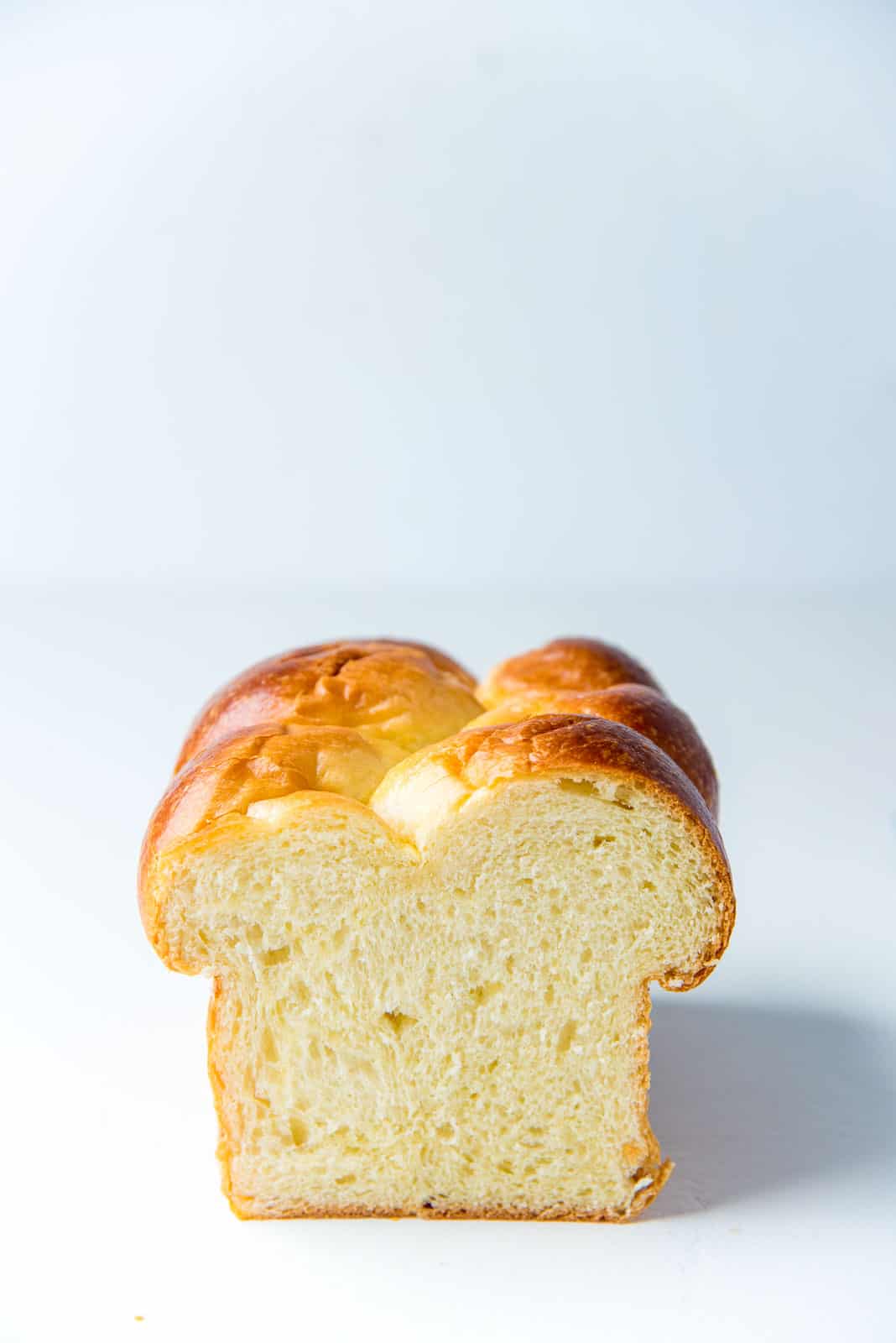
Cross section of a fully baked brioche bread loaf to show the crumb.
Take a look at that crumb!

Can I make brioche bread without a stand mixer?

The brioche dough is generally harder to work with due to the soft consistency, so a stand mixer is highly recommended. However, you can knead the dough by hand, but you will need a very clean working surface and patience to really work the sticky, wet dough until you get the right consistency. Do NOT use a hand mixer with the dough hook – it will be too much of a strain on the motor.

So let’s make brioche

Prep the ingredients

First, have all the ingredients measured and ready to go.

Almost all of the ingredients should be at room temperature. The exception is milk, where we want it to be very slightly warm (like tepid water – about 100°F). You can use warm water instead if you want, but milk adds more richness.

Make sure to use softened butter. The consistency of the butter is really important, so that it incorporates into the dough quickly and well. On a winter day, you may need to keep it somewhere warm to give the butter a chance to really soften (to 73 – 75°F).

If you press the butter with your finger, you would easily be able to leave a mark, with no resistance. But the butter has NOT melted. This is the consistency you want with your butter.

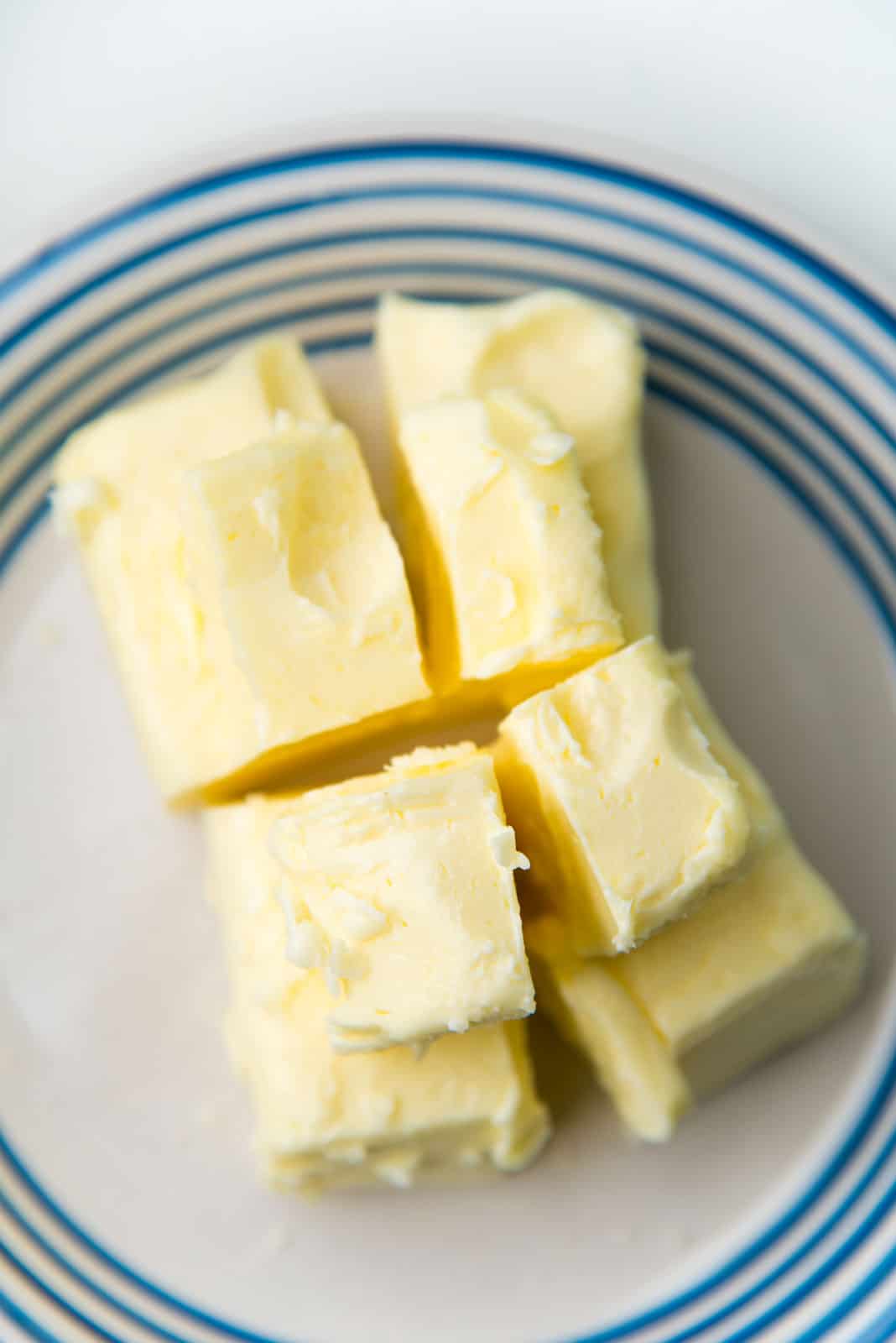
Softened butter on a small white plate with a finger indentation to show the butter is soft.
Softened butter
Butter roughly divided into 4 portions on a small white plate.
Roughly divide the butter into four portions

Activate the yeast

First, activate the yeast. Since we’re using active dry yeast, the yeast needs to be dissolved and activated. This will ensure the yeast incorporates evenly into the dough. Place the milk and honey in the mixer bowl and sprinkle the yeast on top. Gently whisk to mix the yeast, and let it sit for about 15 minutes. In that time the yeast should become frothy and bubbly.

Make the base dough

Add the vanilla, sugar, large eggs and egg yolk, and just break up the yolks.

Add the flour, and finally, add the salt over the flour (this is important! Do NOT add the salt directly to the yeast mix).

Using the hook of your mixer, or a dough whisk, mix all the ingredients in the mixing bowl to form a scraggly dough.

Place the bowl on your mixer with the dough hook attached. Start kneading the dough on speed 2 – 3 (low – medium low speed) for about 1 minute.

Adding eggs and other wet ingredients to yeast in a big mixer bowl.
Adding the wet ingredients into the yeast mixture
Mixing in the dry ingredients to make brioche dough in a bowl.
Form a scraggly dough with the dry ingredients
Wet brioche dough kneading in a stand mixer.
Knead the dough for about 1 minute before adding butter

Adding the butter

Then add the butter in four additions, with about 2 minutes of mixing time between each addition. Each portion is added one tablespoon at a time, to make sure the butter is completely incorporated every time. Make sure to use a dough scraper (or bowl scraper) to scrape the sides as you go.

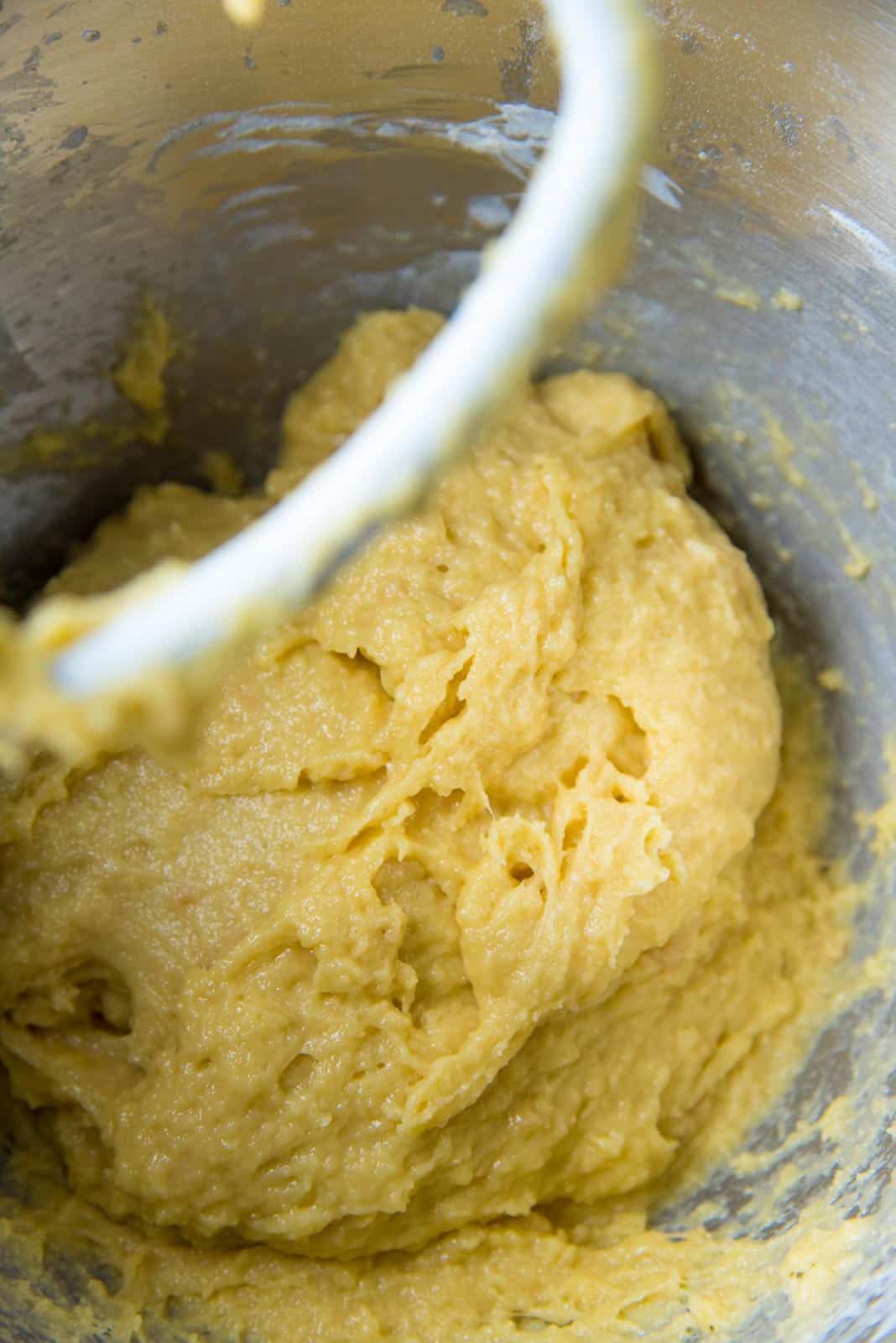
The dough will be very slack and sticky after the butter is added. However, as you knead the dough, it will turn into a smooth, shiny dough that’s a little tacky, but doesn’t stick to the sides of the bowl.

Adding butter to a very wet brioche dough in the mixing bowl.
Adding the butter will make the dough very sticky and soft

Developing the gluten

Once the butter is added (a total of about 8 – 10 minutes), increase the speed to 5 – 6 (medium speed). Knead the dough for a further 10 minutes or so, until you get the right consistency.

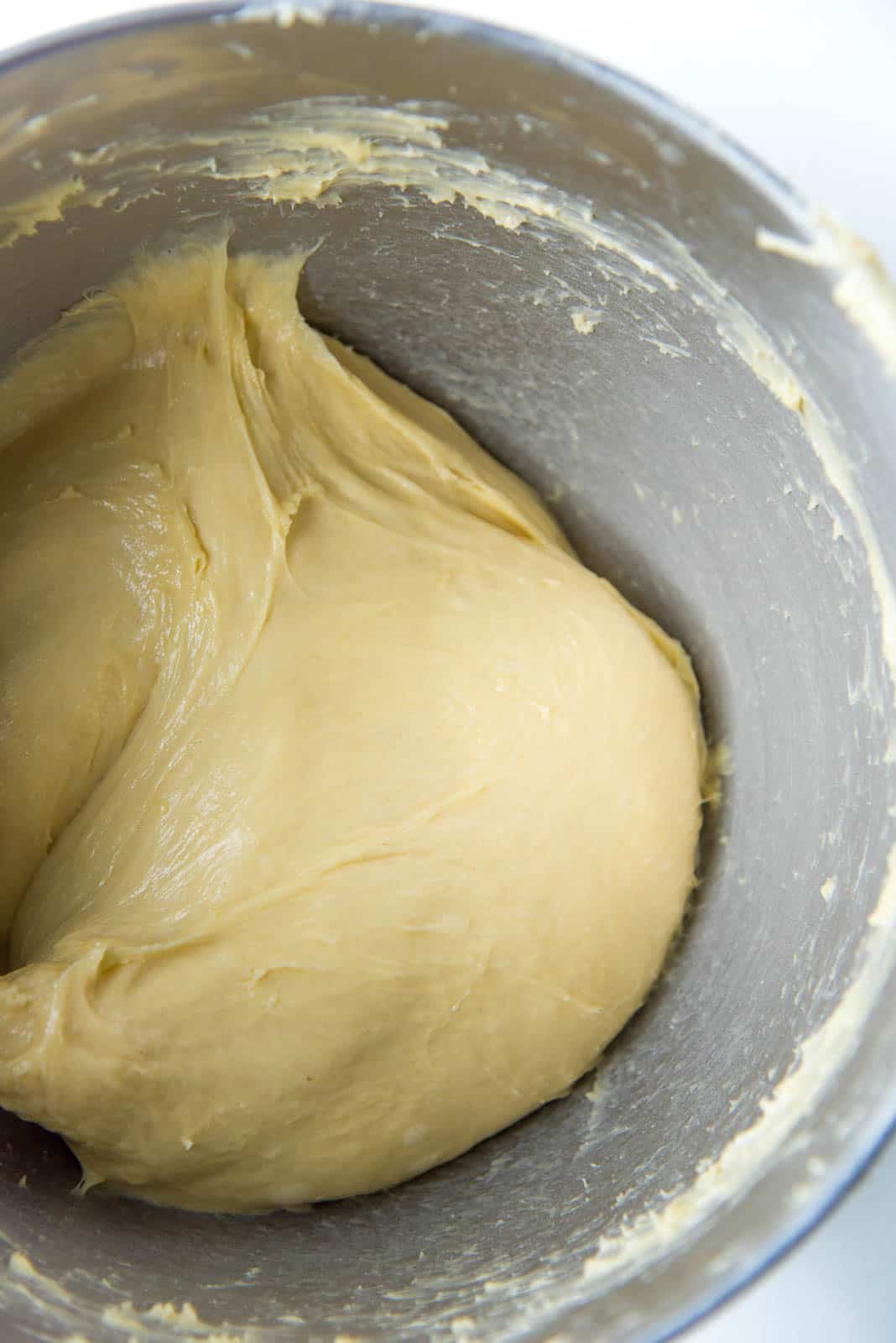
This is where the gluten development occurs. As the gluten matrix forms in the dough, it will become satiny and smooth. It will stick less to the sides of the mixer bowl. And if you use the dough hook to lift the dough from the bowl, it should lift cleanly from the bowl, while still being really soft.

The time it takes for the dough to be properly kneaded will vary. It can take as little as 8 minutes or as much as 15 minutes. It depends on the speed of the mixer, the type of mixer and other environmental factors too. Look for the signs to make sure it’s done. The whole mixing time from start to finish can be between 20 – 30 minutes.
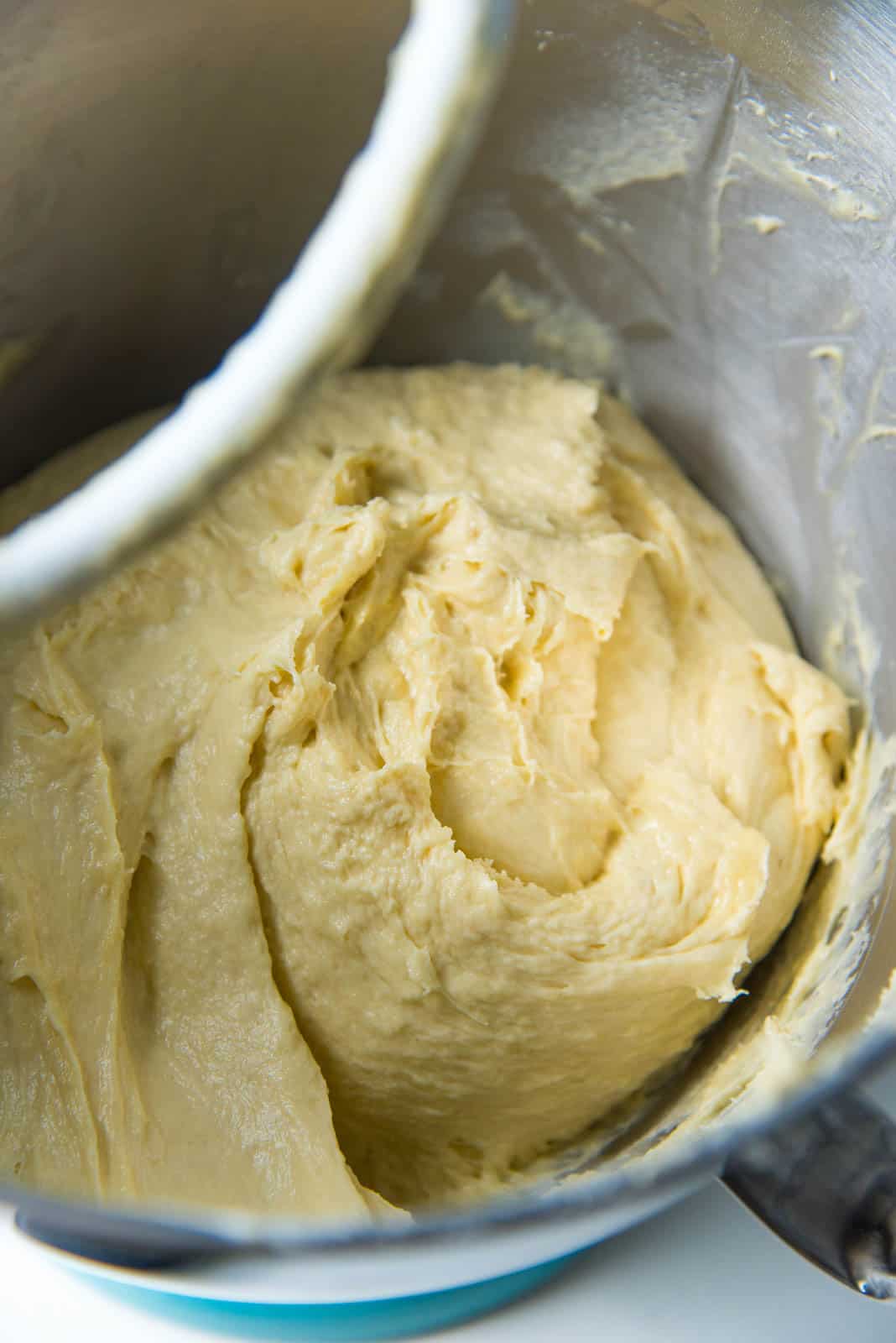
All butter added to brioche, but not kneaded enough
The dough is still not smooth and satiny, and needs to be kneaded longer
A well kneaded shiny, smooth brioche dough
The dough is now smooth and satiny because the gluten has formed. The dough is ready at this point.

First proofing

This first proofing is very important. As the yeast multiplies and emits CO2, the dough will expand, further developing the gluten matrix.

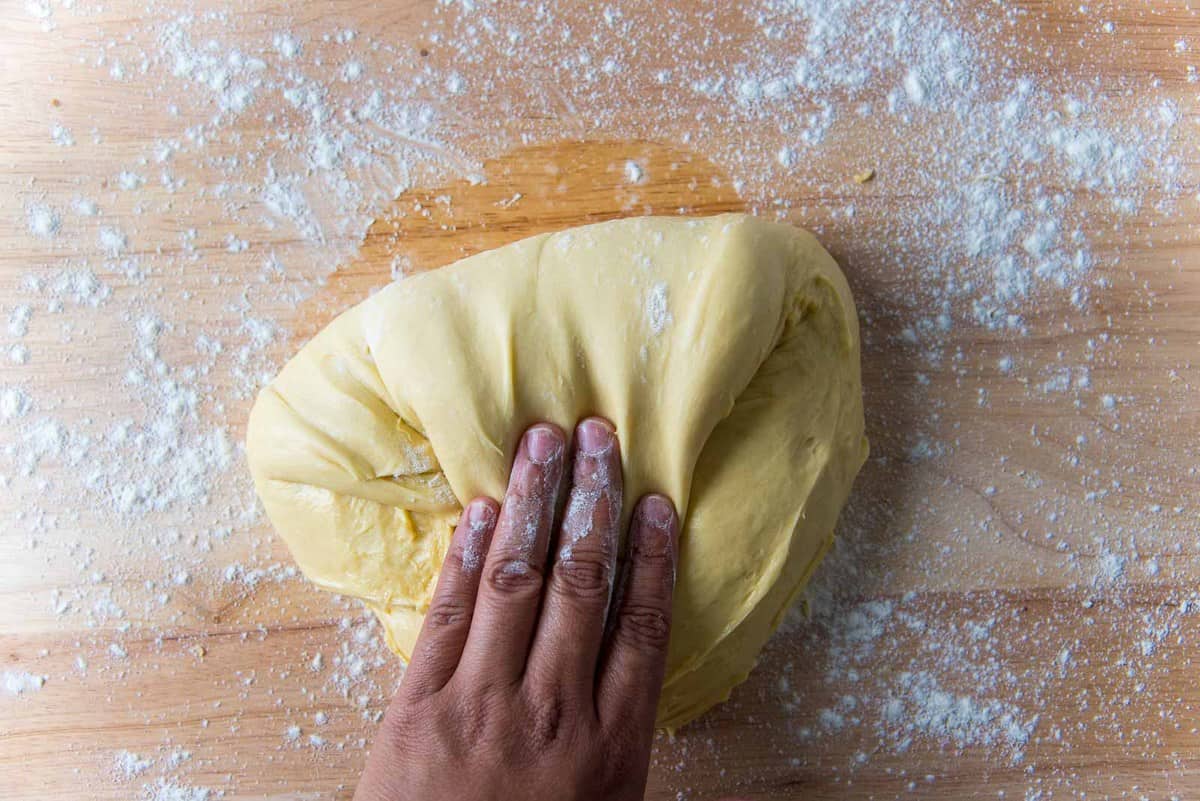
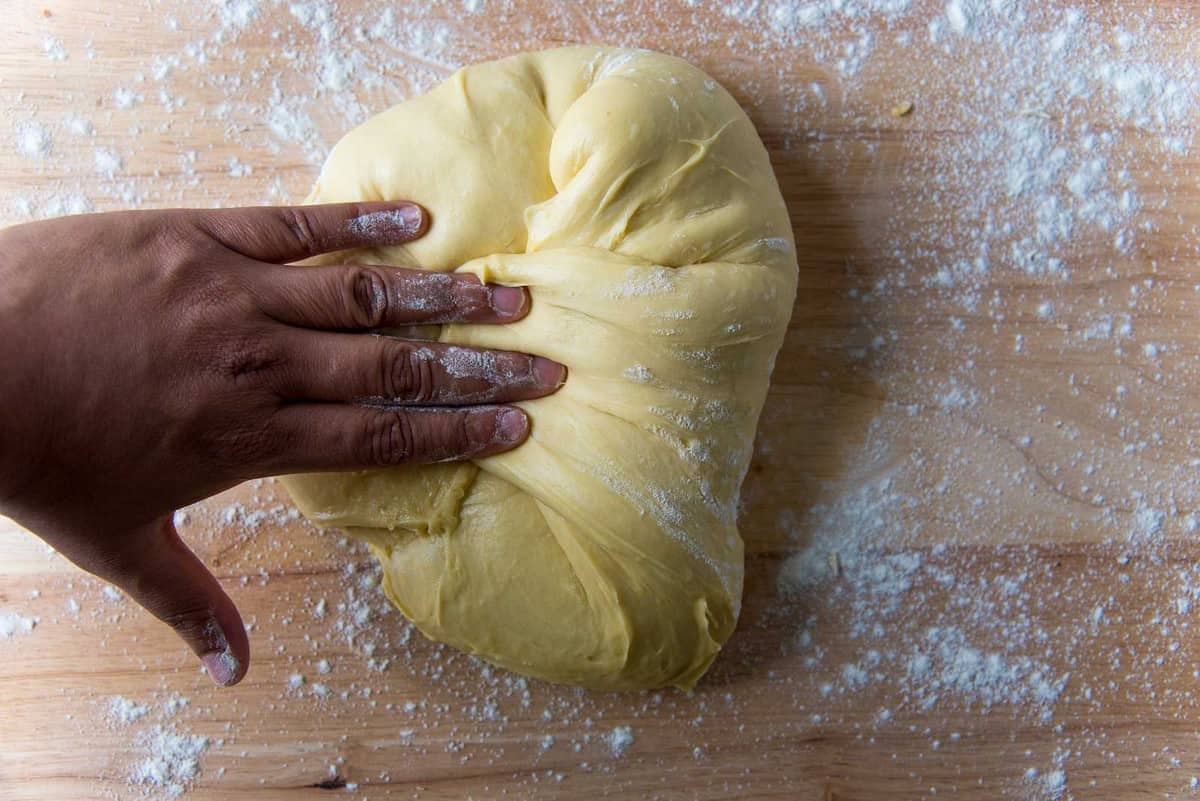
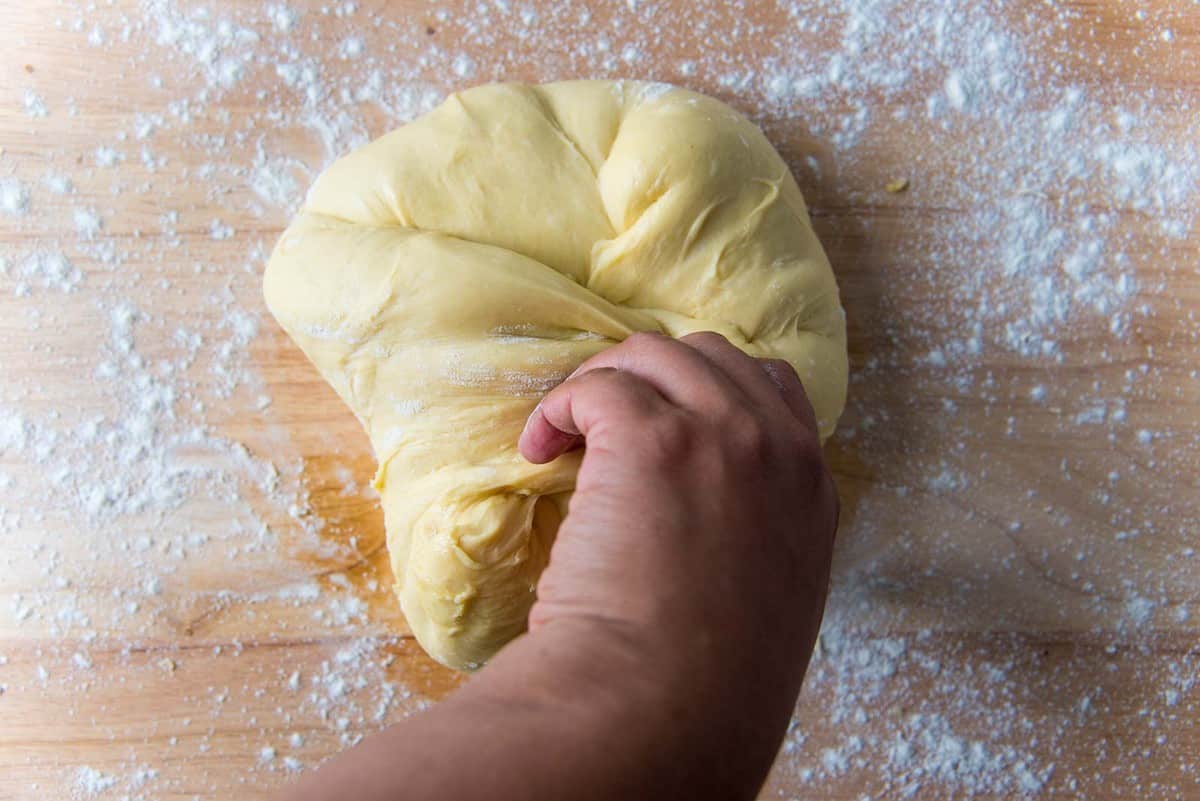
Turn the dough out onto a floured work surface and shape the dough into a smooth ball of dough. Since the dough will be really soft, make sure your hands are lightly floured too.

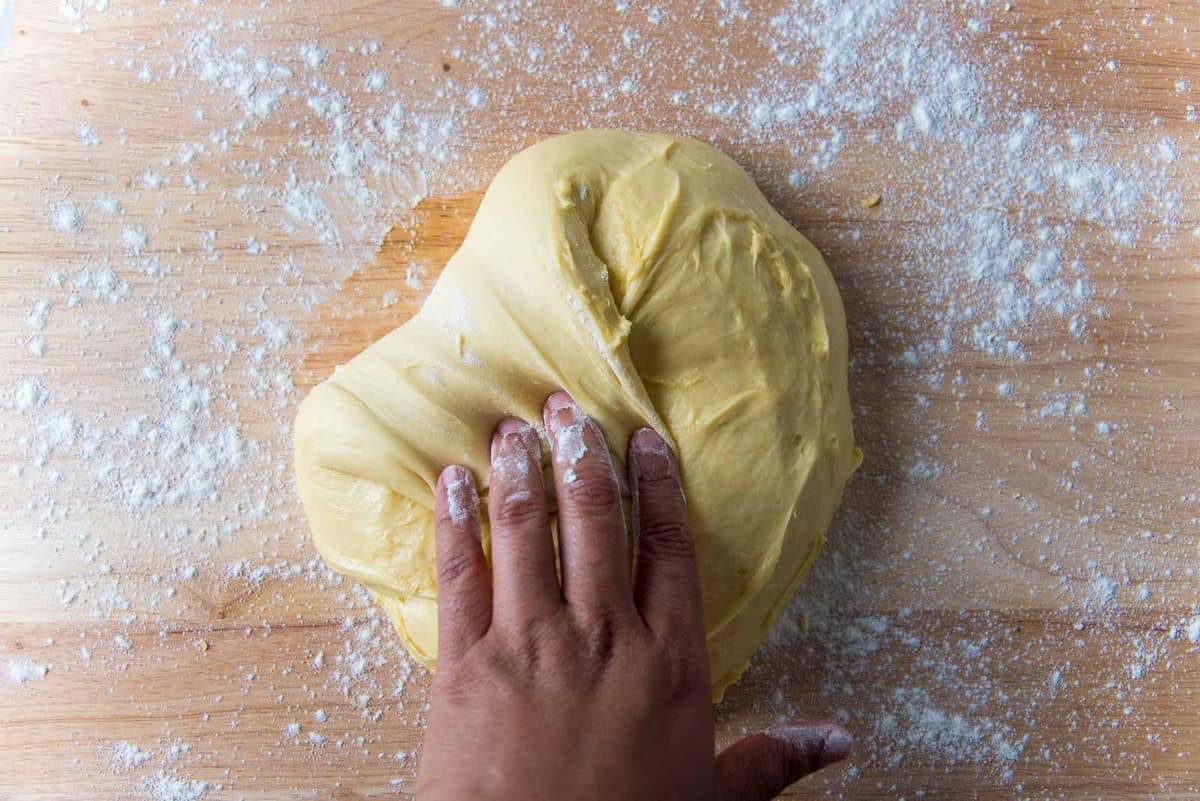
Brioche dough after first proofing on a lightly floured wood work surface.
Turn the dough out on to a floured surface
Folding one end of the brioche dough by hand towards the middle.
Fold in all the edges towards the middle
Folding another end of the brioche dough by hand towards the middle.
Keep going
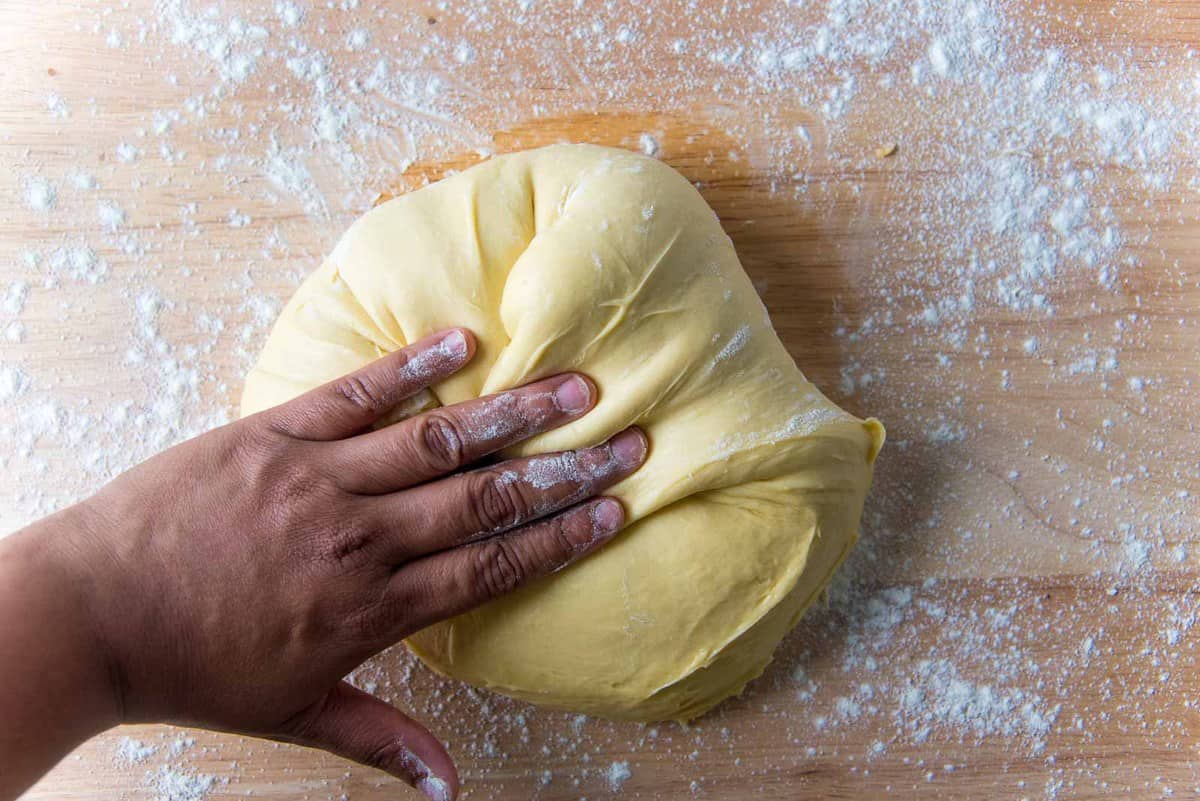
Folding the brioche dough by hand towards the middle on a lightly floured work surface.
Three more to go
Folding the brioche dough by hand towards the middle on a lightly floured wood surface.
Two more
Folding the brioche dough by hand towards the middle.
Last one!
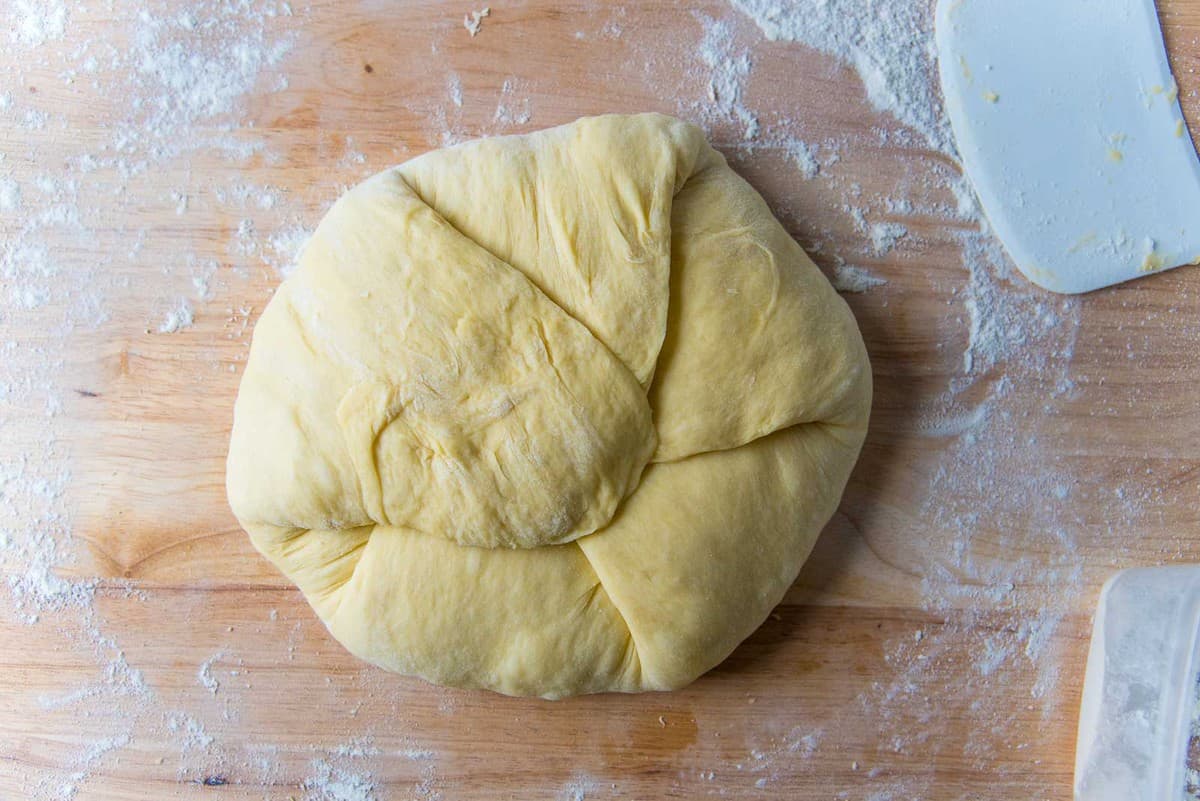
Shaped brioche dough sitting on a lightly floured wood work surface.
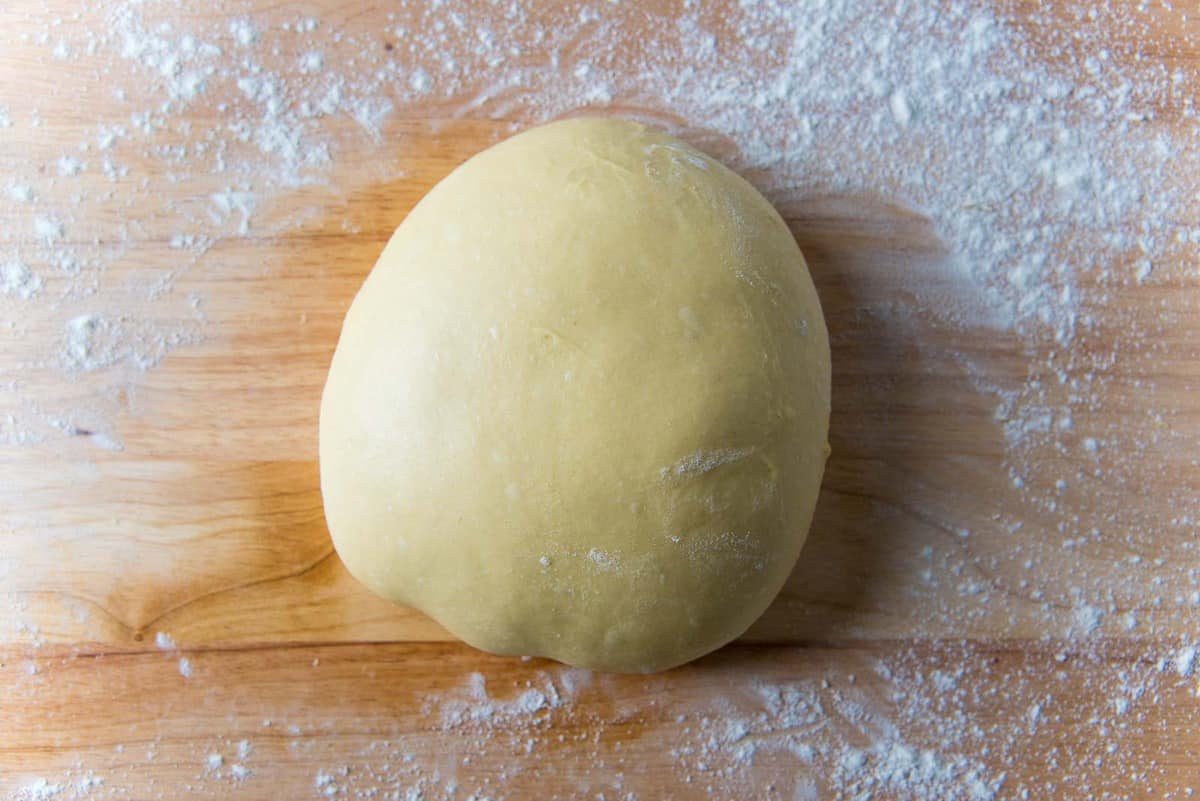
Carefully flip the dough over, then use your hands to tighten the dough into a smooth dough ball
A smooth and shaped brioche dough ball on a lightly floured wood work surface.
Like this…

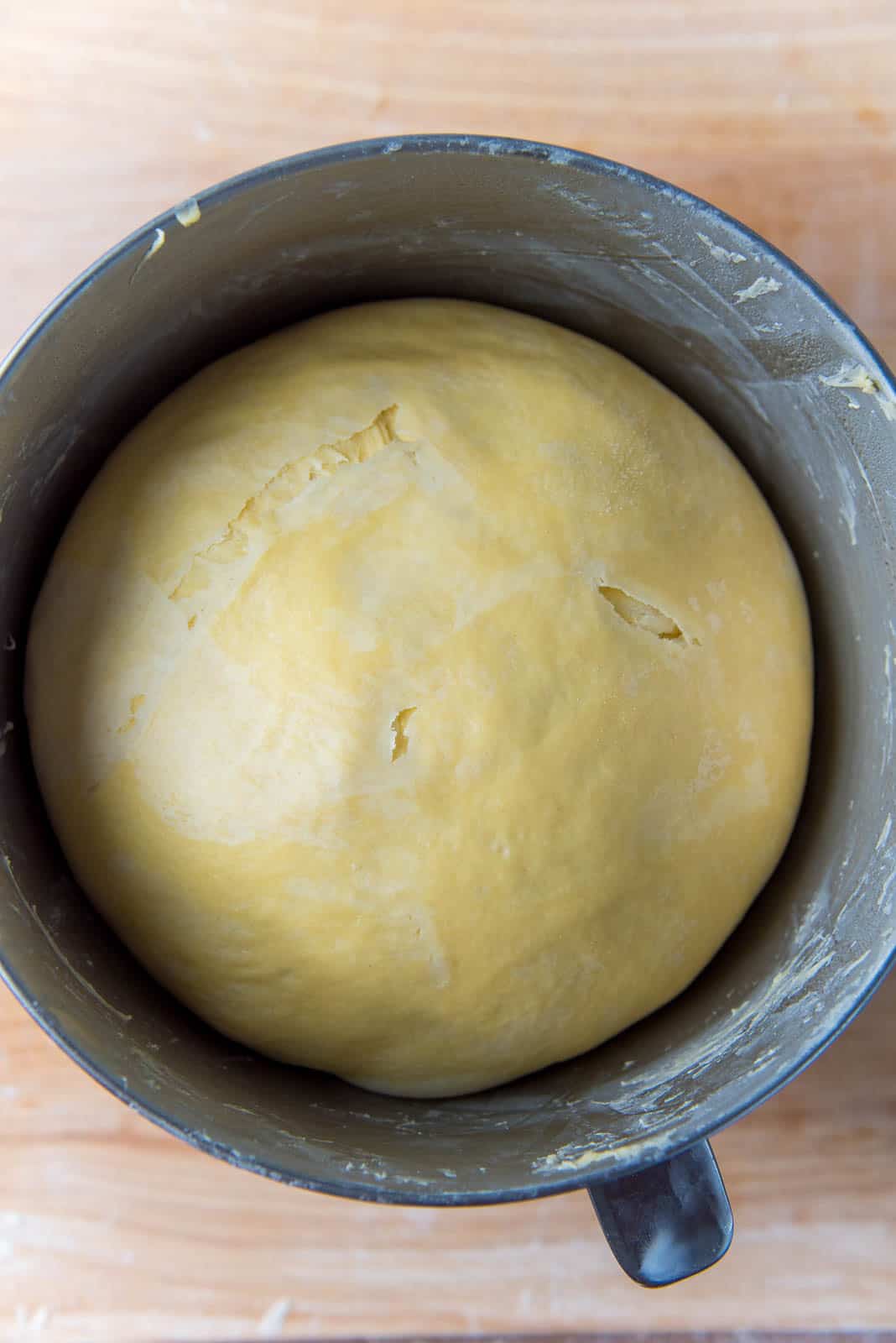
Place the shaped dough back in the bowl or a different large bowl (you don’t have to butter it, since brioche is so rich it shouldn’t stick to the bowl). Cover with plastic wrap and let the dough at least double in size in a warm place.

If you’re living in a colder climate like me, it’d be hard to find a place that’s warm enough in the kitchen in winter. So what I do is, I turn the light on in my oven, and keep the bowl in the oven. The oven warms up when I cook on the stove too, so it helps the dough proof.

Depending on the temperature, the brioche dough will proof in 1 hour, but it can take up to 2 – 2.5 hours too.

The first proofing is complete when the dough has AT LEAST doubled in size, or even tripled!

Brioche dough in a glass bowl before the first proof.
Before first proof
First proof brioche after
After first proof

Retard proofing the dough

This is the name for letting the dough proof in the fridge. This low temperature proofing is a much longer process, and helps develop the flavor of the dough. In a more practical sense, it makes the dough far easier to handle when it’s time to shape the loaves, plus it allows the dough to rest.

After the first proof, turn the dough out onto a lightly floured surface. With lightly floured hands, shape the dough again, and form a dough ball with a smooth, taut surface. Transfer the dough back into the bowl, cover with plastic wrap and place it in the fridge.

This dough can be stored in the fridge for up to 24 hours (maybe even 48 for a stronger flavor).
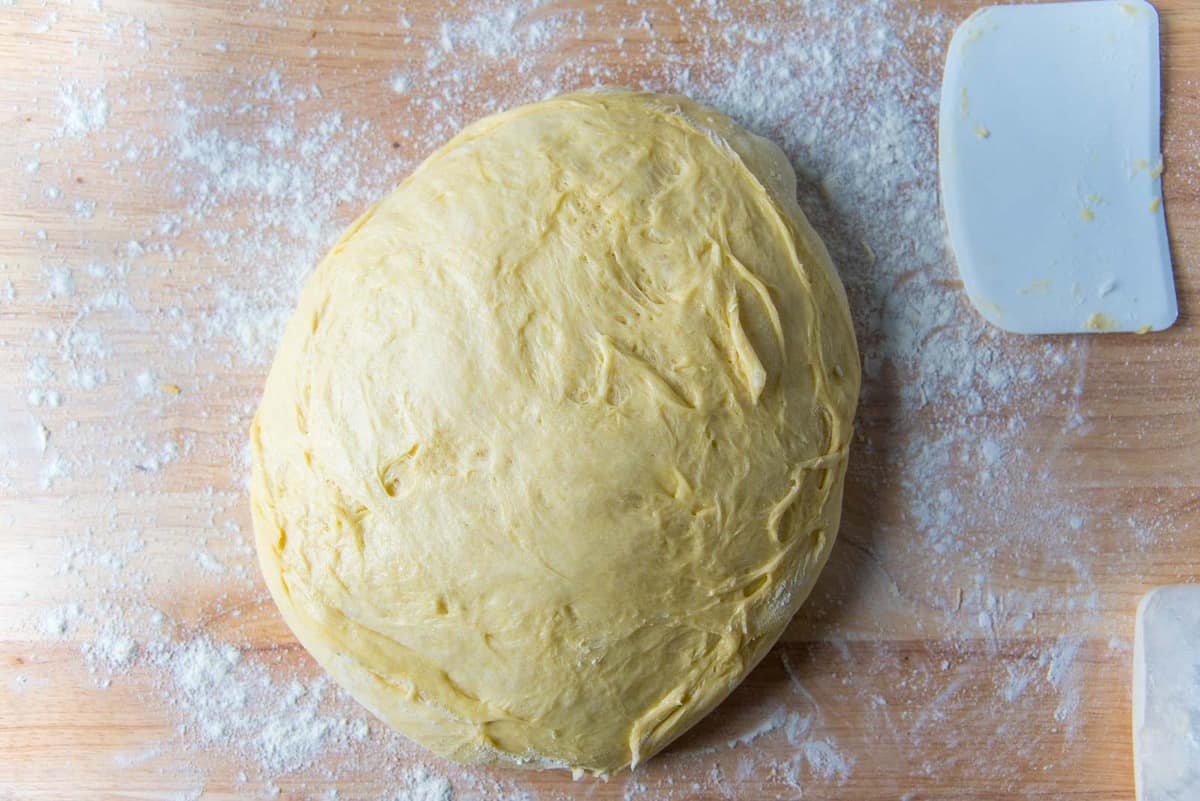
Dough on a lightly floured work surface with a flexible bowl scraper on the side.
Deflate and reshape the proofed dough
Dough on a lightly floured work surface with the edges folded in towards the middle.
Fold in the edges of dough, and carefully flip it over
Smooth ball of brioche dough on a light floured wood work surface.
Re-tighten the dough
The dough in the mixer bowl before low temperature proofing in the fridge.
Place the dough in a bowl and refrigerate, covered.
The dough is now bigger in the mixer bowl after low temperature proofing in the fridge.
After 12 hours

Shaping the bread loaves

When the dough is nice and chilled, it can be divided and shaped. You can either bake them in a loaf pan, or even a cake pan. In the case of the braided loaf, you can bake that on a baking tray too.

Two brioche loaves baked in two different sized loaf pans, cut in half to show their different sizes.
Brioche loaf baked in a 8.5 x 4.5 loaf pan vs 9 x 5 loaf pan

With this recipe, you can make TWO bread loaves. You can shape them in one of three ways (there are more ways, but I’m only going to talk about 3 here).

Turn the dough out onto a lightly floured surface and gently flatten the dough into a circle. This will also help release any gas in the dough. Weigh and divide the dough into two portions.

Simple loaf – easiest way to shape the dough

This is the easiest way to shape the loaf. It’s a standard loaf shape with no patterns.

This is very similar to how I shaped my white bread loaf which you can find here.

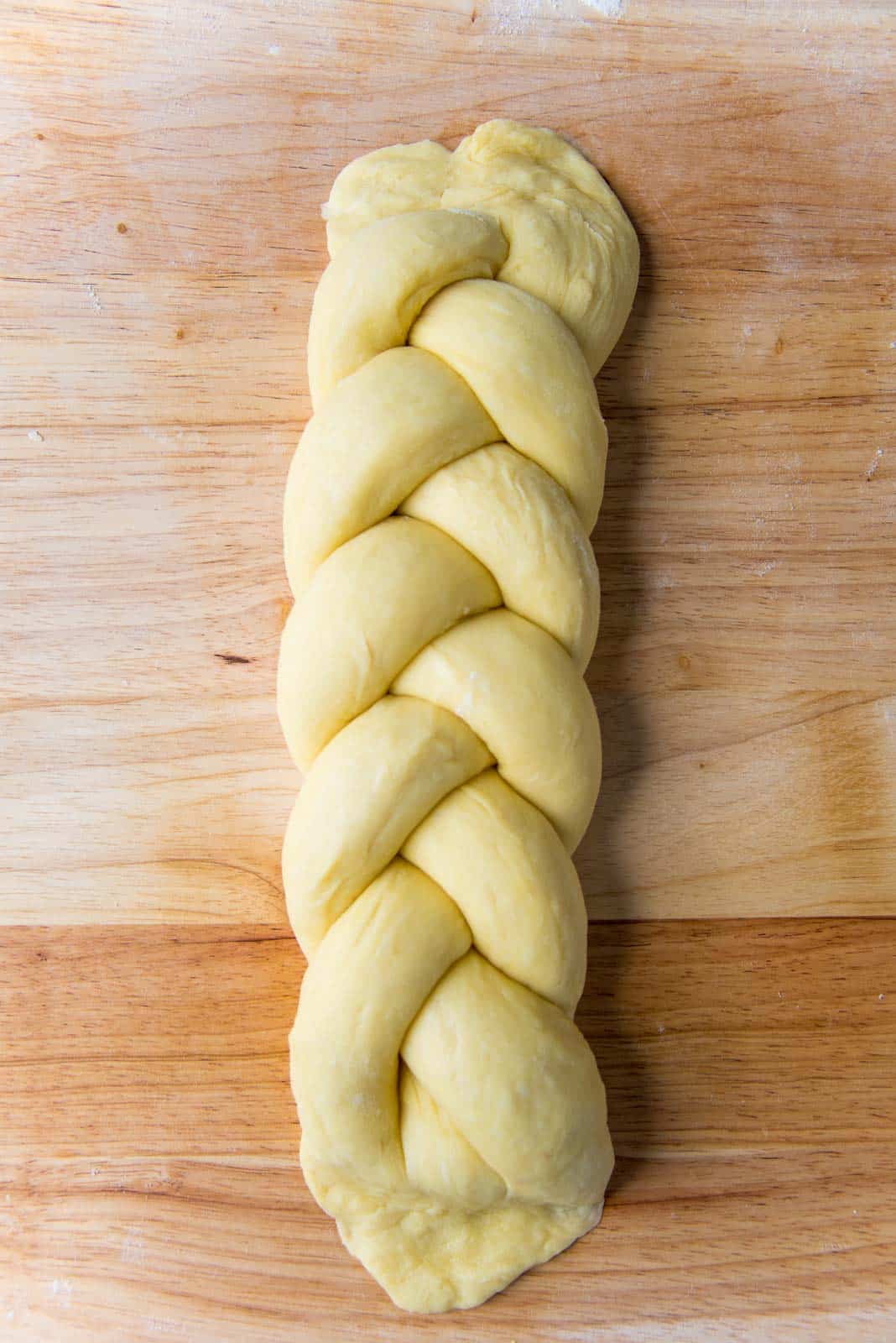
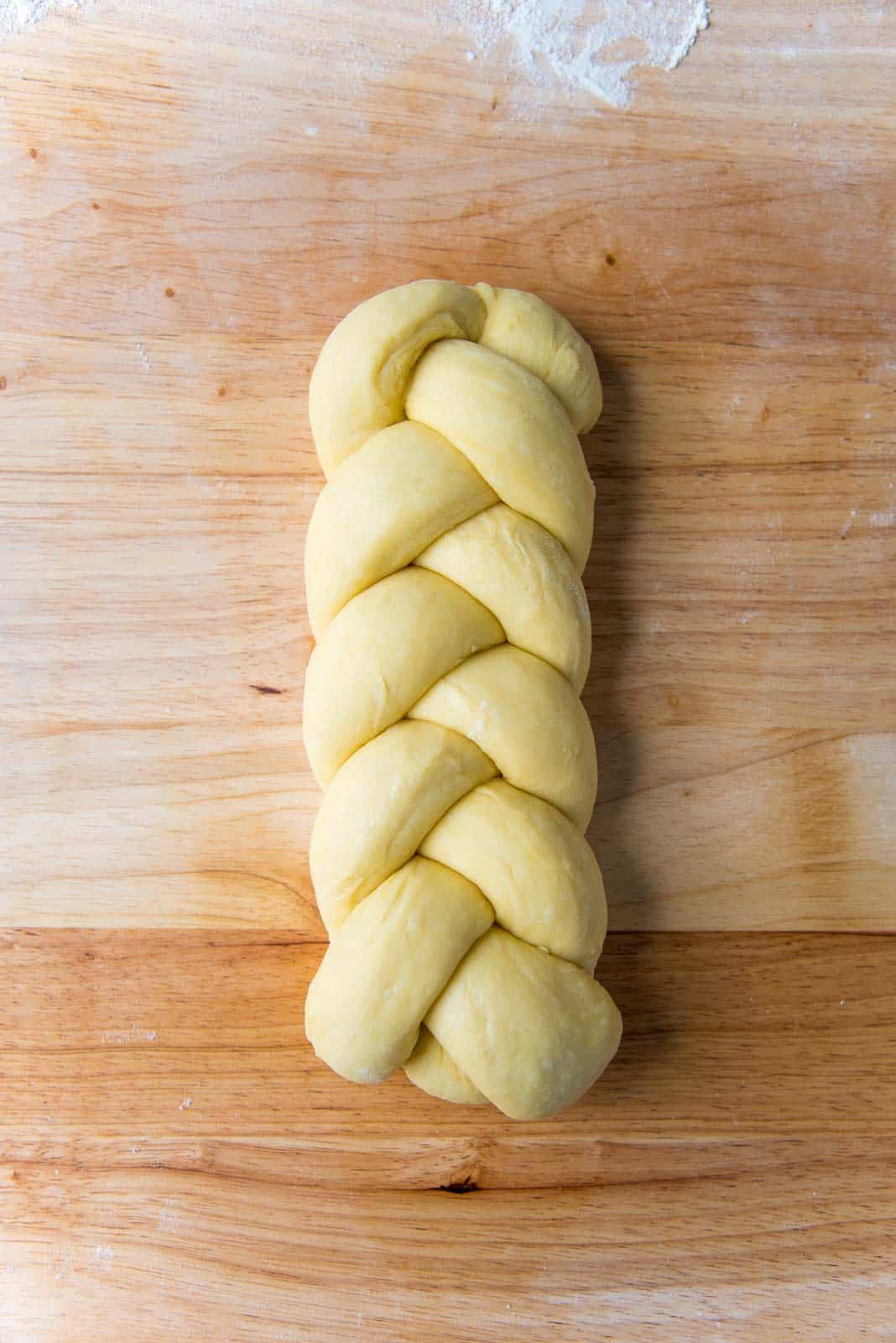
Braided brioche loaf

This is a classic braided loaf that can be either baked in the loaf pan, OR baked as is on a baking tray.

This is made by dividing the dough into 3 equal portions, then shaping each portion into a long “rope”, then forming a braid with the 3 “ropes”.

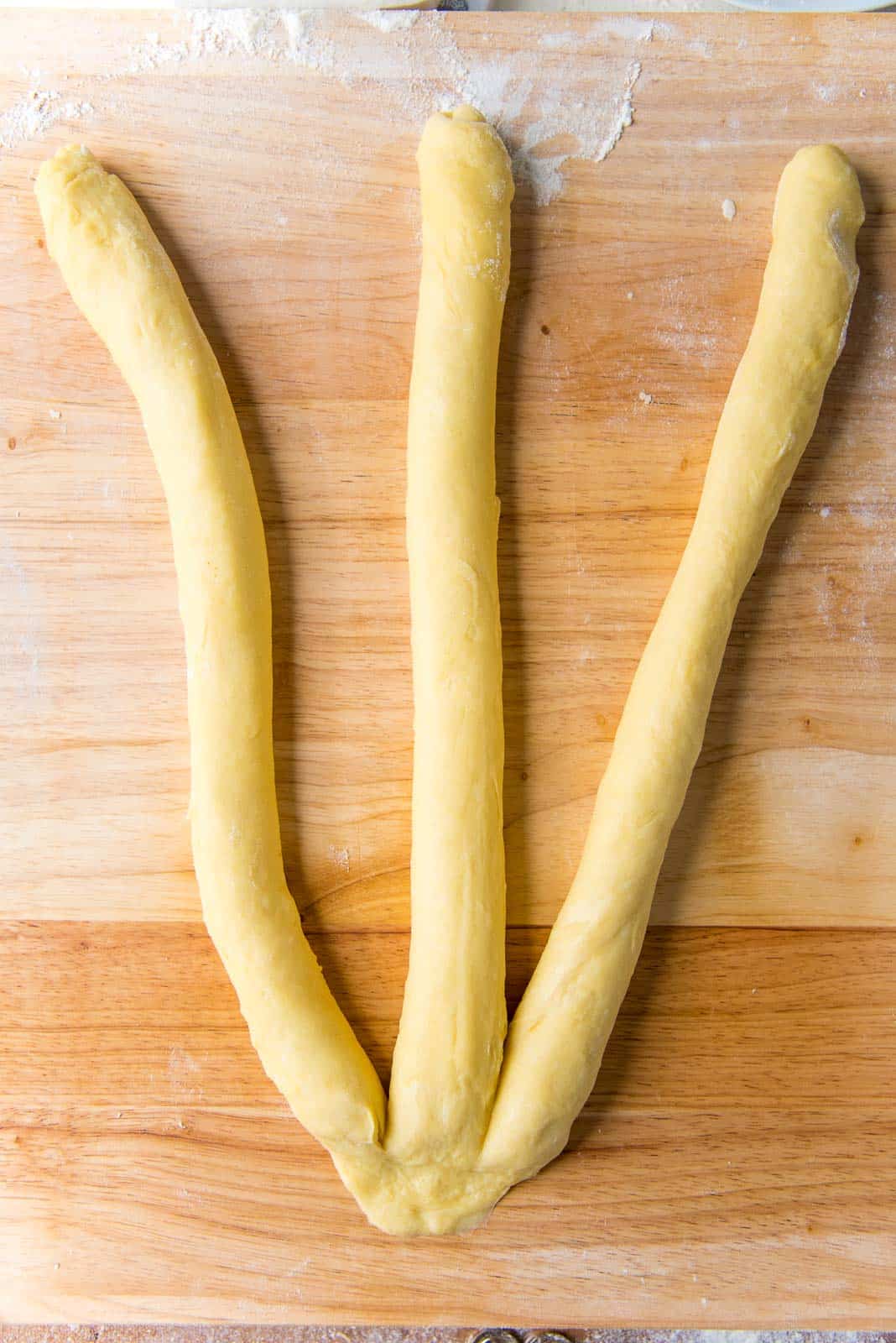
Three long ropes of dough on a wood work surface and a metal loaf pan on the side.
Make 3 equal sized dough ropes.
Three ropes of dough on a wood work surface with the ropes joined together on one end.
Pinch the ends together at one end to seal.
Braided brioche loaf dough on a wood work surface with the two ends pressed and sealed.
Braid the dough ropes, tightly, without stretching the dough.
A braided brioche loaf dough on a wood work surface with the two ends flattened.
Press the two ends into the board, to flatten and seal the ends.
Braided brioche loaf dough on a wood work surface with two ends folded under the dough.
Tuck in the flattened ends to get a rounded, beautiful loaf.
Braided bread loaf in a metal loaf pan before proofing.
Place the loaf in the loaf pan.

Nantaise brioche loaf

This is also a very classic way of shaping brioche dough. I call it a faux-braided loaf, because it looks braided, but it’s not. The dough balls can also be cleanly pulled apart from the dough with this loaf.

The dough is divided into 8 equal pieces, and each portion is shaped into a small, smooth ball. The balls are then placed in a zig-zag pattern in the loaf pan as shown below.

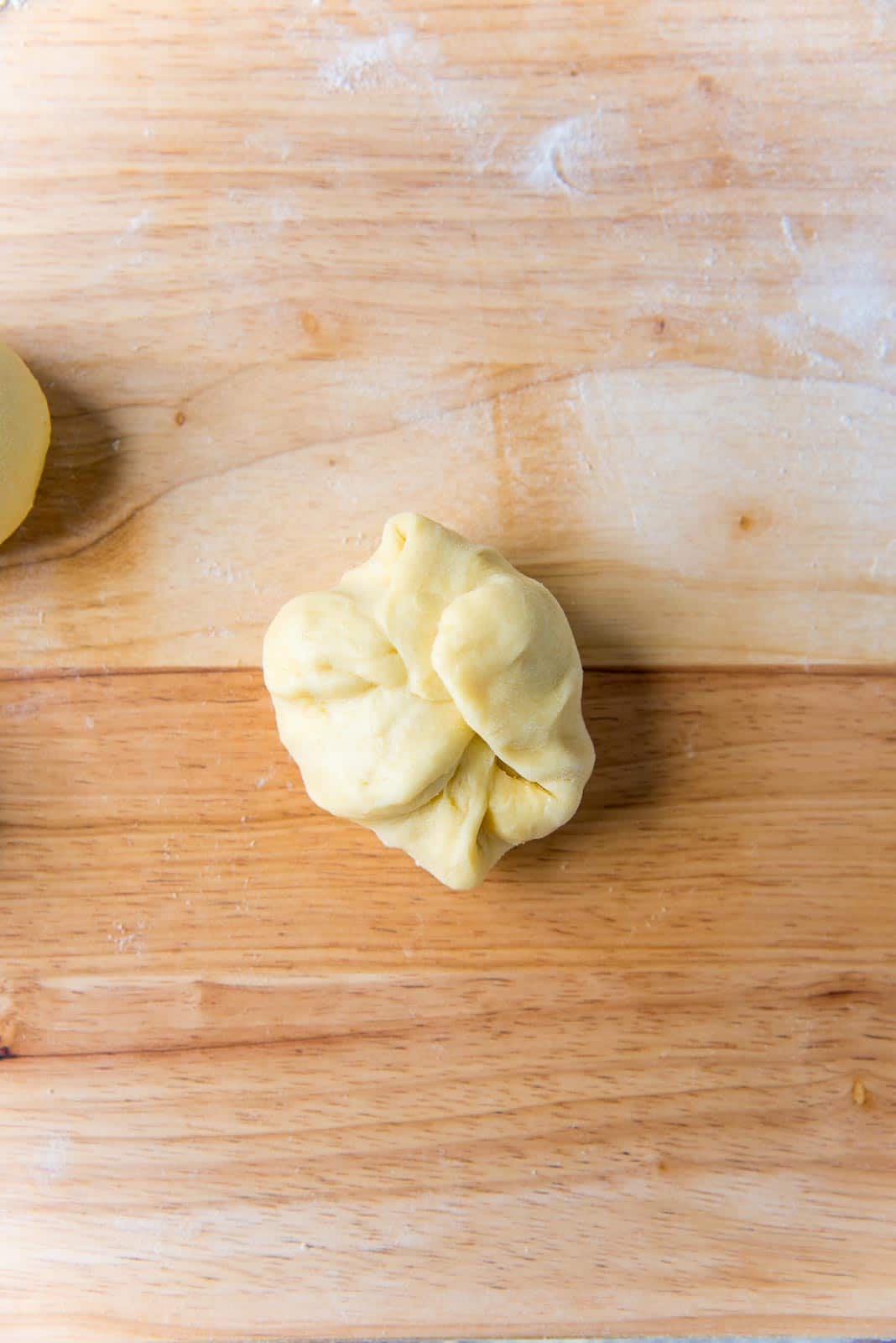
Portioning the dough into 8 equal portions to make a nantaise brioche loaf.
Portion the dough into 8 equal pieces.
Shaping a dough portion by folding the edges towards the middle to form a dough ball.
Shape each portion by folding in the edges towards the middle, and pressing them in.
A small dough ball with a lightly floured surface on a wood block.
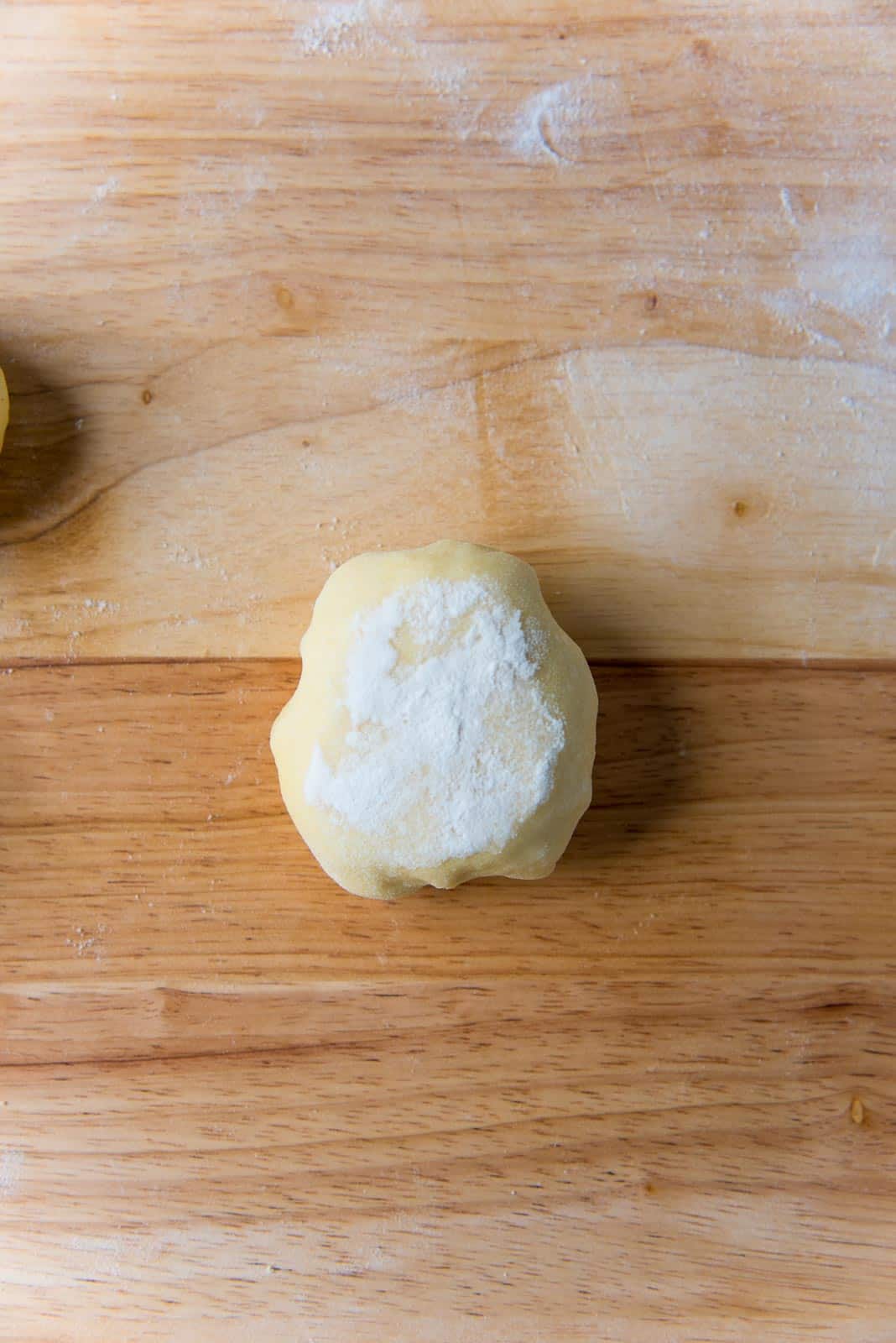
Carefully flip it over, and lightly flour the smooth surface of the dough portion.
Rolling a dough portion with a cupped palm on a work surface to form a dough ball.
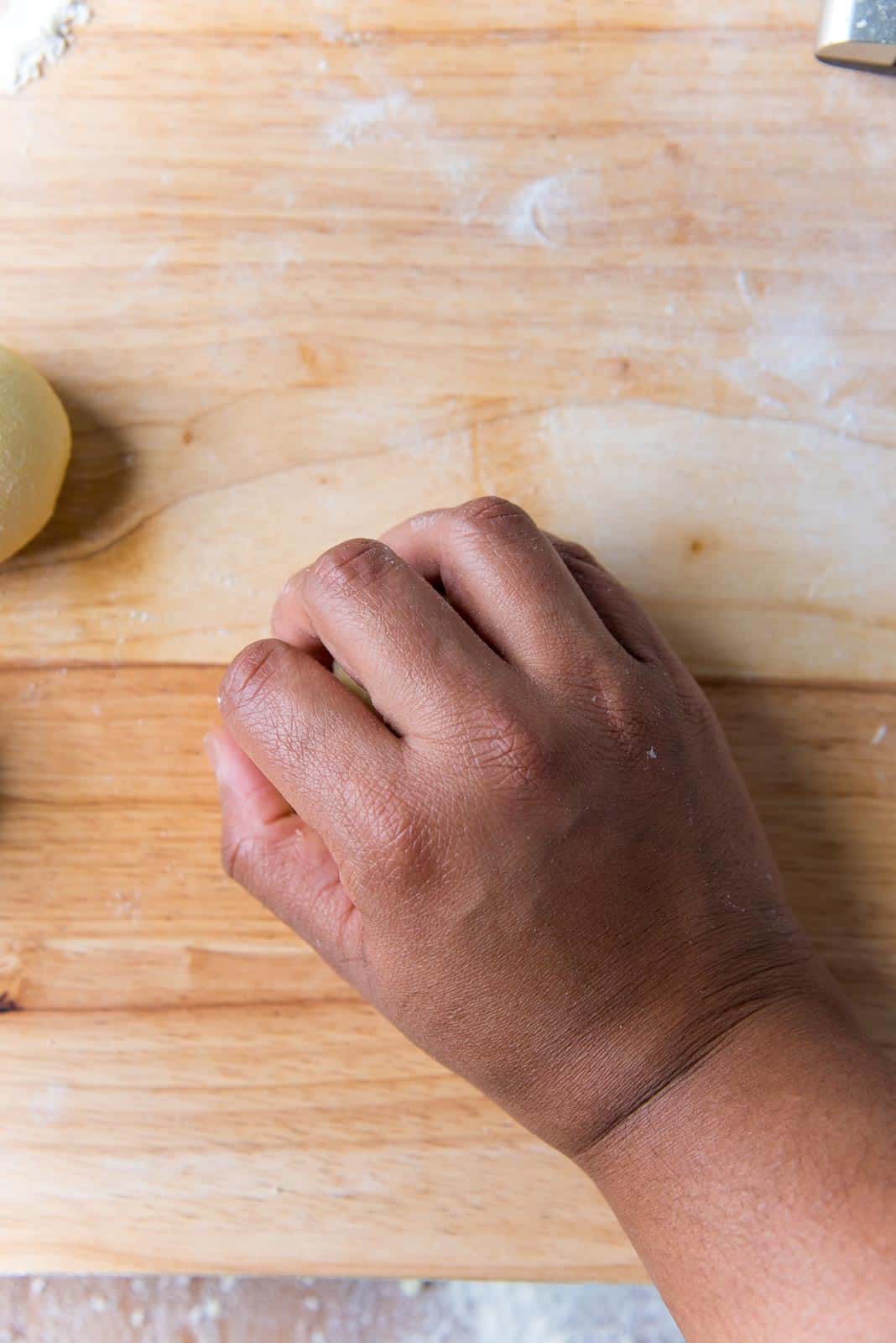
With floured side up, cup your palm around the dough portion, and gently roll the dough on your work surface to form a round ball.
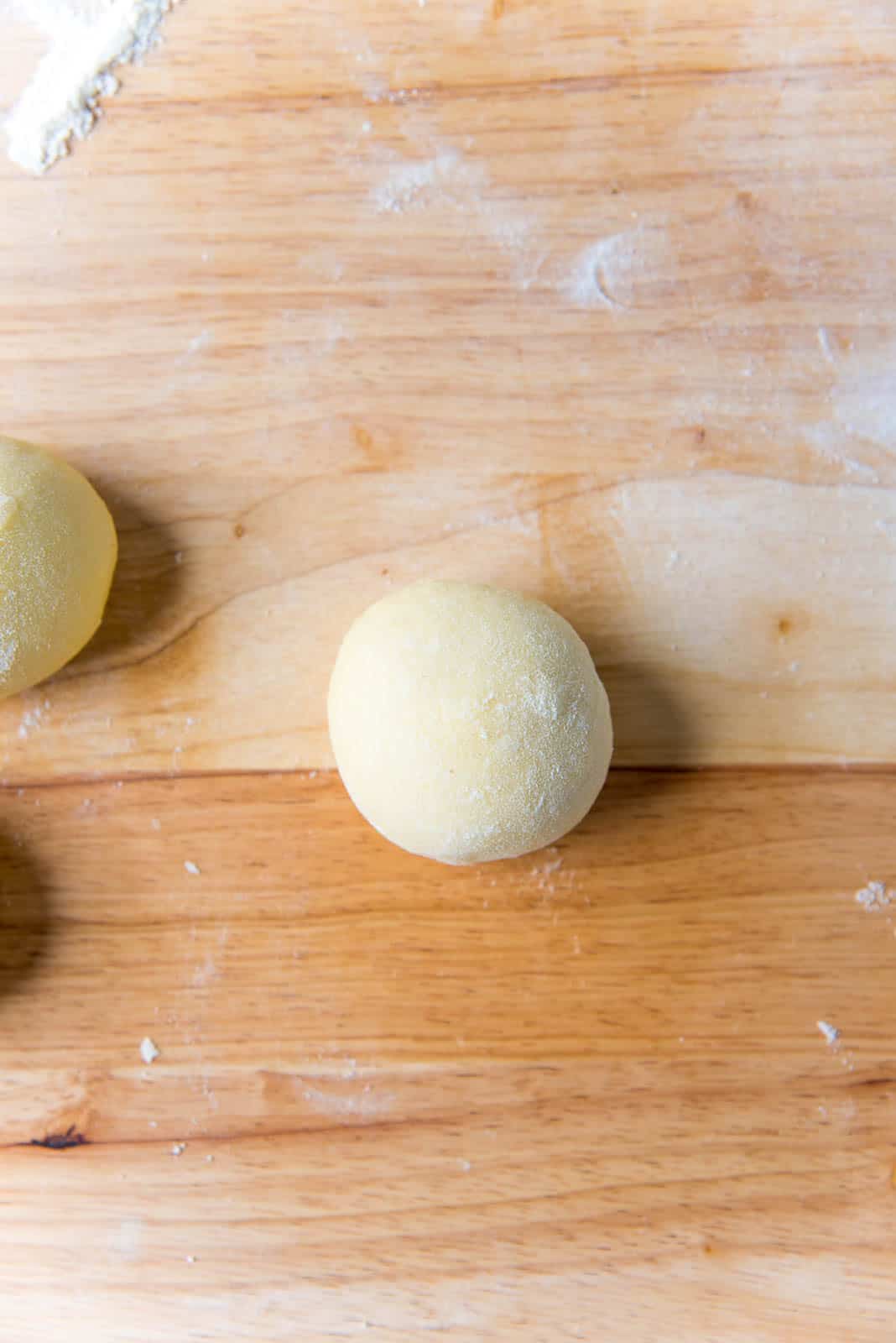
Smooth perfect round dough ball on a work surface.
The dough ball should look smooth like this.
A round dough ball that is sealed all around so that no seams are showing.
The underside should be nice and sealed like this as well.
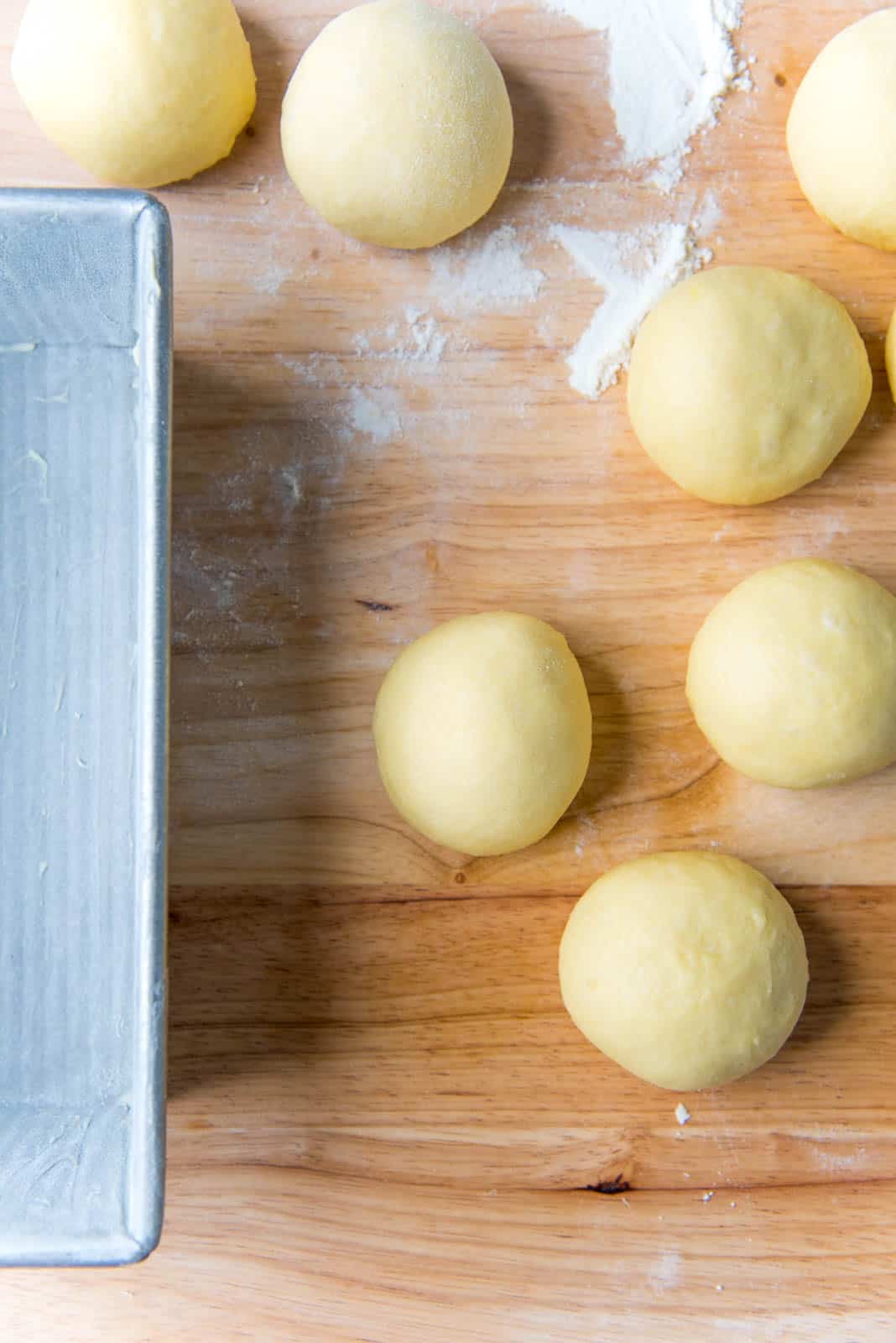
Several perfectly formed smooth round dough balls on a work surface.
Repeat with all the dough portions.
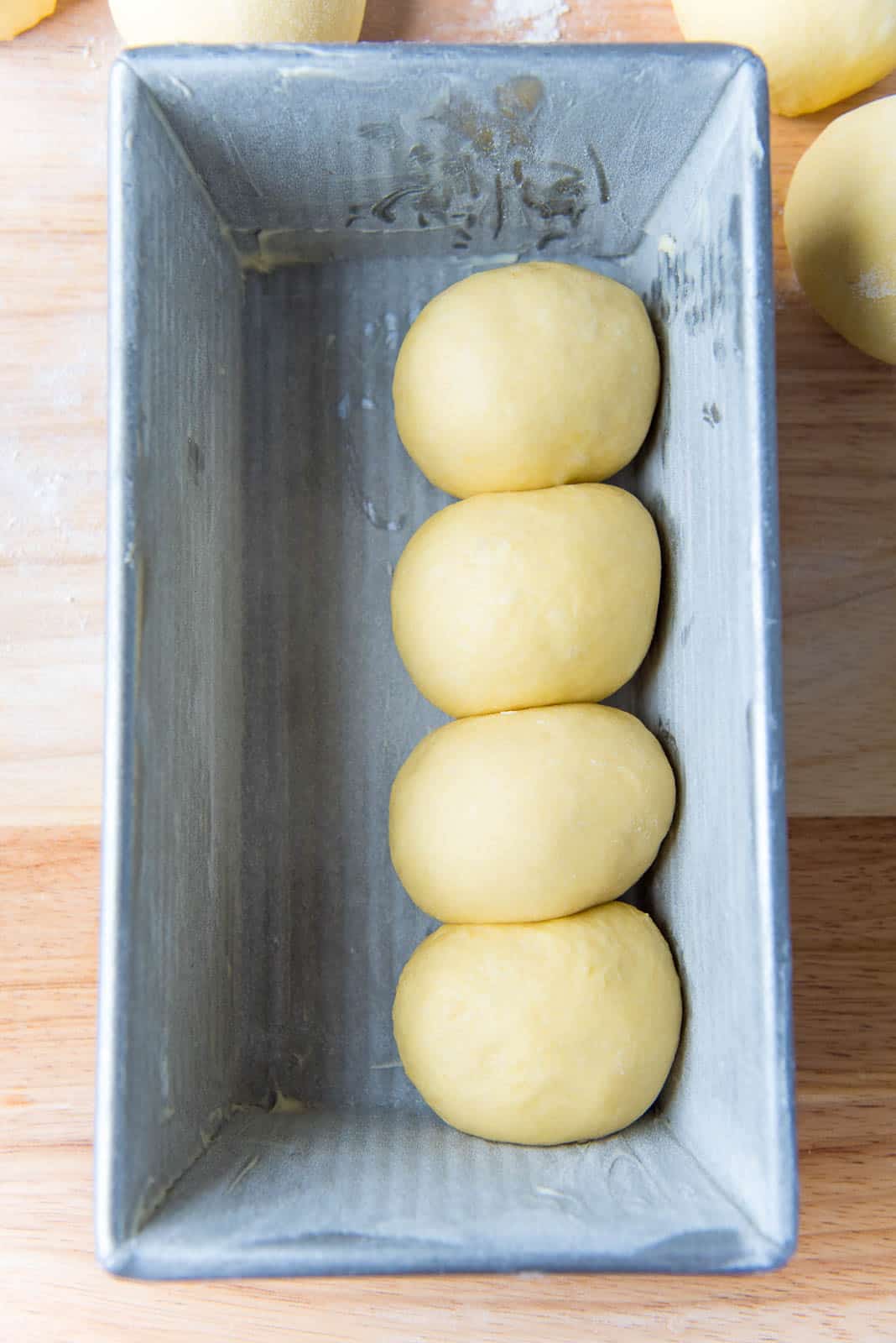
Four round dough balls placed in a row inside a metal loaf pan.
Place 4 dough portions on one side of the pan.
Eight round smooth dough balls placed inside a metal loaf pan to form a nantaise brioche loaf.
Then the other 4 portions on the other side of the pan, like this (kind of a zig-zag pattern).

Final proofing and baking

Cover the shaped dough in loaf pans with plastic wrap and allow it to double in size before baking. This will be the final proof. This proofing can also take 2 hours at cooler room temperature, so make sure to keep it in the oven with the light on, or the warmest place in your house.

When the dough doubles in size and reaches the top of the loaf pan, it should be properly proofed. Do the finger test to find out if the dough is properly proofed. To do this, gently press the side of the loaf with your lightly floured finger. This leaves an indentation. If this indentation remains, OR if it bounces back halfway, then the loaf is ready to be baked.

If the indentation bounces back completely, then it’s under-proofed and needs more time to proof.

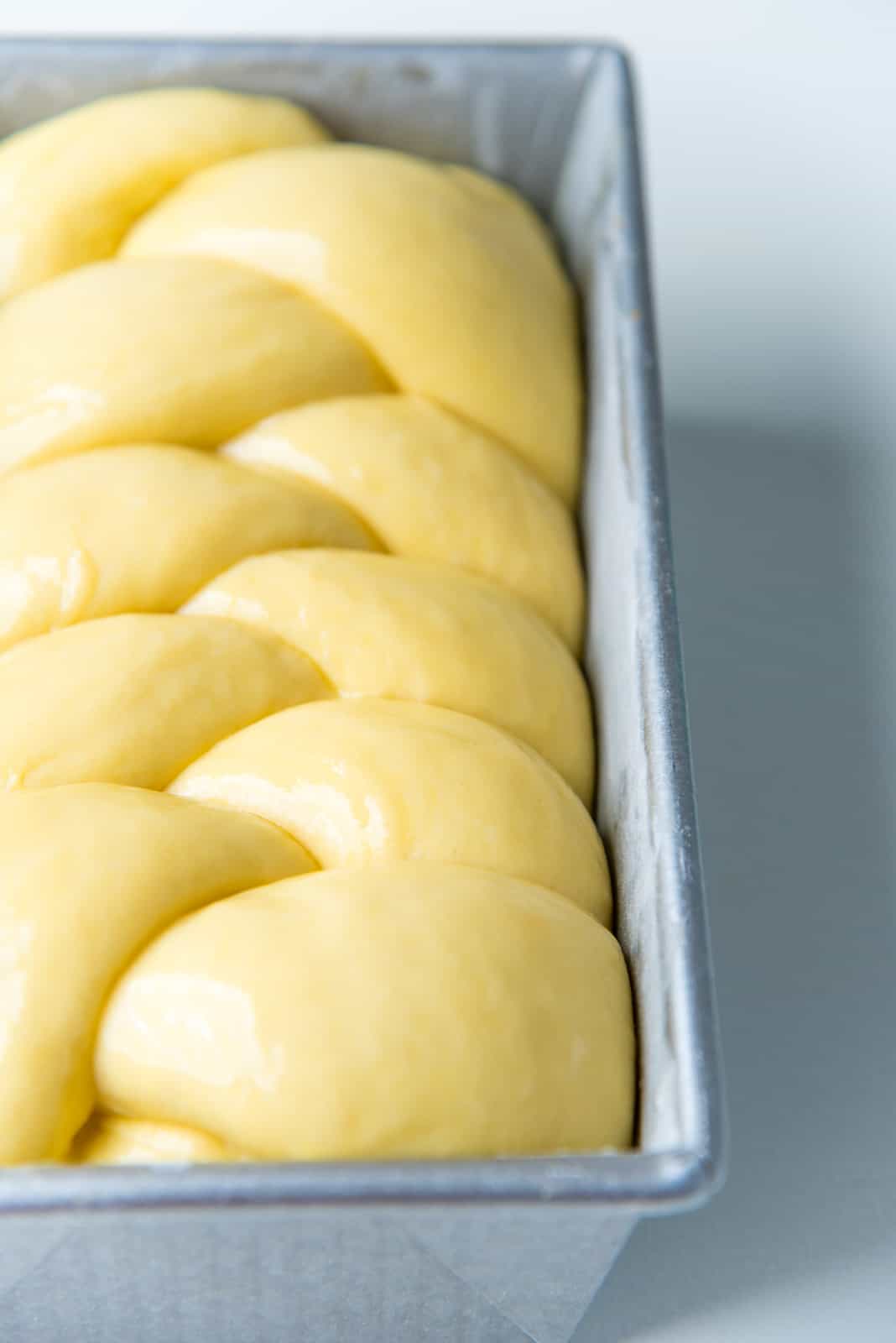
Properly proofed nantaise brioche loaf in a loaf pan before baking.
Proofed nantaise loaf
Properly proofed brioche bread dough in a loaf pan.
Proofed braided loaf

What to do if your brioche was over-proofed?

If the indentation causes the loaf to deflate, that means it was over-proofed!

If your loaf deflates after proofing, then you have to reshape the dough and start again. Otherwise, baking an over-proofed dough can cause the loaf to overflow, or deflate once baked. So make sure to check on the dough periodically, especially when it has nearly doubled in size.

Egg wash or not?

I prefer an egg wash on my plain brioche bread loaves. It gives it a beautiful, shiny crust!

You can alternatively brush the loaf with simple syrup once out of the oven too. But I prefer this option for sweeter brioche bread recipes (like cinnamon rolls or babka).

Brush the surface well with an egg wash. You can sprinkle the top with small pearl sugar (Swedish pearl sugar, not the Belgian kind) if you like, for that extra crunch!
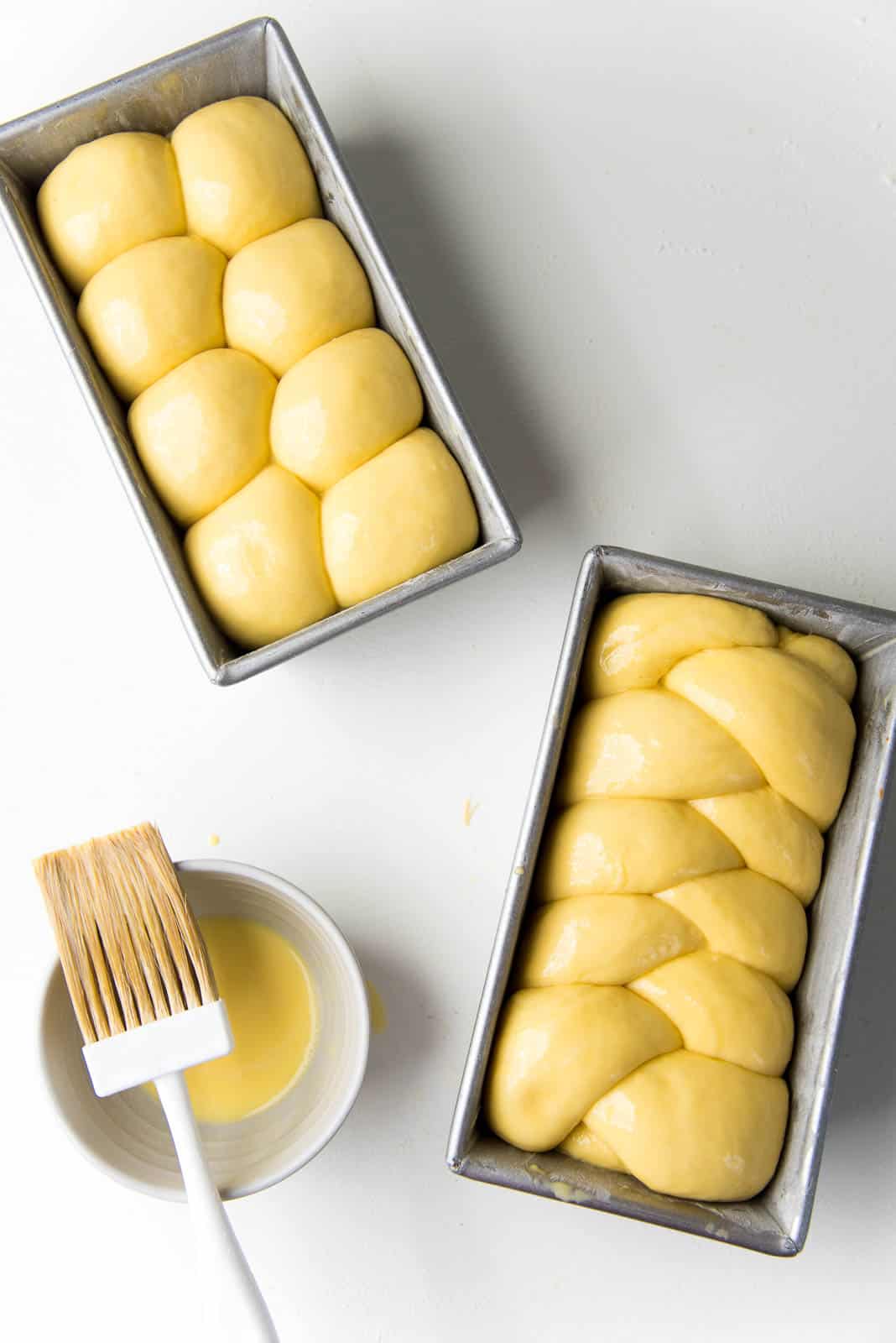
Two unbaked brioche bread loaves in pans, one is braided and other is shaped in the Nantaise method.

Preheat the oven while you prep the loaves for baking. Bake the loaves in the preheated oven until the loaf is a beautiful deep golden brown in color, and the internal temperature is about 180° – 190°F when checked with an instant read thermometer. Because this dough is enriched, it doesn’t need to reach 205°F like other types of lean dough.

Once baked, turn the loaf out onto a wire rack and allow it to cool completely.

A perfectly baked brioche bread loaf shaped in the Nantaise method.

How to enjoy brioche bread

  • Brioche toast is an incredibly delicious way to enjoy brioche bread. It doesn’t even need any butter because of how rich it is (but it won’t hurt of course!).
  • And brioche makes the absolute best French toast! Brioche French toast, brioche French toast casserole, brioche French toast sticks, honey butter toast are all made possible with this brioche bread.
  • Slather some jam on your brioche bread, or any kind of spread – like my fig jam, strawberry jam, grape jelly, or spiced plum jam).
  • Make cinnamon toast with the brioche bread. The caramelized crunchy cinnamon on top is a great textural contrast with the soft bread.
  • You can slice the brioche loaf while it’s still a little warm. A freshly baked, warm piece of brioche dough is one of life’s simple pleasures, indeed! 🙂
  • You can use the brioche dough to make brioche burger buns, or large cinnamon rolls too!
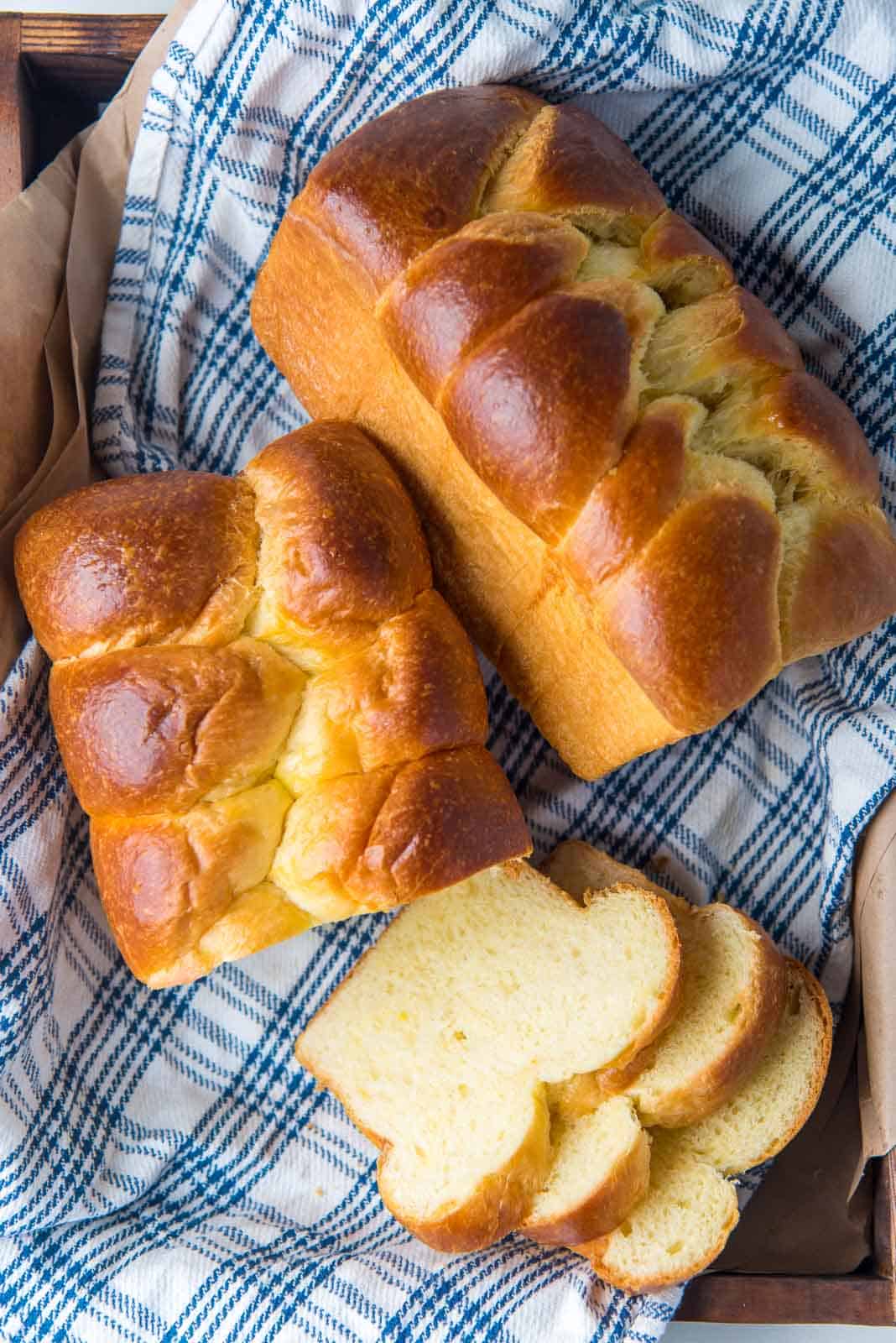
Two braided baked brioche bread loaves, where one loaf is sliced.

What to do with leftover brioche?

  • French toast
  • Bread pudding
  • Croutons
  • Bread crumbs
  • Bostock
  • Stuffing

Brioche; Frequently Asked Questions

I don’t have AP flour. Can I make brioche with bread flour instead?

AP flour has protein content of about 10%, while bread flour has 12%. So bread flour will develop more gluten due to the extra protein, which will result in a chewier bread.

So you can use bread flour, but just keep in mind that the texture might be different. It’ll still be soft, buttery and delicious though.

Can I use salted butter?

I wouldn’t recommend it. Salted butter has more water than unsalted butter, and of course, it has salt too. Even if you remove the extra salt in the recipe, you might end up with a salty bread loaf because of the large amount of butter you’re adding in this recipe.
The extra salt may inhibit yeast growth too.

Can I make this brioche bread sweeter?

Yes, you can. However, the more sugar you add, the more slack the dough will be. For every 50 g of sugar added, remove an equal amount of egg whites. I wouldn’t recommend adding more than 120 – 150 g sugar.

I don’t have a mixer, can I make it by hand?

Ooh boy. It is do-able, especially if you like a good arm workout.

Hand kneading generally takes about twice as long. However with brioche, it might take even longer because you have to incorporate the butter in small additions.
I recommend only making ONE loaf (half the recipe), and expect a really good upper body workout. You’re welcome!

Can I make this dough in a bread machine?

Since I don’t own a bread machine, I can’t be sure how well it would work. This dough is very soft (starts of like a cake batter), and needs to be kneaded for at least 20 minutes (at medium and medium high speed). I am not sure a bread machine will be able to handle such a soft dough. One of my readers did try this, and confirmed that the dough was too soft and it was harder to knead especially when adding the butter.

If you do decide to try it, please remember to halve this recipe, as this is for TWO loaves, and usually bread machines can only knead enough for 1 loaf.
There are recipes that can be made in a bread machine, but these bread machine brioche recipes have less butter and eggs and therefore is less rich and buttery than classic brioche recipes like this.

Can I make one loaf?

Personally, I don’t like making just one loaf in my KitchenAid artisan mixer. This dough is wet, and the kneading hook will have trouble grabbing the dough as well as it should. This can lead to a much longer kneading time.

But you can manually make one brioche loaf with hand kneading if you prefer (see FAQ above).

Can I freeze brioche? How do I store this long term?

Yes, you can freeze brioche. With two loaves, you can easily freeze one for later. I have frozen whole loaves and sliced loaves with equal success.
Store in an air-tight container, OR wrap it well with plastic wrap and foil to avoid freezer burn.
Then let it thaw out at room temperature, or toast while frozen.

Why is my dough so sticky and wet? My other bread doughs aren’t so sticky. 

It’s meant to be. This is an ENRICHED dough. It has A LOT of butter and eggs that make the dough VERY soft. The consistency of this dough after you add the butter will be similar to CAKE BATTER. You have to keep kneading it to help the gluten develop. This can take as little as 15 minutes, but with temperature / humidity changes, it can take as long as 30 minutes as well.

How can I tell that the dough is done?
What should the kneaded dough feel like?

When you try to lift the dough from the bowl with the dough hook, the entire dough should come off the bowl WITHOUT breaking. It will be VERY wet and droop down, but it should come off cleanly from the bottom of the bowl.
The dough should also be shiny and smooth. And when you try to form it into a ball, it will feel more like a water balloon (think high hydration dough), than a taught, firm dough.

My dough is very soft, can I add more flour?

Have you been kneading the dough for at least 30 minutes, and the dough doesn’t look shiny and smooth?
I don’t personally like to add more flour, because the more flour you add the less soft the dough is going to be. But if you absolutely must, add just a little bit of flour. But MAKE SURE YOU KNEAD until the gluten has developed; or you will end up with a crumbly brioche dough.

If the kitchen is very hot, or you live in a hot climate, you may have to chill the dough halfway through the kneading process. This is because the butter is too oily and isn’t mixing in the with the dough properly.

What kind of mixer do you use?

I use a KitchenAid artisan mixer. I use speed 5 – 6. It might seem like this would strain your mixer, but I make this dough very regularly. I also like to keep my hand on top of my KitchenAid head during the kneading process.

Can I skip the overnight proof?

The overnight proof develops more flavor, and also chills the dough so that it’s easier to handle and shape it the next day.
IF you have done the room temperature proof, then you can skip the overnight proof in theory. However you still need to chill the dough so that you can shape it.

Flatten and place the dough on a baking sheet pan (lined with silpat or parchment paper), and wrap it with plastic wrap. Place the pan in the freezer for a few hours to chill the dough quicker. Then you can shape and bake the bread according to the recipe.

Can I skip the first proof at room temperature?

I like doing the first proof at room temperature because it helps with gluten development as well as flavor. However, if you forget and put it in the fridge instead, you may need to proof it longer before baking.
I also prefer to let the dough proof in the fridge longer. If I knew I wanted to keep the dough in the fridge for 48 hours, then I would skip the room temperature proof.

Why is my brioche dough so oily, even after kneading it for so long?

If you live in a high humidity, high temperature area, this can happen. Brioche is like a croissant dough because of the large amount of butter in it. When the dough reaches a temperature of 30°C / 86°F the butter will be too soft and will separate into oils. This will make your brioche oily as the butterfat seeps out of the dough (just like with croissants).
So if you live in a hot tropical climate or your kitchen is very warm, then you may need to chill the dough between kneading to make sure the dough is at least below 30°C / 86°F.

Why does my brioche taste so yeasty?

Brioche SHOULD have a lovely depth of flavor if you proofed it overnight.
However, if you over-proof the dough (the first or last proofing), the bread will have an unpleasant beer-like taste.
So make sure to only proof the dough until needed; so don’t necessarily go by time, go by the appearance of the dough.

Can I make brioche buns instead of loaves?

Yes you can! I’ve shared a recipe specifically for brioche buns. The recipe is the same, but the dough shaping technique is different. Plus, I’ve included different weight variations for different sizes of burgers. From large buns to regular buns, and even slider buns too.

Recipe
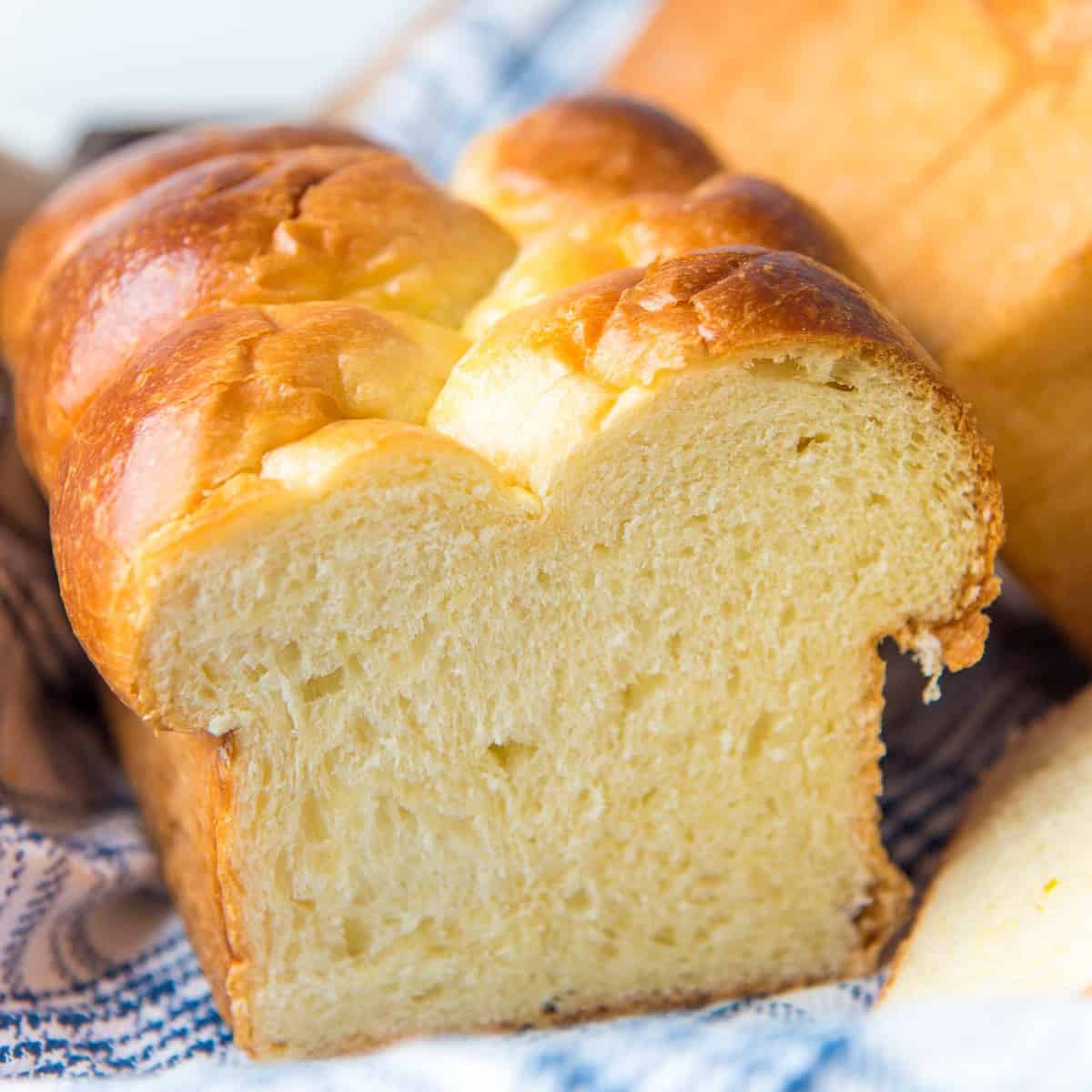
A perfectly baked brioche bread loaf cut in half to show the crumb.
5 from 322 votes

Brioche Bread Recipe

Author: Dini Kodippili
Yield: 2 loaves
Cuisine: European, French

 Difficulty: 

Intermediate
This brioche bread is ultra soft, rich, and buttery! Not only delicious to eat, but easy to make too! Learn how to with my step by step recipe.
INTERMEDIATE – This is an easy brioche recipe, but requires a stand mixer. The dough is slightly harder to manage than a regular lean dough.
US based cup, teaspoon, tablespoon measurements. Common Measurement Conversions.
Weight‌ ‌measurements‌ ‌are‌ ‌recommended‌ ‌for‌ ‌accurate‌ ‌results.‌ ‌You‌ ‌can‌ ‌access‌ ‌metric‌ ‌weight‌ ‌measurements‌ ‌using‌ ‌the‌ ‌toggle‌ ‌button‌ ‌below‌ ‌the‌ ‌ingredient‌ ‌list.‌ 

US based cup, teaspoon, tablespoon measurements. Weight‌ ‌measurements‌ ‌are‌ ‌recommended‌ ‌for‌ ‌accurate‌ ‌results whenever available.

Common Measurement Conversions
Prep: 1 hour hr
Cook: 45 minutes mins
Proofing / chilling: 1 day d
Total Time: 1 day d 1 hour hr 45 minutes mins
Print Recipe Rate SaveSaved!

Video

Makes: 30 slices

Ingredients:
 

  • 120 mL warm milk
  • 9 g active dry yeast about 9 g
  • 10 mL honey
  • 5 large eggs You can also use 4 large eggs
  • 1 large yolk from a large egg. Use 2 egg yolks if using 4 large eggs.
  • 10 mL vanilla
  • 60 g granulated white sugar 5 tbsp
  • 500 g AP flour 4 cups + 2 tbsp (measured by spoon and level method)
  • 1 ½ tsp sea salt fine grind
  • 250 g unsalted butter very soft, roughly divided into four portions (1 cup + 2 tbsp)

Instructions:
 

DAY ONE
    Making the dough
    • Measure all the ingredients and have them ready.
    • Add the milk, yeast and honey into the mixing bowl and whisk gently to combine. Set aside for 10 minutes to allow the yeast to activate.
      120 mL warm milk, 9 g active dry yeast, 10 mL honey
    • Add the eggs and yolks, and whisk gently to break the egg yolks.
      5 large eggs, 1 large yolk
    • Add the vanilla, sugar, flour and sea salt, and mix to form a scraggly dough.
      10 mL vanilla, 60 g granulated white sugar, 500 g AP flour, 1 ½ tsp sea salt
    • With the dough hook attachment, knead the dough on speed 2 or 3 for about 3 – 5 minutes.
    • Divide the butter into roughly 4 portions. Add the first portion of butter, in increments, after the first 5 minutes of kneading. Allow the butter to be mixed well into the dough. This should take about 2 minutes.
      250 g unsalted butter
    • Repeat with the other 3 portions of butter, kneading the dough for about 2 -3 minutes after each addition. Make sure to stop the mixer to scrape down the sides of the bowl (and the bottom if needed) between kneading as well. You will have incorporated all the butter in about 9 – 12 minutes of kneading time.
      250 g unsalted butter
    • Once all the butter is incorporated, scrape down the sides of the bowl (and bottom if needed), and knead the dough for a further 5 – 15 minutes on speed 5 or 6. This could take up to 20 – 30 minutes if your mixer is on low speed.
    • The dough will have been kneaded enough when it can be lifted fairly cleanly off the bottom of the bowl when picked up with the dough hook. It will be very soft and tacky to the touch, but shouldn’t stick to your fingertips. Rather than strictly going by time, knead the dough until you have reached this consistency.
    • Flour your work surface, and turn the dough out onto the floured surface. Lightly flour your hands and the surface of the dough to prevent the dough from sticking to your palms.
    • Fold in the edges of the dough towards the middle and gently press them into the dough (see pictures in the post for more information). Carefully flip the dough over, and then with the heel of your palms, shape the dough to form a tight ball.
    • Carefully pick up the dough ball and place it back in the mixer bowl (or another large bowl).
    • Let it rise until it has doubled in size, in a warm place (72°F), for about 1 hour.
    • Turn the dough out onto a lightly floured surface, and press down gently to deflate the dough with your hands. Fold in the edges again as before towards the middle and press them in. Carefully flip the dough over (seam side down now). Tighten the dough into a ball with a smooth, taut surface (using the edges of your palms). Transfer the dough into the mixer bowl again.
    • Cover and let it chill in the fridge for at least 8 hours, or up to 24 hours.
    DAY TWO
      Shaping and baking the bread
      • Remove the chilled dough from the fridge. The dough will be much easier to work with now.
      • Butter and dust two 8.5 x 4 inch, standard loaf pans with flour. (You can also use 9 x 5 inch loaf pans).
      • Keep a bowl of flour, a pastry brush and a dough scraper/cutter ready as well.
      • Turn the dough out onto a lightly floured surface. Deflate the dough by flattening it lightly. Measure the weight of the dough, and then divide it into two EQUAL portions, using the dough cutter or a sharp knife.
      • Now you've got two dough portions to make two brioche bread loaves.
      Shaping the loaves
        Nantaise brioche loaf
        • Weigh one portion of the loaf and divide it into 8 equal portions.
        • For each portion (with the smooth side down), fold in the edges towards the middle as before. Carefully flip the dough over, and using a cupped palm, roll the dough portion on your work surface until you have a smooth dough ball (see pictures in the post for more details). Repeat with the other dough portions to get 8 smooth dough balls.
        • Place the dough balls in the loaf pan in a zig-zag manner. This will likely be a fairly snug fit.
        • After arranging the dough balls in the loaf pan, flatten them slightly. Then cover the pan with plastic wrap and set aside.
        Braided brioche loaf
        • Divide one portion of the dough into 3 equal portions.
        • Flatten each portion into a small rectangle. Then tightly roll up the rectangle to form a tube. Using your palms, and a back and forth motion, roll out the dough into a 14 inch long bread rope. Apply light but even pressure to get a bread rope with even width.
        • Repeat with the other two portions.
        • Now you have three 14 inch long bread ropes. Bring the ends of the three ropes together and pinch to seal. Braid the dough, while being careful to avoid any loose folds and to not stretch the dough ropes at the same time. Once braided, the bread loaf should be a little longer than the length of the pan (about 9 – 10 inches).
        • Pinch to seal the other end. Using your palms, press down the ends of the bread to flatten them against the work surface. Tuck the flattened ends to get a lovely, rounded loaf.
        • Carefully transfer this to the buttered and floured bread pan. Flatten slightly to fit the loaf pan.
        • Cover with plastic wrap and set aside.
        Regular bread loaf
        • Follow the same shaping instructions as for my white bread loaf in this recipe to form a regular bread loaf shape.
        Proofing the bread before baking
        • Proof the bread in the covered loaf pans for about 2 hours at room temperature, or until doubled in size, and almost reaching the top of the pan. Preheat the oven to 325°F/163°C before baking the loaves.
        • Once doubled in size, brush the tops with an egg wash. Optionally, you can also sprinkle some Swedish sugar pearls on top for a sweet crunch.
        • Bake in preheated oven until golden brown on top and the internal temperature registers 190°F/88°C. This can take about 35 – 45 minutes.
        • Remove from the oven and let the bread loaf cool slightly – about 5 minutes.
        • Carefully flip the bread loaf out of the pan, onto a cooling rack. Let it cool completely. Store in an air-tight container.

        Recipe Notes

        Note on the dough

        This dough is very soft and wet. Make sure you read the FAQ section and the post for information on the dough consistency, and how it changes after kneading. If you can’t find an answer in the post or FAQ section, let me know. 
        Please take your time kneading the dough while adding the butter (as recommended in the recipe). 
        See the video in the recipe card that will show you the consistency of the brioche dough.
        https://www.youtube.com/watch?v=cv_eo4boM6U

        Note on yeast

        • If you have access to fresh yeast, use 18 g of fresh yeast. 
        • If you have access to instant yeast, use 4.5 g of instant yeast. 

        Note on proofing 

        In winter, or if you don’t have a warm place to proof the dough in your house, turn on the oven light, and keep the bowl inside the oven. The heat from the light will warm the oven sufficiently to help with the proofing. Use a metal bowl to make this proofing process go faster. 
        Proofing times will vary depending on the temperature of the dough, environment and the type of yeast you use. So rather than going by time, go by sight and feel. 
        • If you make a small indentation in the dough with your fingertip and it bounces back slightly, then it’s ready to be baked.
        • If the indentation stays, it’s starting to over-proof, so bake it as soon as possible.
        • If the bread deflates when poked with a finger, then it has over-proofed.

        Note on halving the recipe 

        If you’re halving the recipe, use 2 LARGE EGGS + 1 EGG YOLK. 

        Notes on making this brioche in a hot kitchen / hot climate

        Use cold butter instead of room temperature butter. 
        You may also have to chill the dough halfway through kneading. This will help chill the dough so that the butter will incorporate better and the gluten can be developed. 

        Other recipe variations and homemade breads

        Brioche buns
        Hawaiian dinner rolls
        Brioche cinnamon rolls
        French toast
        Honey butter toast
        Bostock pastry
        White bread (sandwich bread)
        Focaccia
        Hokkaido milk bread

        Nutrition Information:

        Serving: 1slice Calories: 151kcal (8%) Carbohydrates: 16g (5%) Protein: 3g (6%) Fat: 8g (12%) Saturated Fat: 5g (31%) Cholesterol: 56mg (19%) Sodium: 130mg (6%) Potassium: 45mg (1%) Fiber: 1g (4%) Sugar: 3g (3%) Vitamin A: 266IU (5%) Calcium: 14mg (1%) Iron: 1mg (6%)

        “This website provides approximate nutrition information for convenience and as a courtesy only. Nutrition data is gathered primarily from the USDA Food Composition Database, whenever available, or otherwise other online calculators.”

        Tag me on Instagram!I love seeing what you’ve made! Tag me on Instagram at @TheFlavorBender or leave me a comment & rating below.
        Dini Kodippili Avatar

        About

        Dini Kodippili

        Dini Kodippili is a professional food writer, recipe developer, food photographer, cookbook author, and baker. Dini has been featured on HuffPost, Cosmopolitan, Forbes, Delish, Food & Wine and more. Learn More

        I love hearing from you! Submit your question or recipe review here.

        5 from 322 votes (14 ratings without comment)

        Leave a Reply Cancel reply

        Your email address will not be published. Required fields are marked *

        Made this? Rate this recipe:


        This site uses Akismet to reduce spam. Learn how your comment data is processed.

        986 responses

        1. Jane
          July 3, 2020

          5 stars
          I have made this recipe twice now and love it. They turned out great!

          You mentioned that the receipe can easily be made into sweet or savory. What and how much to add to do this? My daughter loved this but asked if I could make it sweeter, too.

          Reply
          1. Dini
            July 4, 2020

            Hi Jane
            I’m so glad you enjoyed this recipe!
            Yes, you can make it sweeter or more savory. For the sweeter version you can increase the sugar by 50 g (so 110 g for two loaves). I would also recommend using only 4 eggs and 2 egg yolks if you’re increasing the sugar.
            You can also add cinnamon to the dough. Or roll out the dough and then roll it up (firmly) with a sprinkle of cinnamon and raisin for a cinnamon raisin loaf.
            I also had a reader who added chocolate chips to make chocolate chip brioche dough, although I haven’t tried that myself.

            For savory options – you can keep the original sugar amount, and add all kinds of savory herbs to the dough.
            My favorite is chives! You could also add some grated cheese to get some cheesy flavor in your brioche dough.
            I hope that helps!

            Reply
        2. Marcela Arratia
          July 2, 2020

          I’ll make this recipe tomorrow. Only I don’t have an standing mixer so wonder if my Oster Bread Machine could perhaps knead the dough? Have anyone tried it?

          Reply
          1. Dini
            July 3, 2020

            Hi Marcela
            Unfortunately I’m not sure about using a bread maker to knead the dough. This dough is very soft (starts of like a cake batter), and needs to be kneaded for at least 20 minutes (at medium and medium high speed). I’m not very familiar with bread machines with brioche dough, so I don’t know if it is capable of handling such a soft dough.
            If you do decide to try it, please remember to halve this recipe, as this is for TWO loaves, and usually bread machines can only knead enough for 1 loaf. I hope it does work, and if it does, let me know! 🙂
            I hope that helps!

            Reply
        3. KT
          June 27, 2020

          I am going to make it today, but
          I only have instant yeast with me. Can I use 2 1/2 tsp of instant yeast instead of active yeast?
          Thanks

          Reply
          1. Dini
            June 27, 2020

            Hi KT
            Instant yeast is more active than active dry. I recommend using about 1.5 – 2 tsp instead, and also adjusting proof times. This is because the dough will likely proof faster with instant yeast. I hope that helps, good luck!

            Reply
            1. KT
              June 28, 2020

              I made the bread. The result after bake seem oily to me. It is somehow like croissant.

              During the process, after adding the butter, the dough took longer time to form (about 40 mins). And it is very oily too. The texture that time is like playing a water balloon., and it never form a solid dough like yours in the picture. Mine like a water balloon which sagging down. I am not sure what I did wrong. Am I using too less flour or my house is too warm (83’F temp).
              After the proofing, the dough become like slimy dough. Thought it is not enough flour, then I add more into it and knead with machine, and then move to fridge for overnight.
              I just feel something not right about the dough, but the result still soft, except the crust kind dry.

              Also, I like to use gram in measurement, so I convert the 17.6oz AB flour to grams., which is 500g I am using. It doesn’t seem right to me too. 🙁

              I am not sure how true brioche bread taste. The only one I tried and love it is the one I bought from whole food brioche bread.

              So, do I need to cut down the butter or steps I made is wrong or others.

              Thanks

              Reply
              1. josh irvin
                June 28, 2020

                Love this recipe, first time making it and edited it slightly for more savory than sweet and it came out perfect!!

                Reply
        4. Millyluv
          June 27, 2020

          I love the recipe, so fluffy and taste good. The bread came out good and my family love
          it.

          Reply
        5. Kd
          June 24, 2020

          I fallow the recipe exactly as the direction point out. The dough look more like a cake than a bread. I add more flour to the dough. Maybe the eggs were to big?? I don’t know.

          Reply
          1. Dini
            June 24, 2020

            Hi Kd
            I have mentioned in the post that a brioche is between a cake and a bread. So it’s normal that the dough will be cake-like at the beginning (see images). It requires more kneading time for the gluten to develop further. Sometimes it can take longer than stated, depending on the mixer. I use medium and medium high speeds intermittently (as noted in the recipe).
            If the eggs are too big, this can make the dough more liquid as well. I have also included an alternative for people who are worried about the dough being too wet, and to reduce an egg white (4 whole eggs + 2 egg yolks). You can add a little extra flour if you like, but you will still need to knead the dough until it’s smooth. I hope that helps!

            Reply
        6. Chanra
          June 24, 2020

          5 stars
          I just wanted to hop back on here and tell you that I tried this recipe again, this time carefully making sure I do not overproof! This time I tried the 4 eggs + 2 yolks & I only used 2 tsp of yeast. This the perfect recipe! It came out so amazingly delicious, soft, buttery, flaky…I can go on. My husband and I ate half of a loaf in one evening and I’m not even ashamed! Thank you so much for this amazing recipe!

          Reply
          1. Dini
            June 24, 2020

            Hi Chanra,
            I’m so glad you gave it another go, and didn’t overproof the dough!
            My husband has eaten half a loaf in one day too (multiple times in fact!) 😀 It makes me happy that you really enjoyed the bread too.
            Thank you so much for coming back and letting me know that the recipe was successful.

            Reply
        7. Rett
          June 23, 2020

          5 stars
          I have now made this twice- it’s absolutely perfection! I followed the recipe and instructions carefully and it was perfect. I am an amateur baker and never have baked bread before, this is SO SATISFYING to make and SO DELICIOUS!

          Reply
        8. Amber
          June 21, 2020

          This will be my second time making this and I’m hoping it’s not dry like it was last time . I’m pretty sure I followed all directions to a T but, maybe I over baked? I used instant yeast and combined it with the milk and honey like normal. I didn’t realize until the I got to the end of the recipe I should have only used half of what it called for for active. Could that have been the problem? Proofing was fine. And mixing was fine. It was just a little dry.

          Reply
          1. Dini
            June 21, 2020

            Hi Amber
            Did you use cup measurements or weight measurements? If you used cup measurements it’s likely you used too much flour.
            It’s very hard to make this brioche bread dry because it’s such a rich, soft, slack dough. The only reason it would be dry is if it was WAY overbaked (and the crust was burnt), or you used too much flour.

            Using extra instant yeast will make the dough proof faster, and maybe give it an extra yeasty flavor, but shouldn’t contribute to the dryness.

            Reply
        9. Najd Ibrahim
          June 21, 2020

          Hello,
          Is it okay if i leave the dough in the fridge for more than 24 hours?

          Reply
          1. Dini
            June 21, 2020

            Hi Najd
            You could. However, the longer you keep it in the fridge the more fermentation occurs, which can develop the flavor further. I personally don’t mind it, but some prefer not to have the fermentation flavor to be that pronounced.
            The longest I kept brioche dough in the fridge was 30 hours.
            I hope that helps!

            Reply
        10. Ruth G
          June 20, 2020

          The recipe looks good. Can I use bread flour instead of all purpose?

          Reply
          1. Dini
            June 21, 2020

            Hi Ruth
            Yes, you can use bread flour. The resulting bread will be slightly chewier than the cake-bread hybrid described in this recipe. But it will still be super soft.
            I hope that helps!

            Reply
        11. Chanra
          June 20, 2020

          I’m on my second proof now. I am worried this will not turn out right but I’ll continue on and see what happens. My dough took a while to knead, almost 30 mins. When I tried to put it into a ball and picked it up to put in the bowl, it wasn’t tight and I had trouble keeping its shape. It proofed for 3 hours – only Bc I went to dinner and forgot about it. It was almost spilling out of the top! I deflated it and again tried to make it into a round ball and put it back in the bowl for the second proofing and i had trouble keeping its shape. What did I do wrong? I wonder if I needed more flour. I measured everything correctly. I hope it’ll be okay tomorrow!

          Reply
          1. Dini
            June 21, 2020

            Hi Chanra
            Your kneading time is normal. It can take longer sometimes depending on the mixer.
            A tight ball is for the outside of the dough (the skin) to be tight. The dough itself is super soft. So what you describe is right and you did not need more flour.
            However, the first proof did go for too long in your case – which resulted in a dough that is softer than if it was proofed until just doubled in size. Overproofing can lead to a yeasty, beer-like taste. This also could lead to the dough not rising properly during the third and final proof before baking, because the yeast may have exhausted its capacity to produce CO2.

            In this situation, what I would have recommended is to flatten the overproofed dough on a half sheet pan (just gently flatten it with your hands, not a rolling pin), cover it well with plastic wrap, and chill the dough in the fridge so that it chills as fast as possible. You could even keep it in the freezer to let it chill quickly.
            But as soon as the dough is chilled, take it out, shape the dough and place it in loaf pans and let it proof one last time before baking. By avoiding the overnight proof, you still can get a good rise from the dough before baking it.

            I hope it still comes out well tomorrow too. Let me know if it does!

            Reply
            1. Chanra
              June 21, 2020

              I saw this message the next morning. I kept going with the bread and just finished cutting it up. I tasted it and it was over proofed Bc I can taste the yeast. It does taste a lot like beer bread. It still tastes fine but not like brioche. It’s verrrry soft. I will try again!

              Reply
              1. Dini
                June 21, 2020

                Hi Chanra
                That makes sense. There will be some flavor of fermentation due to the overnight cold proof. But overproofing will make the yeast flavor more prominent.
                And the brioche dough is meant to be very soft.
                As the post states, a brioche is meant to be between a bread and a cake. Light brioche recipes have a firmer dough, but are not as rich due to reduced yolks and butter. This is a classic brioche that uses 50% butter – so the dough will very soft when at room temperature.

                I hope next time will be better! 🙂

                Reply
                1. Chanra
                  June 22, 2020

                  So I took the second loaf to my parents house and we all tasted it and it was DELICIOUS! I have no idea why the first loaf was soooo yeasty but the second one was perfect. They came from the same batch. Anyway, I am going to try this again today. Do you think I should use less yeast? Maybe omit the 1/2 tsp? I do not weigh ingredients, I use cup/spoon measurements. My comment about the softness was a good thing! The texture was great. I think other than the yeast flavor, the brioche came out beautiful although I need to work on my braiding skills.

                  Thanks so much!!

        12. Newmei
          June 19, 2020

          5 stars
          I just got into bread baking and I thought this will be too much for a beginner like me but I challenged myself instead because I love Brioche. I tried this one today. It was scary how wet & sticky the dough after the mix but I then decided to just TRUST the recipe, kept following the instructions to the T…and it worked. It Is soft, buttery & flaky outside. The best I have done so far! Thank you for this & for keeping it simple for novices like me.
          Question: If I want to make it sweeter, do you think it is safe to add more sugar? Will that affect the consistency or texture? Thanks in advance!

          Reply
          1. Dini
            June 20, 2020

            Hi Newmei
            I’m so glad you kept going with the recipe! It can be unnerving how wet and sticky the dough can be, but it does come together eventually 🙂 I’m even more happy that you loved the bread that you baked!

            Yes, you can make it sweeter. Adding extra sugar does add more “volume” to the dough, which can make it stickier (sugar dissolves easily in the dough). I recommend using just 4 whole eggs and 2 egg yolks and increasing the sugar by 40 grams. If you want to add more sugar (I wouldn’t recommend going higher than 150 g), you can reduce another egg white from a whole egg and substitute with the rest of the sugar. Adding extra sugar can make the bread softer as well, and can make it brown faster in the oven too. So keep an eye on the dough while kneading, proofing and baking.
            I hope that helps!

            Reply
        13. Rachel
          June 19, 2020

          Hi! First of all, loved how well explained this recipe is! I live in tropical very humid weather so I’m guessing is a safer bet to go with less eggs as suggested, my question is does this dough proofs well before baking if I make buns with no molds/pan? Or would you strongly suggest to use a mold/pan for this?

          Reply
          1. Dini
            June 19, 2020

            Hi Rachel
            You can go with 4 whole eggs and 2 egg yolks if you would like the bread dough to not be too slack.
            Recently, the weather has been hot and humid where I live as well. I have made the recipe as is, but it does take longer for the dough to come together when kneading. I also highly recommend refrigerating the dough for at least 4 hours until the dough is chilled. It’s easier to shape when the dough is cold.
            I have also made buns with this recipe, and don’t always use any molds or special pans either. This recipe can make 14 buns. They do proof well, and in hot and humid areas they may proof too quickly, so you need to keep an eye on them.
            I hope that helps!

            Reply
            1. Rachel
              June 27, 2020

              Thank you so much!! Will do it this weekend and comment here how it went❤️

              Reply
            2. Rachel
              July 6, 2020

              5 stars
              Hi Dini!!
              I finally gathered the courage to make this recipe, I must say I wasn’t expecting much and was ready to hang the gloves on bread making after several not so good results with other recipes but this recipe changed it all!! I accidentally left it “over toast” (a bit more brown than golden) on the top out of fear of it not being ready But the inside was still so soft!! And the flavor OMG! So, SO GOOD! ThanK you for the detailed explanation, it truly made a difference! I halved it as I was 80% it Wouldn’t go right, specially on this tropical weather but the experience and knowing what to expect at each point was a delight!!
              Thank you sooo much!

              Reply
              1. Dini
                July 7, 2020

                Hi Rachel, thank you so much for coming back and letting me know how it turned out for you. I’m so happy to hear that it worked well and you had great results! 🙂

                Reply
        14. KT
          June 19, 2020

          Very well written, and that make me must try it.
          1. If using instant yeast or fresh yeast, Do I still need to add the yeast to the liquid and let it sit for 15min?

          2. Can I use bread machine to knead?

          3. Is there any minimum time to leave in fridge?

          4. After removing from fridge, do I need wait or I can work the dough right a way?

          Thanks

          Reply
          1. Dini
            June 20, 2020

            Hi KT
            1. If you use instant yeast, you don’t have to let it sit. If you use fresh yeast, you will need to whisk it into the milk to just help break up the fresh yeast (since it usually comes as a “cake”). This will help dissolve the yeast in the water – however you do not have to let it sit for 15 minutes.

            2. I don’t know if a bread machine can be used for this. This makes two loaves, so I think a bread machine might not be able to handle dough for two loaves.

            3. If you do the first proof at room temperature, the minimum time is however long the dough will take to be completely chilled. You can flatten the dough a little and place it on a sheet pan, cover it with plastic wrap and leave it in the fridge to help the dough chill faster. A longer cold proof also helps develop a more pronounced flavor in the bread.

            4. The purpose of chilling it in the fridge is to make it easier to handle and for added flavor. So, definitely work the dough while it’s chilled. After I portion the dough, I like to keep the portions I’m not working with in the fridge while I shape the rest.

            I hope that helps!

            Reply
            1. KT
              June 20, 2020

              The reason I asked if it be able to use bread machine is because I plan to cut it into half. Using 2 full eggs and 1 eggs yolk.
              Will it work?
              Thanks

              Reply
              1. Dini
                June 21, 2020

                Hi KT
                I can’t be certain because I never have tried it before. This brioche recipe takes an extended kneading time, and I’m not sure how much kneading time a bread machine has.
                Sorry I couldn’t be more helpful

                Reply
        15. Mo
          June 18, 2020

          Hi! I have a quick question about the recipe. It says it calls for “AP Flour.” Does that mean all-purpose flour?

          Reply
          1. Dini
            June 18, 2020

            Hi Mo
            Yes, AP flour is All Purpose flour.
            I hope that helps! 🙂

            Reply
        16. Marianne
          June 17, 2020

          4 stars
          I followed everything step by step and it turned out great and it looks great but when eating, it taste like yeast, why is that and how can I prevent that from happening in the future?

          Reply
          1. Dini
            June 17, 2020

            Hi Marianne
            Did you weigh the yeast, or did you use teaspoons to measure it? If you used teaspoons, then it’s likely that you may have used too much yeast. If you used weight measurements and still have a yeasty flavor, it could just be the fermented flavor of the bread from proofing in the fridge. This is natural for breads that have been fermented for a longer period of time.
            You can reduce it by using less yeast, and not letting the bread proof in the fridge overnight. Once the dough is proofed at room temperature, flatten the dough, and store it in a half sheet pan (covered with plastic wrap), and just let it chill for a few hours until it’s easy to handle. Also make sure the bread dough doesn’t overproof before baking the bread in the oven. Overproofing can also lead to an unpleasant yeasty/beer-like taste.
            I hope that helps!

            Reply
        17. Ana Evans
          June 17, 2020

          5 stars
          I am going to make this for my grandpa for Fathers Day! Brioche is his favorite!! Thank your for your recipe.

          Reply
        18. Grace
          June 16, 2020

          5 stars
          Hi from Jakarta! I’ve made this recipe 3-4 times. Everytime the results are always excellent. I think your recipe is a must keep. It is a step by step how to, that me myself a beginner bread maker during this wfh, can accomplish! Thanks a lot Dini!

          Reply
          1. eugeni
            June 18, 2020

            Hi! I tried making this recipe yesterday for the second time, and after proofing in the fridge this morning I just have a big chunk of batter! it got all hard and it is not manageable. I followed all of the instructions but maybe I did something wrong? I live in a tropical country, matbe I should leave overnight out of the fridge??

            Reply
            1. Dini
              June 18, 2020

              Hi Eugeni
              I recommend keeping the dough in the fridge because
              1 – It helps develop the flavor of the brioche
              2 – The dough hardens and becomes more manageable.

              It is meant to be very stiff, but you can still work with it. If it is hard (like rock candy or ice), then it’s because your fridge was too cold and the dough froze. If the dough was like batter, that means it wasn’t kneaded long enough to form gluten.

              Living in a tropical country makes it more important to store the dough in the fridge because it is way too soft to manage at room temperature. You can let the dough soften slighty at room temperature, but I prefer working with it while it’s chilled as it is far easier to roll out and make into shapes.

              It was very hot where I live the past few days and I made brioche this week. I kept it in the fridge overnight and shaped it into a loaf and buns with no issues. I had to refrigerate the dough during the shaping process because the dough got too soft because of how hot my kitchen was.
              I hope that helps.

              Reply
        19. John Matthews
          June 10, 2020

          5 stars
          Made a nantaise and a braided loaf this morning and both were excellent!

          Reply
        20. CK
          June 7, 2020

          – fresh yeast
          ^ I plan on making my own fresh yeast (sourdough starter ). Is this what you are referring to when you write ‘fresh yeast’? If so, is the amount of fresh yeast needed the same measurement?

          If the above about fresh yeast is correct, do I skip the step entitled “Substituting some of the egg with milk”?

          Is there anything else to be aware of when using fresh yeast?

          Thank you!

          Reply
          1. Dini
            June 7, 2020

            Hi
            Fresh yeast isn’t the same as levain (which is wild yeast). Fresh yeast is he normal commercial yeast that you can find fresh, and sold as “cakes” or “blocks”.
            I havent made this recipe with levain, so I can’t be certain unfortunately. I recommend searching for a sourdough brioche bread recipe.
            I hope that helps.

            Reply
        ←Older Comments
        1 2 3 4 5 6 … 28
        Newer Comments→

        Hey There!

        Hi! I’m Dini, a third culture kid by upbringing and a food-geek by nature. I was born in Sri Lanka, grew up in New Zealand and lived in Australia, and then the US, before moving to and settling down in Canada. My food is a reflection of those amazing experiences!

        Read More
        Front cover of the Secret Layer Cakes cookbook by Dini Kodippili.

        The Flavor Bender

        Cookbook

        Buy now on Amazon!

        Recipe Basics

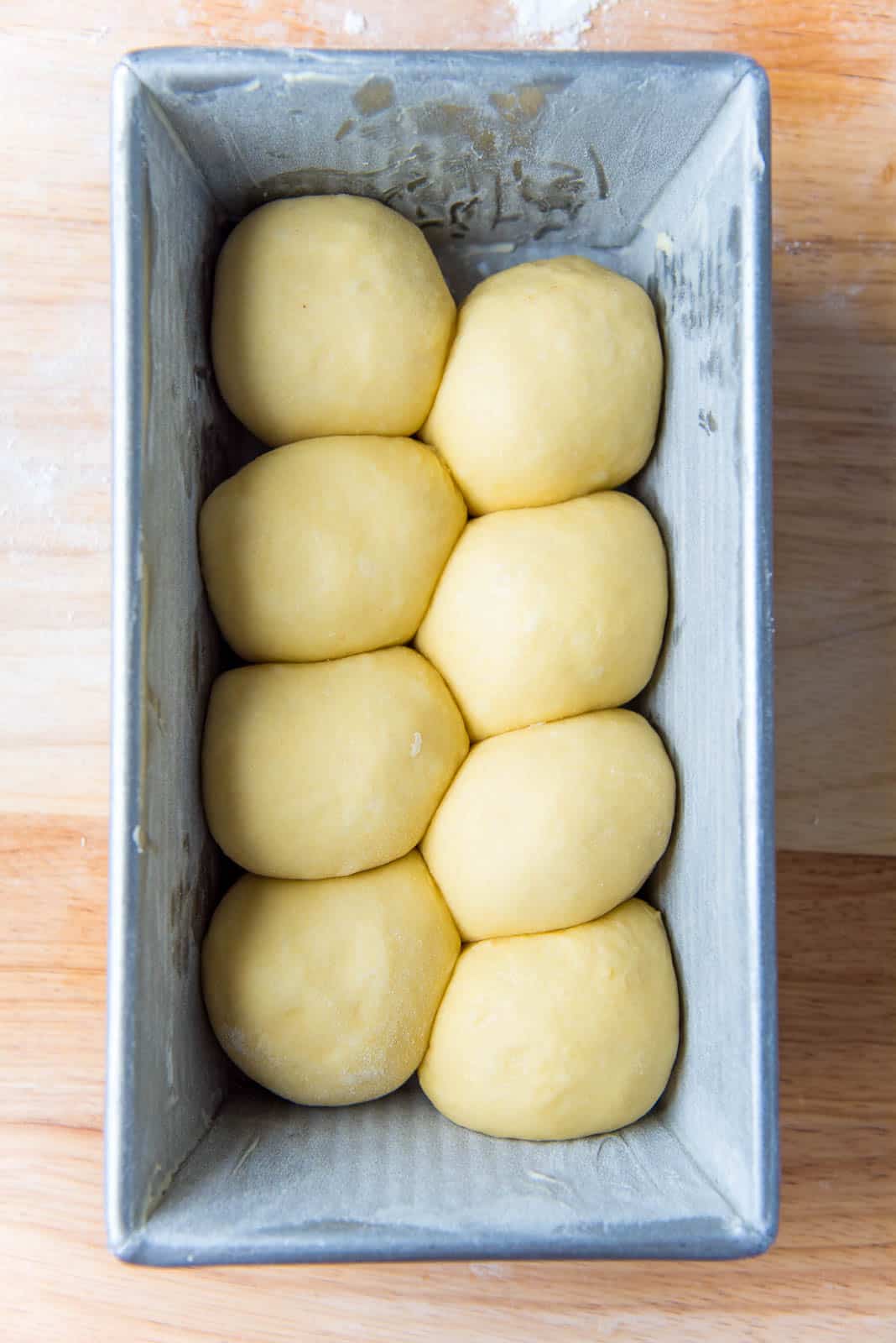
        • How To Make Perfect Choux Pastry

          How To Make Perfect Choux Pastry

        • Flaky All Butter Pie Crust Recipe

          Flaky All Butter Pie Crust Recipe

        • How To Make Homemade Marshmallows (Foolproof Guide)

          How To Make Homemade Marshmallows (Foolproof Guide)

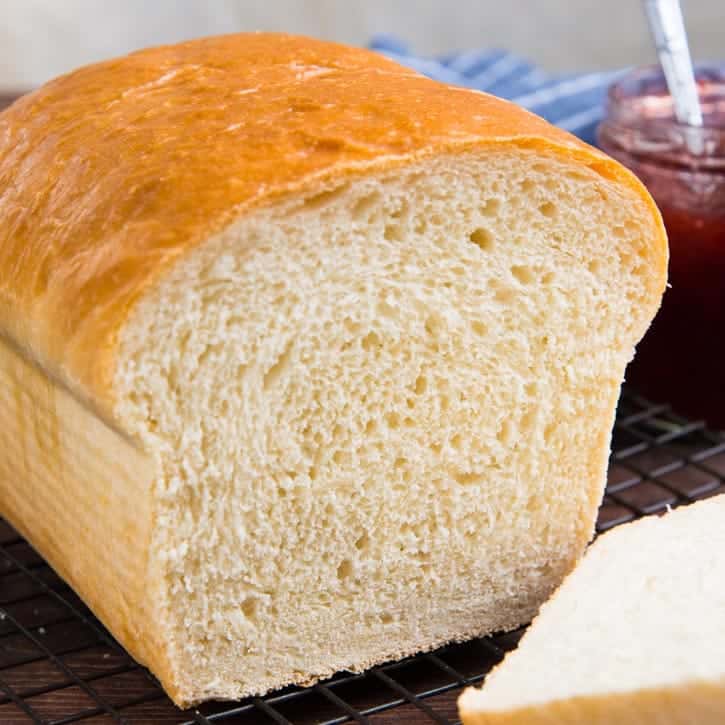
        • The Best Homemade Bread (White Bread Recipe)

          The Best Homemade Bread (White Bread Recipe)

        • Homemade French Croissants (Step By Step Recipe)

          Homemade French Croissants (Step By Step Recipe)

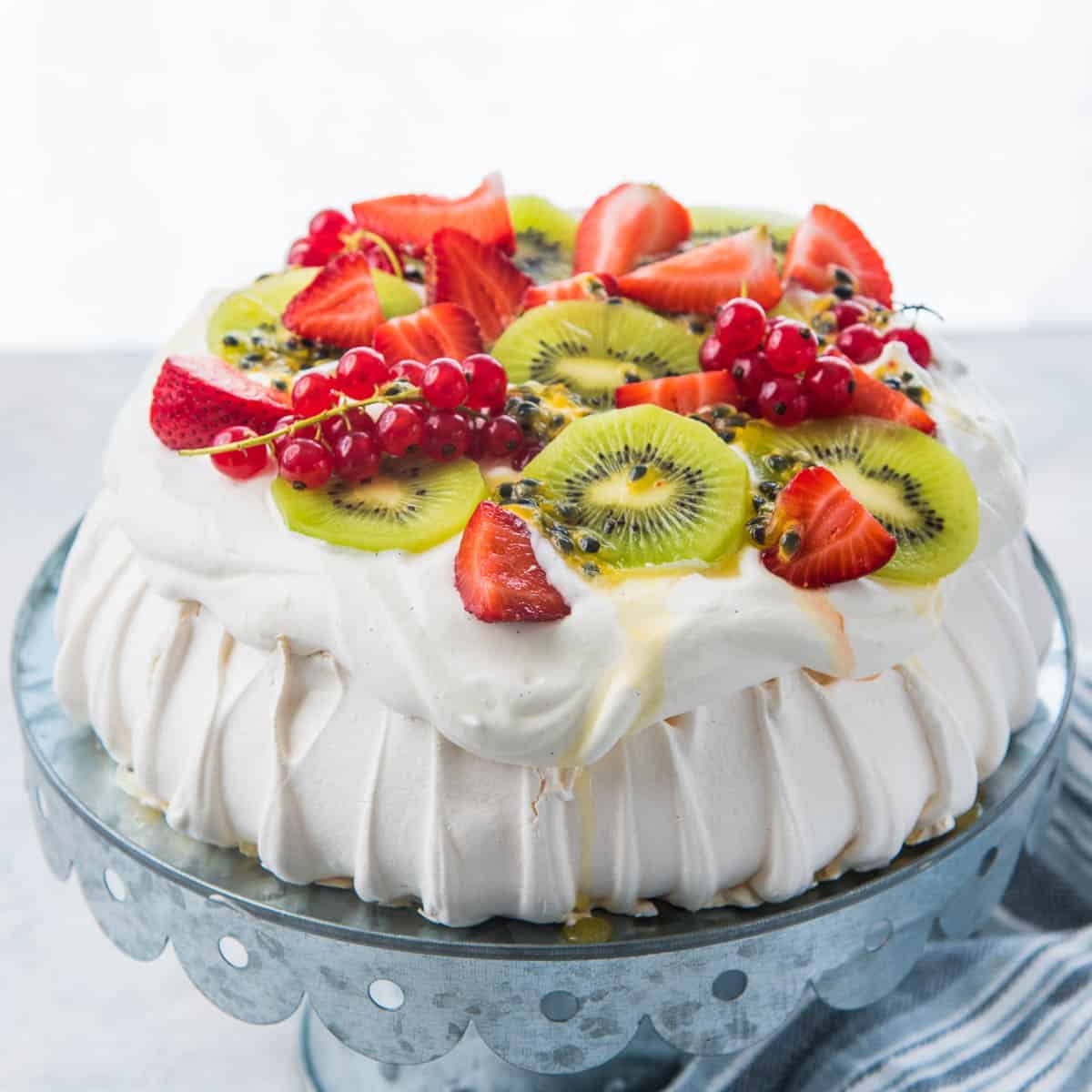
        • The BEST Pavlova Recipe (Step by step recipe and video)

          The BEST Pavlova Recipe (Step by step recipe and video)

        Featured On

        Master the science of baking!

        Get my FREE Printable Cake Pan Conversion Chart!

        So you’ll know how to substitute cake pans of different shapes, sizes & volumes in a pinch!

        A must have resource for all pro bakers, novice bakers, and aspiring bakers alike!

        Download now!

        Reader Faves

        • How to make the Best Instant Pot Short Ribs

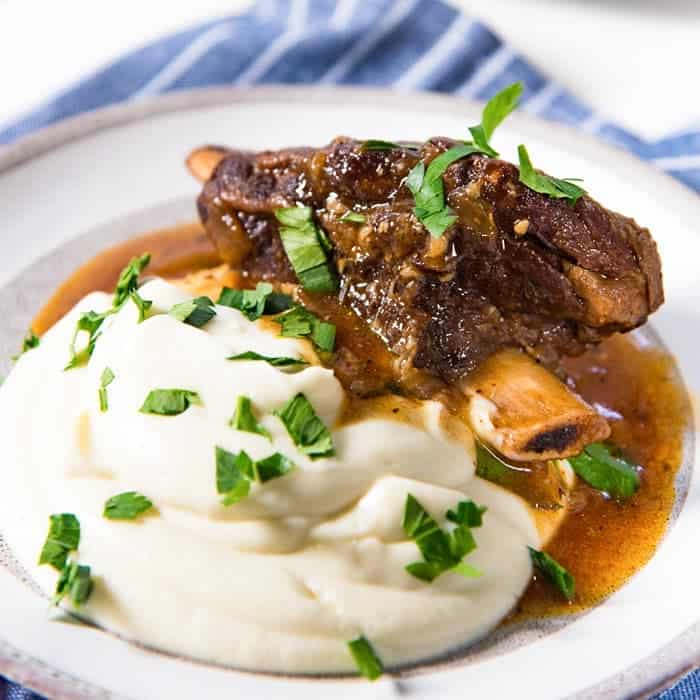
          How to make the Best Instant Pot Short Ribs

        • Perfect Quick and Easy Rough Puff Pastry

          Perfect Quick and Easy Rough Puff Pastry

        • The Best Spicy Sweet Chili Sauce (Easy Recipe!)

          The Best Spicy Sweet Chili Sauce (Easy Recipe!)

        • The Best Homemade Bread (White Bread Recipe)

          The Best Homemade Bread (White Bread Recipe)

        The Flavor Bender

        I love baking, cooking, experimenting with flavors and ingredients, and passing on all my tips and tricks to you!

        Read More

        About

        Meet Dini
        My Book
        Work With Me
        Contact

        Browse

        Recipes
        Measurement Guide
        Baking How-To’s
        Shop My Faves
        Privacy
        Disclosure
        Terms

        Branding by MRD

        Theme by OC

        Back to Top
        • Facebook
        • Instagram
        • Pinterest
        • X
        • YouTube
        42132 shares

        Rate This Recipe

        Your vote:


        A rating is required
        A name is required
        An email is required

        Recipe Ratings without Comment

        Something went wrong. Please try again.